The AI Catfish Is Here: How Fake Photos, Fake Voices, and Fake Feelings Are Changing Dating Apps
AI-generated faces, cloned voices, deepfake video calls, and scripted romance. The AI catfish doesn't borrow someone's identity — it builds one from scratch. Here's what it looks like and why reverse image search alone isn't enough anymore.

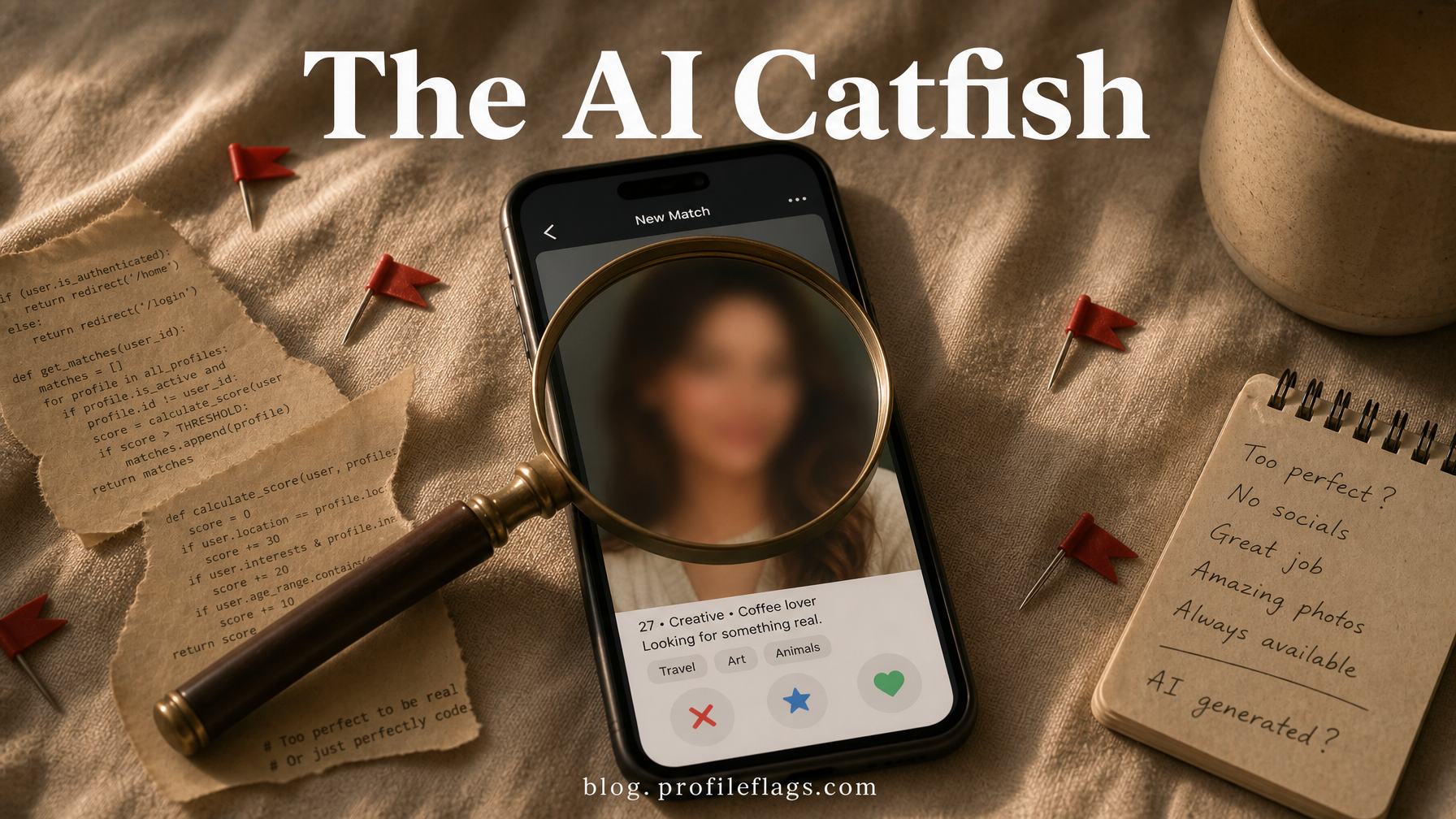
The photos looked real. The voice sounded real. The person never existed.
This is the AI catfish — and it's different from anything that came before it. Traditional catfishing required stealing real photos from a real person and hoping you didn't get caught. AI catfishing generates a person from scratch. New face. New voice. Scripted personality. A complete human being built in minutes, designed specifically to match what you're looking for.
The FBI reported $20.9 billion in internet crime losses in 2025. The FTC found that nearly 60% of people who lost money to a romance scam in 2025 first connected with their scammer on social media — and the median individual loss exceeded $10,000. Behind a significant portion of those numbers is a new generation of scammer who isn't even using a real face anymore.
The old advice — reverse image search the profile photo — is no longer sufficient. This post covers what the AI catfish actually looks like, why traditional detection methods are failing, and what still works.
What Makes the AI Catfish Different
The classic catfish borrowed someone else's identity. They used a real person's photos, made up a backstory, and hoped their target never got suspicious enough to do a reverse image search. When they did, the game was usually up — the photo traced back to a model, an influencer, or a regular person who had no idea their face was being used.
The AI catfish doesn't have that problem. The face in the profile photo has never existed. It was generated by an AI image tool in seconds — no source to trace back to, no real person to find. Run a reverse image search and you get nothing, because there's nothing to find. The face is original. It just isn't real.
According to ESET's 2026 security analysis, AI has reshaped online dating fraud to the point where traditional detection methods have been broken. This isn't a future threat. It's the current environment.
The Four Tools the AI Catfish Uses
1. AI-Generated Profile Photos
AI image generators can produce photorealistic portraits of people who don't exist — complete with consistent lighting, natural-looking backgrounds, and subtle imperfections that used to signal authenticity. The tells are there, but they require knowing what to look for.
AI-generated faces often have specific anomalies: ears that don't match, hair that behaves strangely at the edges, backgrounds that blur inconsistently, or accessories that partially dissolve. Teeth can look slightly off. Glasses may not reflect light correctly. The overall image is usually too smooth — not in the way of a professional headshot, but in a way that makes the face look almost frictionless.
One photo with this quality might be nothing. Three or four with the same slight wrongness is a pattern worth taking seriously.
2. Voice Cloning
AI voice tools can generate realistic voice messages from a text script in seconds, and clone a specific voice from a short audio sample — meaning a scammer can build a consistent voice persona across weeks of audio messages that sounds like the same real person every time.
Stay Safe Online's 2026 guidance specifically flags voice cloning as one of the newer tools scammers use to appear highly realistic. A voice message used to feel like proof of existence. In 2026, it isn't.
The tell isn't always in the audio quality. It's in the delivery. AI-generated voice messages tend to have consistent pacing without the natural irregularities of real speech — no breath sounds between long sentences, no filler words, no slight stumbles over complex phrases. Real people speak with imperfection. Cloned voices sound too clean.
3. Deepfake Video
This one is still emerging but documented. A Reddit thread on r/OkCupid from early 2025 specifically noted: "Scammers are now using AI to create super realistic dating profiles. We're talking perfect pictures, smooth conversations, and even deepfake video calls."
Video calls used to be the gold standard for proving someone was real. That's no longer reliable on its own. The tells in deepfake video include slight lag between speech and lip movement, unnatural blinking patterns, lighting that doesn't respond correctly to movement, and edges around the hairline that blur or flicker. If something feels slightly off during a video call — trust it.
4. AI-Scripted Conversations
AI chatbot tools allow a single scam operation to maintain dozens of simultaneous "relationships," each with consistent emotional tone, memory of past conversations, and scripted escalation toward the eventual financial ask. This is why AI-assisted romance scams feel different. They're more responsive. The emotional pacing feels more natural. The vulnerability disclosures hit exactly the right notes. That's not coincidence — it's calibrated output from a system trained on human emotional responses.
Why Reverse Image Search Is No Longer Enough
The FTC's consumer guidance on romance scams still recommends reverse image search — and it's still worth doing. A match is definitive proof of catfishing. But no match is no longer proof of authenticity.
AI-generated faces don't exist anywhere else on the internet. That's the entire point. The image was made for this profile. There's no source photo to find. Reverse image search has been the default advice in every "how to spot a catfish" guide for a decade. That advice hasn't kept up with what scammers are doing now.
What the AI Catfish Can't Fake (Yet)
The technology is advancing fast, but behavioral tells still exist:
They can't place themselves in your city with real specificity. Ask a local, unverifiable question — a neighborhood, a restaurant, a recent event. AI systems can hallucinate plausible-sounding answers, but not the natural specificity of someone who actually lives somewhere.
They can't do spontaneous, unscripted video. Ask them to do something specific in real time on camera — hold up two fingers, wave with their left hand, show you what's behind them. Pre-rendered deepfake video can't respond to live instructions. Real-time deepfake tools have visible tells under this kind of pressure.
They avoid verifiable real-world connections. No mutual friends. No social media with history. No tagged photos from events. A real person living a real life leaves traces in other people's digital lives. An AI persona exists in isolation.
The emotional escalation is always on schedule. Real relationships move at their own pace. AI-scripted romance follows a template — vulnerability disclosure at the same point, crisis arriving on schedule, ask following predictably. If your relationship feels like it's hitting marks rather than developing organically, that's the pattern showing.
Spontaneous, unplanned video is rare or always declined. A real person will occasionally answer a video call unplanned — in their car, slightly unflattering angle. Someone managing an AI catfish persona has to prepare for video.
What to Do Now That the Old Rules Don't Work
Replace reverse image search with AI detection tools. Tools like Google's "About this image" feature, Hive Moderation, or Illuminarty are specifically built to flag AI-generated images. They catch what reverse image search misses. Run profile photos through one of these before you invest significant time in a connection.
Treat video calls as necessary but not sufficient. Request video early — within the first week of messaging. But know that video can now be faked. Look for the specific tells: lag, blinking patterns, edge blur. Do the "hold up fingers" test.
Watch the emotional pacing, not just the content. The feelings generated by an AI-scripted romance are real — your emotional response is genuine even when the person isn't. What's different is the pacing. Too fast, too intense, too perfectly calibrated to what you've shared about yourself.
The financial ask is always coming. Every AI catfish operation ends the same way. A medical emergency, a business crisis, a travel problem, a cryptocurrency opportunity. If someone you've never physically met introduces financial need into the conversation, that's the signal regardless of how real everything else has felt.
The ProfileFlags scanner reads the behavioral and language signals in a profile before you've had the conversation that lowers your guard. It's built for exactly this stage — when a profile looks compelling and you want a second set of eyes before you engage.
And if something in a current connection already feels off, Romance Scams, Soft Life Lies & Dating App Money Traps breaks down the specific patterns — including AI-assisted versions — in full detail.
The Bottom Line
The AI catfish isn't a more sophisticated version of the old catfish. It's a different category of threat. The photos weren't stolen — they were made. The voice wasn't recorded — it was generated. The connection wasn't built — it was scripted.
The emotional response it produces is real. That's what makes it effective. You're not being fooled by a bad actor pretending to be a good one. You're being fooled by a system designed specifically to produce the feelings that make people trust, invest, and eventually transfer money.
The good news is that behavioral tells still exist. The technology can fake a face and a voice. It can't fake the spontaneous, unscripted, inconvenient reality of an actual person living an actual life. That's still what real looks like — and it's still worth knowing how to see it.