The New Romance Scam Doesn't Sound Fake Anymore
AI-generated conversations, cloned voices, and synthetic video have made romance scams nearly undetectable by the old rules. Here's what the new red flags actually look like.

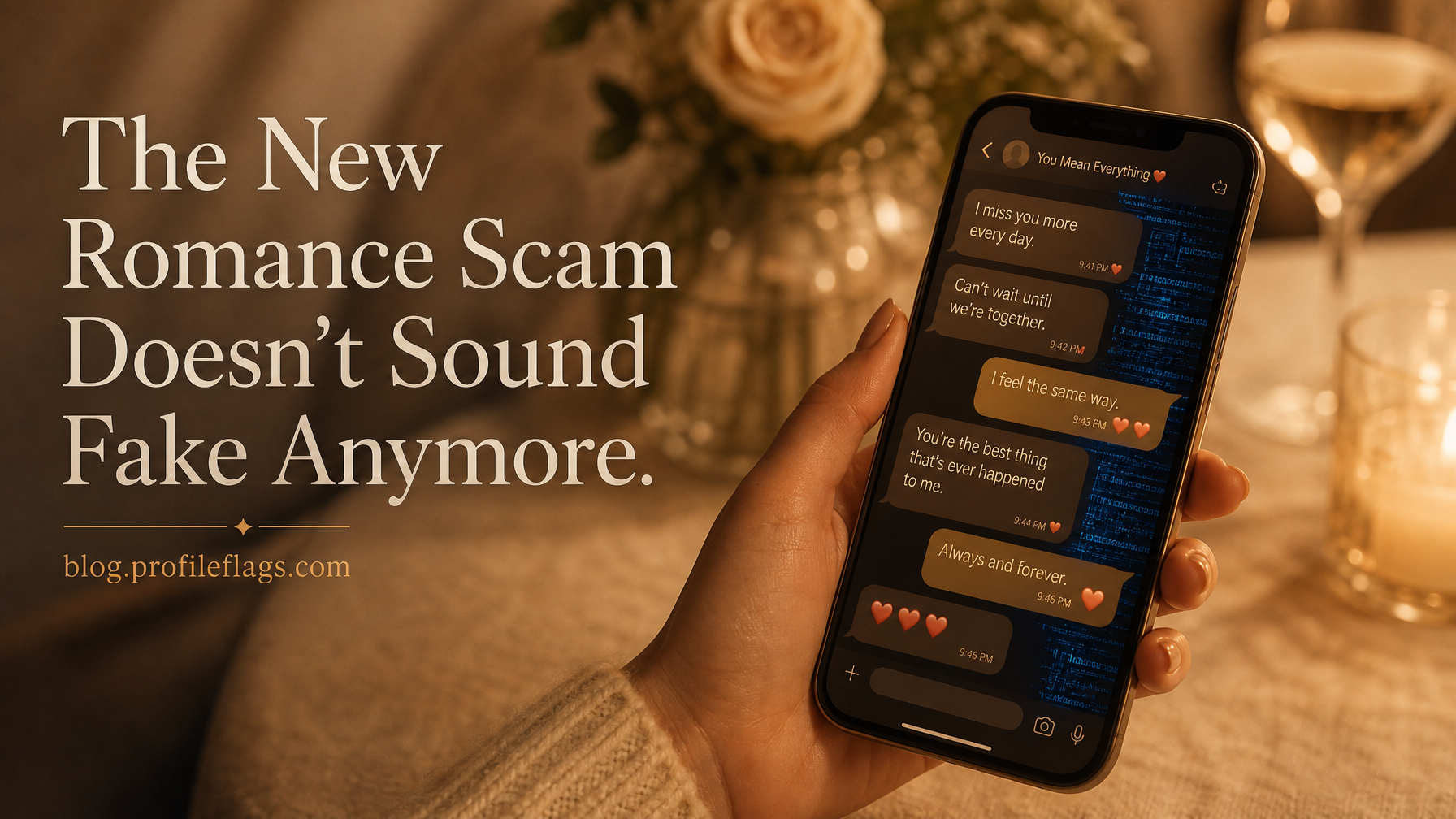
The old version of a romance scammer was easy enough to spot if you knew what to look for. Broken grammar. Stock photos that reverse-searched to a modeling website. Stories that never quite added up — a widowed military engineer working offshore who needed gift cards to get home. The tells were there.
That version of the scam is mostly retired now.
What replaced it uses AI-generated profile photos that pass reverse image searches. Conversations written and timed by language models that mirror your communication style, remember what you told them three weeks ago, and respond to grief and joy with the exact right words. Voice notes that sound warm and real. Video calls that look convincing enough — for now. The FTC reported that nearly 60% of people who lost money to a romance scam in 2025 were first contacted through social media. Total fraud losses across all categories hit $12.5 billion in 2024. Romance scams were among the highest-grossing categories.
The scam didn't get louder. It got quieter, more fluent, and a lot harder to dismiss.
What AI Actually Changed
The fundamental structure of a romance scam hasn't changed — build trust, create emotional attachment, manufacture a crisis, extract money. What AI changed is the quality of execution at every stage.
Profile photos used to be the first giveaway. A reverse image search would pull up the original source — a fitness influencer, a stock photo, a stolen Instagram. AI-generated faces don't reverse-search to anything because they don't exist anywhere. They're made to order: attractive, believable, consistent across multiple photos, with the kind of natural variation that real photo collections have. They pass the checks that used to catch scammers in thirty seconds.
The conversation was always where scammers struggled most. Maintaining believable, emotionally intelligent dialogue across weeks or months while managing dozens of targets simultaneously is hard. Language models removed that bottleneck entirely. A scammer running an AI-assisted operation can now maintain hundreds of relationships at once — each one personalized, each one emotionally calibrated, each one remembering the details you shared and referencing them at exactly the right moments to build the feeling of being truly known.
Voice cloning took what was already working and made it more intimate. A voice note sidesteps every concern about written language. It sounds warm. It sounds present. It sounds like a real person who called because they were thinking about you. Senator Maggie Hassan pressed AI voice cloning companies in April 2026 to prevent their tools from being used for exactly this — after victims reported being deceived by calls that sounded indistinguishable from someone they cared about.
Deepfake video is the last frontier and it's closer than most people think. Current technology still has artifacts under scrutiny — lighting inconsistencies, micro-expressions that don't track, slight blurring around edges. But it's good enough to run a short video call that creates plausibility, and it's improving faster than most people's ability to evaluate it.
The New Red Flags
The old flag checklist no longer applies wholesale. You need a new one.
The profile is too visually consistent
Real people's photos have variation — different lighting, different angles, different stages of their lives, casual shots mixed with good ones. AI-generated profile sets tend to have an uncanny consistency. Every photo is well-lit. Every angle is flattering in the same way. There's no bad hair day, no awkward family photo, no picture from ten years ago that clearly dates itself. The visual story is too curated to be lived-in. This isn't definitive on its own — plenty of real people only post their best photos — but combined with other signals, it matters.
The conversation never loses the thread
One of the things that makes AI-assisted scam conversations feel so real is that they're remarkably consistent. They remember. They follow up. They reference something you mentioned two weeks ago at exactly the right moment. But human memory in early-stage conversations has natural gaps — people forget, misremember, ask you to remind them. A conversational partner who never loses the thread and always recalls specifics with unusual precision may be working from a log, not a memory.
The emotional escalation is fast and symmetrical
AI-assisted scammers are optimized for attachment acceleration. The conversations go deep quickly. They ask meaningful questions. They share vulnerability early. They match your emotional energy with precision — when you're warm, they're warm; when you share something hard, they share something equally hard. Real connection develops unevenly and sometimes awkwardly. Engineered connection feels almost too right, too quickly.
Video calls happen on their terms only
If someone consistently has reasons they can't video call — technical issues, bad connection, working in a location without good signal — that's a flag. If video calls do happen but they're always brief, always on their schedule, always initiated and ended by them, that's a flag too. Deepfake video requires setup and control. Someone using it cannot afford a spontaneous, extended call where you can ask them to do something unexpected in real time.
The crisis arrives after the attachment is built
This part of the script hasn't changed with AI — because it doesn't need to. The crisis comes after weeks or months of genuine-feeling connection. A medical emergency. A business problem. A legal situation. A travel complication. It arrives when you're emotionally invested enough that helping feels like the natural response to someone you care about. The AI didn't change the ask — it just made the relationship that precedes it more convincing.
They've never existed anywhere you can independently verify
Real people leave traces. A LinkedIn that predates your conversation. Friends who tag them in photos. A comment history that goes back years. An employer that can be verified. AI-generated identities are built for the present conversation — they may have constructed backstories, but the independent digital footprint either doesn't exist or was recently created. Searching beyond what they've told you and finding nothing is information.
The Asks Have Gotten Subtler Too
Early romance scams asked for money. That ask is now often delayed and disguised. The newer versions involve investment opportunities — cryptocurrency platforms, trading accounts, business ventures — where you're not being asked to send a gift, you're being invited into something that sounds like a financial opportunity. This is the pig butchering model: build the relationship, introduce the investment, show early returns that look real, encourage larger deposits, then vanish.
Some operations don't ask for money at all initially. They ask for information — personal details, financial habits, relationship status, vulnerabilities — that get used later or sold. Some ask for photos. Some build to a point where the target is so emotionally compromised that almost any ask feels reasonable.
The sophistication of the ask has scaled with the sophistication of the setup.
What Still Gives Them Away
AI makes the scam more convincing at the surface. It hasn't solved the fundamental problem: real relationships can be verified, and scammers can't afford verification.
They can't meet in person. They can't video call spontaneously. They can't be confirmed by mutual connections. They can't be found through channels that predate your conversation. They can't answer unexpected, specific, real-time questions — "what's behind you right now, can you show me the whole room" — without losing control of the interaction.
The flags aren't gone. They moved. They're no longer in the grammar and the stock photos. They're in the resistance to verification, the perfect emotional calibration, the crisis that arrives on schedule, and the ask that feels like it couldn't possibly be a scam because you've been talking for months and you know this person.
You know a version of a person that was built to make you feel exactly that.
How to Protect Yourself
The practical steps haven't changed even as the technology has:
- Reverse image search every photo — and if nothing comes back, that's not clearance, that's a flag
- Video call early and spontaneously — ask them to do something specific and unrehearsed in real time
- Search for them independently — LinkedIn, social media, employer verification — beyond what they've provided
- Never send money, gift cards, or cryptocurrency to someone you haven't met in person, regardless of how long you've been talking
- Never share financial information, account details, or personal documents with someone you met online, regardless of how real the relationship feels
- If a "business opportunity" enters the conversation, treat it as a red flag regardless of how it's presented
The scam has upgraded its tools. Your verification process needs to upgrade too.
Romance scams, soft life lies, and dating app money traps — the full breakdown of every financial red flag in modern dating is in Romance Scams, Soft Life Lies & Dating App Money Traps. $22.99 on Gumroad. It covers pig butchering, fake investors, financial red flags that show up before any money ask, and how to verify someone before you're too invested to think clearly.
And before you match with anyone, run their profile through the ProfileFlags scanner — it flags behavioral and language patterns in a dating profile before the first conversation starts.
The new scam sounds real. The flags still exist. You just have to know where to look for them now.