The Deepfake Boyfriend: Why Video Calls Aren't Proof Anymore
You asked for a video call to prove he was real. He got on camera. He looked you in the eye. He smiled. And he was never there. Here's what deepfake romance scams actually look like now — and what to do instead of a video call.

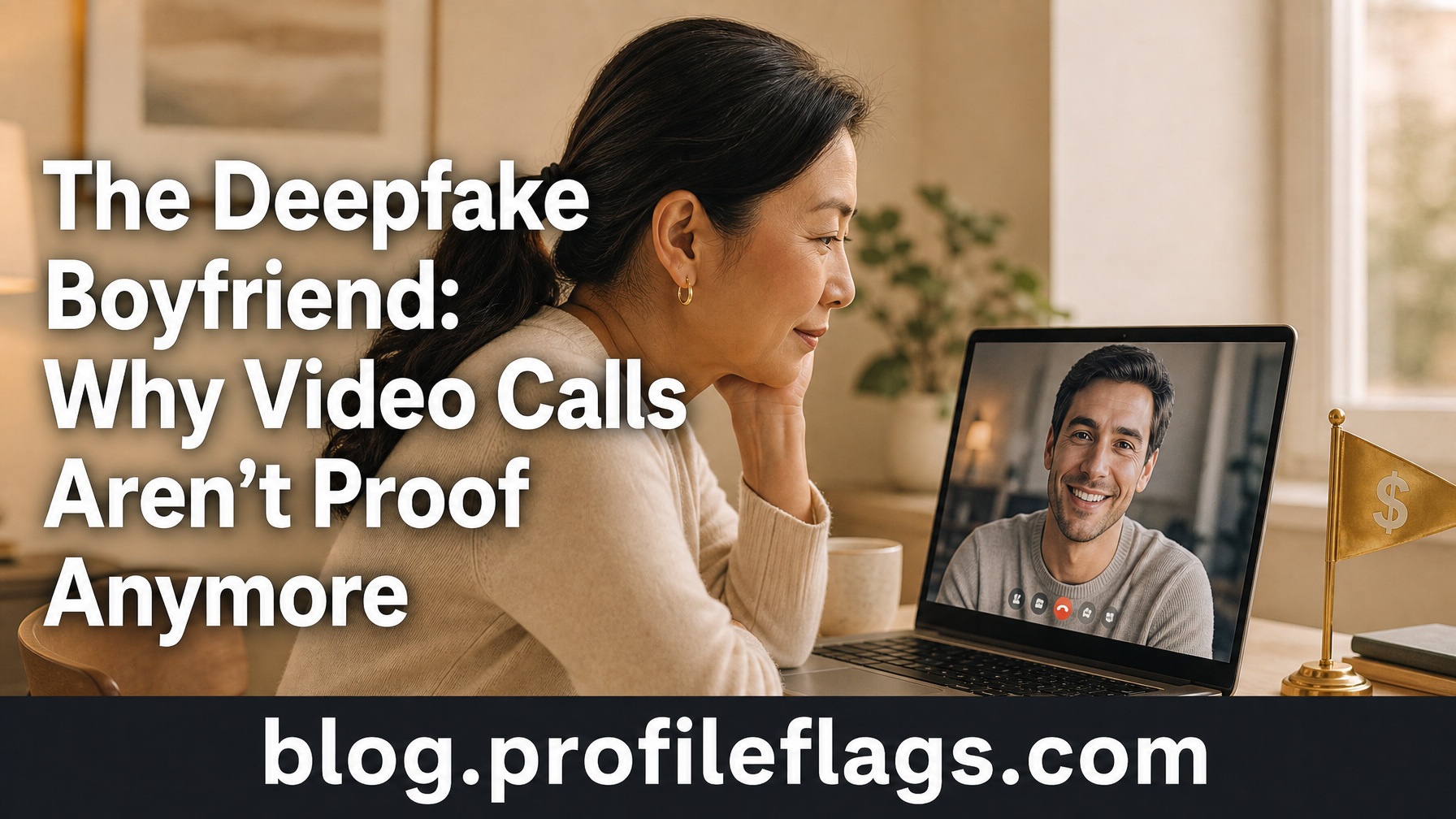
For years, the advice was consistent: if you suspect someone online isn't who they say they are, ask for a video call. A real person can get on camera. A scammer can't fake that.
That advice is now outdated. In some cases, it's actively dangerous — because it creates a false sense of certainty that scammers are now specifically designed to exploit.
In July 2026, the New York Post reported on a woman who lost her entire savings to a romance scam. The scammer posed as Sheikh Hamdan bin Mohammed, the Crown Prince of Dubai — a real person with 17 million Instagram followers. She met him on a dating site, moved to WhatsApp, and eventually had what she believed were intimate video calls with a member of Dubai's royal family. The video calls were deepfakes. The man on screen was entirely fabricated by AI in real time. She lost everything.
This is not a fringe case. It is the new standard.
What a Deepfake Video Call Actually Is
A deepfake is an AI-generated video that replaces a real person's face — or fabricates a face entirely — over a live video feed. The technology has existed in research labs for years. What changed in 2024 and 2025 is accessibility. Tools that previously required significant technical skill and expensive hardware are now available as apps, subscriptions, and downloadable software that organized criminal networks purchase and deploy at scale.
Crystal Intelligence, a blockchain analytics firm that tracks crypto fraud, described it directly in their February 2026 report: "Most alarming is real-time deepfake video — scammers can appear on a live video call using a completely fabricated face." The FBI's Norfolk Field Office confirmed the same month that criminals are now using AI-generated voice messages to make schemes more believable. The face and the voice can both be fake, simultaneously, in real time.
A Connecticut woman lost nearly $1 million after a scammer maintained a months-long relationship using exactly these tactics. She saw him on video. She heard his voice. Neither was real.
The Numbers Behind It
The scale of what's happening right now is not easy to absorb.
Deepfake video scams surged 700% in 2025, according to ScamWatch HQ data cited by Vectra AI. Impersonation scams — the broader category that includes deepfake romance fraud — rose 148% in 2025 alone, largely driven by AI tools, according to ESET's May 2026 dating safety report.
Romance scam losses in Northern California alone jumped from approximately $22 million in 2024 to over $40 million in 2025, according to the FBI San Francisco Division. The Global Anti-Scam Alliance (GASA) estimates that in 2025, $442 billion was lost to scams worldwide. Romance scams sit in a specific category within that figure: low in total case volume, extremely high in average financial loss per victim.
AARP's February 2026 research found that nearly one in 10 adults aged 50 and older have had an online romantic connection ask them for money or push a crypto investment. Adults aged 50 to 64 face this risk at more than double the rate of those 65 and older.
Despite those numbers, 55% of romance scam victims never report the crime. Shame is the primary reason.
The Fake Dubai Prince Playbook
The OCCRP — the Organized Crime and Corruption Reporting Project — published a full investigation into the Dubai Prince scam in February 2026, and it is worth understanding in detail because it illustrates exactly how professional and methodical these operations are.
Sheikh Hamdan bin Mohammed (known publicly as "Fazza") is a real 43-year-old who globe-trots, competes in extreme sports, and posts to 17 million Instagram followers. That large public presence gives criminal networks an enormous library of real footage, photos, and voice recordings to train deepfakes on. His face is recognizable enough to feel credible but distant enough that most targets have no personal knowledge of him to contradict the fiction.
The scam follows a documented blueprint:
Contact begins on a social media platform or dating site. The person with a polished, attractive profile reaches out — sometimes by harvesting data from breached databases to identify people who are lonely, recently divorced, bereaved, or in financial distress. Once conversation starts, they push quickly to private encrypted messaging apps like WhatsApp or Telegram. This removes the platform's fraud monitoring from the picture.
From there, the relationship builds. The deepfake video calls establish "proof" of identity. The fake Crown Prince is charming, attentive, and generous in tone — even while the money requests take shape. The reasons a billionaire might need financial help from his new romantic partner are creative: frozen assets, diplomatic banking restrictions, a situation requiring foreign currency that he can't access directly. A collaborator sometimes poses as his financial manager and meets the victim in person to reinforce the story.
Fake bank deposit confirmations are shown. The victim may be unknowingly turned into a money mule, moving funds on the scammer's behalf and potentially implicating themselves in financial crimes without realizing it.
And after the victim starts catching on and tries to recover their money — there's a second layer. Someone new contacts them, posing as a bank representative, an authority, or an "asset recovery" specialist. They promise to recover the lost funds. For a fee.
Andrei Skorobogatov, director of policy at GASA, put it plainly: "These are criminal networks and gangs. These are not people working by themselves. And they will use whatever tools and requirements they need to make themselves more legitimate."
Why the Video Call Test No Longer Works
The advice to "ask for a video call" was based on a reasonable assumption: that real-time video was too technically complex to fake convincingly. That assumption is gone.
OCCRP now explicitly includes video calls in their red flags list: "Even be wary of video calls now — scammers can take advantage of AI or deepfakes to mimic a stranger's face during brief calls."
This matters because the video call has become a trust-building tool that scammers actively want to use. A victim who asked for a video call and got one feels more certain, not less. The scammer has now bypassed the most common protection measure and created stronger emotional investment in the process.
The brief, slightly stilted video call that "proves" he's real is part of the script now.
How to Spot a Deepfake on a Video Call
Deepfake technology is convincing but not flawless — yet. There are specific tells that appear consistently across reported cases, confirmed by Crystal Intelligence's fraud analysts:
Unnatural eye movement. Deepfake faces struggle with realistic, spontaneous eye behavior. Watch for eyes that don't track naturally, blink at wrong intervals, or stay fixed in a way a real person wouldn't.
Lighting that doesn't match. The AI-rendered face is often lit differently from the background environment. A slight mismatch between the light source on the face versus the room behind them is a consistent tell.
Audio that doesn't sync perfectly. Even with voice cloning, lip sync often lags or leads the words slightly. Watch the mouth carefully against what you're hearing.
Edges of the face. Hair, ears, and the jawline are harder for deepfakes to render cleanly. Blurring, flickering, or an unnaturally smooth boundary where the face meets the background shows up in many cases.
The call is brief and controlled. Scammers using deepfakes keep video calls short and limit unexpected requests — they don't want you asking them to turn sideways, hold up a piece of paper, or do something unscripted. If a request for spontaneous, unplanned movement is declined or deflected, that's a signal.
They won't video call on your terms. They initiate the call, control the duration, and end it when they're ready. A real person is flexible. Someone managing a deepfake feed needs to control the environment.
What Actually Works Instead
The video call was a shortcut. There are better tools — they just require more patience.
Reverse image search everything. Run every photo they've sent through Google Images and TinEye. AI-generated profile photos won't surface in a reverse image search, but stolen real-person photos often do. If the photos trace back to a real person's account who is clearly someone else, that's your answer.
Search the name plus "scam." Sheikh Hamdan / Fazza + "scam" returns hundreds of documented cases before you ever get on a video call. If someone is using a persona that scammers have previously used, it will show up. Always search before you invest emotionally.
Ask them to do something specific and spontaneous on camera. Hold up a specific number of fingers. Write your name on a piece of paper and show it. Turn fully to the side. These requests break deepfake scripts because the AI can't improvise reliably with props and unscripted movement.
Make the video call unpredictable. Request it at a time they didn't suggest. Ask to switch apps mid-call. Spontaneous changes disrupt prepared deepfake setups.
Talk to someone outside the relationship. Scammers isolate. They work hard to make the relationship feel private and special in a way that discourages outside input. If you find yourself reluctant to tell people about this person, or if they've subtly discouraged you from discussing the relationship with friends and family — that reluctance is worth examining.
Never send money, period. This is the one rule that holds regardless of how convincing the evidence feels. No amount of video call confirmation should move you to send money to someone you haven't met in person in real life. Not crypto, not wire transfers, not gift cards, not anything.
The Platforms Are Starting to Fight Back
Some structural protections are beginning to take shape. In October 2025, Tinder rolled out Face Check in the US — mandatory facial verification for new users. In markets where it's active, Tinder reported a 60% decrease in exposure to potential bad actors. The Romance Scam Prevention Act passed the US House of Representatives in June 2025 and is currently before the Senate — it would require dating platforms to notify users when they've received messages from accounts previously banned for fraud.
These are meaningful steps. They don't solve the problem, but they acknowledge that the current environment requires structural change, not just individual vigilance.
Before You Give Someone Your Trust
Deepfake scams work because they exploit something real: the human need for connection, and the hope that someone on the other side of a screen is exactly who they appear to be. That hope is not naive. It's normal. Scammers are professionals at manufacturing the conditions that make it feel justified.
The ProfileFlags scanner analyzes dating profiles for the language patterns, behavioral signals, and red flags that appear in early communication — before a video call ever happens, before emotions are involved. The profile tells you a lot if you know what to look for. Patterns that precede financial scams show up in the very first messages.
And if you want to practice recognizing manipulation tactics in real-time conversation — the escalating trust-building, the emotional pressure, the pivots toward financial asks — PracticeBae is built for exactly that. Train your instincts before the stakes are real.
If you believe you've been targeted, contact your bank immediately. Report to ReportFraud.ftc.gov in the US. In the UK, report to Action Fraud at actionfraud.police.uk. Cryptocurrency losses can be reported through Crystal's Scam Alert platform, which feeds directly into blockchain forensics used by law enforcement.
And tell someone. The 55% who never report do so because of shame. The scam worked not because you were foolish — it worked because criminal organizations with serious resources spent months building something designed specifically to be believed. That is not your failure. It is theirs.