Did You Fall for Them. Or Their AI?
Not a fake profile. A real person using AI to manufacture the version of themselves you fell for. Match Group data, CHI research, and how to tell.

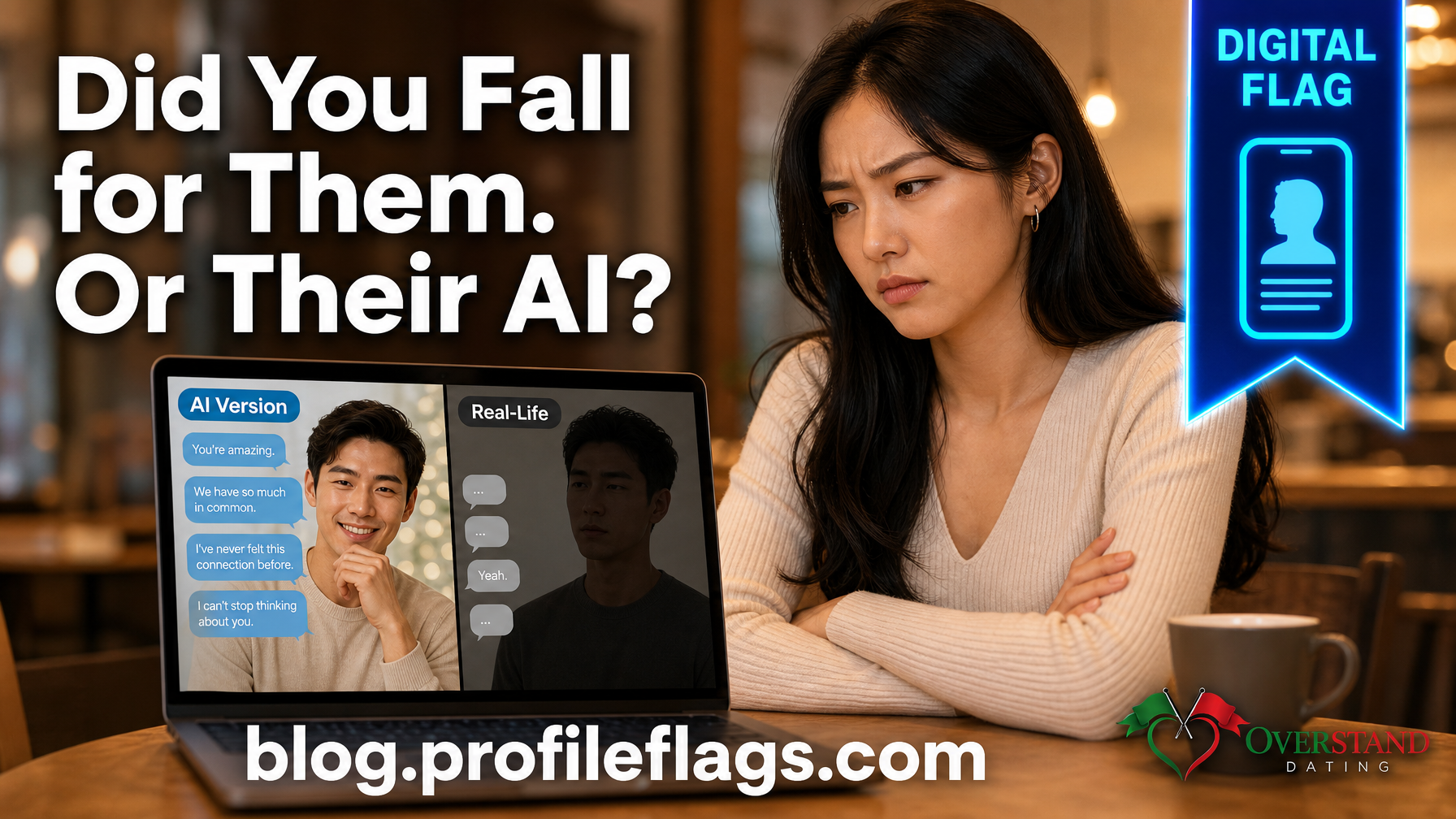
The Digital Flag is a term coined by Overstand Dating on July 15, 2026.
TLDR: The new dating problem is not only fake profiles. It is real people using AI to write bios, polish photos, and manufacture every reply until you fall for a personality that never sat across from you. Match Group found nearly half of singles view AI in romantic contexts negatively. CHI research from University of Michigan-Flint found many AI users deliberately hide that help so partners will not reject them. Spot the gap between the chat and the person before you invest.
Table of Contents
- TLDR
- The New Kind of Catfish
- What the Data Actually Says
- What Reddit Is Already Screaming
- Why Nondisclosure Is the Real Problem
- How to Spot AI-Assisted Attraction
- What Is Fair Use vs What Is a Performance
- What to Do When You Suspect It
- The Digital Flag Verdict
You did not match with a bot farm. You matched with a real person who showed up on time, ordered a drink, and still felt off.
The texts were sharp. Funny. Curious about your job in a way that made you feel seen. The first date was polite and flat. Jokes landed wrong. Opinions that sounded strong over text turned into shrugs. You left thinking you misread the chemistry. You may not have. You may have fallen for a version of them that an AI wrote, then met the person who only approved the drafts.
That is a different problem than catfishing. Catfishing is a fake identity. This is a real identity wearing a rented personality. The fear a lot of online daters have not fully named yet: not that nobody is real, but that the attraction was manufactured.
If a profile already feels too polished, run it through ProfileFlags before you build a whole story around the chat. One scan, $19.99, unlimited checks. Catch the pattern on the profile, not three weeks into a connection that only exists in perfect paragraphs.
The New Kind of Catfish
People have always edited themselves on dating apps. Better photos. Height rounded up. A bio that sounds more interesting than a Tuesday night. The difference now is scale and skill. Generative AI can write a whole dating persona in seconds: witty openers, thoughtful follow-ups, emotional depth on demand, even photo polish that makes someone look like a better-lit version of themselves.
You are not always talking to a stranger's best self. Sometimes you are talking to a model trained on millions of charming conversations, prompted to sound like the kind of partner you said you wanted.
That does not make every AI user a villain. Some people use tools the way they once used a thesaurus. The line that matters is disclosure and continuity. Did the AI help them say something true, or did it invent a person you were never going to meet?
What the Data Actually Says
Match Group surveyed about 1,000 U.S. singles ages 18 to 39 about AI and dating. Coverage of that survey in CNET and Axios reported several numbers worth sitting with:
- Nearly half (47%) view AI in romantic contexts negatively.
- About 74% say they use ChatGPT.
- Roughly 64% say AI helps them with dating tasks like stronger profiles and keeping conversations going.
- Two in five singles refuse to date someone who uses AI companion apps. Among women 18 to 24, that climbs to over half (51%).
Read that carefully. Plenty of people use AI as a tool. Plenty of people also treat certain AI uses as a hard no. The culture is split, and the split is not abstract. It shows up on first dates when someone admits the banter was not entirely theirs.
On the research side, Meryem Barkallah and Douglas Zytko at University of Michigan-Flint presented CHI 2026 work titled "I Wanted Them to Think That I Wrote That." They surveyed 113 online daters who used AI-generated content that their in-person meeting partners saw. The findings, as summarized by the authors, are blunt: generative AI is often used to fabricate attractive dating personalities with little relevance to the person's actual identity, and users seldom disclose that help because they fear romantic rejection. The paper frames nondisclosure as a consent problem. If someone agrees to meet, invest, or get physical based on a self-presentation that was partly invented by a machine and never labeled, the other person did not get a fair shot at informed choice.
That is not internet panic. That is human-computer interaction research treating this as a real safety and ethics issue, not a quirky tech trend.
The APA Monitor on Psychology (January 2026) has also tracked how AI companions and chatbots reshape emotional connection, including the risk that constant validation from machines raises expectations human partners cannot match. Different problem than AI-written Hinge replies, same underlying theme: people are outsourcing intimacy skills and then bringing the aftertaste into real dating.
What Reddit Is Already Screaming
You do not need a lab to hear the pattern. On r/mildlyinfuriating, a post titled "Guy I'm dating uses chatgpt to reply to all my texts" drew tens of thousands of upvotes. The poster said the replies felt like ChatGPT, so they pasted their own last text into ChatGPT and got back essentially the same answer he had sent. Dates had gone fine. The texts felt empty of him.
On r/datingoverforty, a man described a Hinge date who admitted she used ChatGPT to write all pre-date texts. Over text she was enthusiastic and jokey. In person she was monotone and cynical. He cut the date short and unmatched before he got to the car. The thread filled with people calling it a modern Cyrano situation: the charm belonged to the tool, not the person across the table.
Those stories are not peer-reviewed data. They are useful because they match what the research predicts. The gap shows up face to face. The chat sells a product. The date delivers a different SKU.
If the chat already feels too smooth and you cannot tell whether you are attracted to them or to the polish, PracticeBae is built for that middle stretch. Practice reading mixed signals, future-faker energy, and too-perfect replies with AI personalities that mirror real dating patterns, so you get sharper at spotting performance before you hand over your real evenings.
Why Nondisclosure Is the Real Problem
Plenty of people would shrug at "I used a tool to fix my grammar." Fewer people shrug at "every joke you liked was generated, and I chose not to tell you because I wanted you to think it was me."
Barkallah and Zytko's title says the quiet part out loud: "I wanted them to think that I wrote that." The harm is not only the content. It is the intentional misattribution. You calibrated your interest, your trust, your body language, maybe your sexual consent, to a persona that was partly outsourced and never labeled.
That sits next to older dating deception research, the "profile as promise" idea from earlier online dating studies: the profile is a promise about who will show up. AI does not invent that promise. It industrializes breaking it.
There is also a practical version of the harm that needs no ethics paper. You spent two weeks bonding with someone who does not exist at that skill level without a prompt window open. Your nervous system attached to consistency, wit, and emotional availability that may vanish the second they stop pasting your messages into a chatbot.
How to Spot AI-Assisted Attraction
None of these alone prove anything. Together they are a pattern.
1. The voice does not match the body.
Over text they are poetic, structured, emotionally fluent. In person they struggle to finish a thought, repeat the same three stories, or go blank when you leave the script of the chat.
2. Reply latency with essay energy.
Long, balanced, multi-paragraph answers that arrive after odd pauses, especially late at night, with the same tidy structure every time. Real people ramble. AI often outlines.
3. Generic intimacy.
They mirror your interests with uncanny precision and zero friction. Every hobby you name is "actually one of my favorites too," with a polished paragraph attached. Specificity without lived mess is a tell.
4. Perfect emotional regulation in text only.
Conflict over text is calm, validating, textbook healthy. Conflict in person is defensive, flat, or absent. The tool is good at sounding secure. The person may not be.
5. Photo polish that does not survive daylight.
Not full deepfake territory necessarily. AI photo editors and aggressive enhancement create a face that is almost them. You meet someone adjacent.
6. They collapse when you go voice or video early.
People who can only perform in typed channels often stall a call. That is not always AI. It is often a useful filter anyway.
7. You get the uncanny valley of care.
The words say they are invested. Your gut says nobody is home. Listen to that. You are allowed to trust the mismatch.
For more on how profiles themselves leak patterns before the chat even starts, see The Dating Profile Red Flags People Notice Instantly and Is He Lying About the Basics?.
What Is Fair Use vs What Is a Performance
A useful split:
Lower concern: brainstorming first-date ideas, cleaning up grammar if English is a second language, asking AI how to phrase a boundary you already mean, getting unstuck on a reply you then rewrite in your own voice.
Higher concern: AI writes the entire conversation. AI invents hobbies, values, or trauma stories. AI runs the emotional labor of the relationship. AI companion apps replace the partner while the human still collects your attention. AI photos that misrepresent appearance. Zero disclosure when the help is load-bearing.
Match Group's own framing in recent coverage is that many singles want AI as a helper, not as a stand-in lover. The ick spikes hardest around companion apps and around deception. That tracks with what people say in comment threads: help me show up as myself is different from build me a self.
If you use AI in dating, the ethical floor is simple. Do not let the tool become the person. Do not hide material help when the other person is forming attachment. And do not be shocked when someone walks away after learning the chemistry was partly synthetic.
What to Do When You Suspect It
Move offline faster. Short texting windows reduce the runway for a manufactured persona. Suggest a call or a low-stakes coffee within a few days of matching.
Ask direct, low-drama questions. "Do you use AI to write dating messages?" asked lightly. How they answer matters as much as the yes or no. Defensiveness, mockery, or a speech about how everyone does it is data.
Test for continuity. Reference a small detail from three texts ago. Ask a follow-up that requires memory plus opinion, not a polished essay. Real attention has texture.
Watch the first disagreement. AI is excellent at agreeable. Real compatibility shows up when something is inconvenient.
Believe the face-to-face data. If the person and the chat are two different products, date the person in the room. Or do not date them. You are not obligated to keep investing in the better-written version.
Before you pour more hope into a polished profile, scan it with ProfileFlags. When the chat feels off and you want to practice your next move without spiraling, use PracticeBae. And if you want a free checklist for the subtle patterns people miss while they are already attached, grab The 5 Red Flags Most People Miss.
The Digital Flag Verdict
The Digital Flag is for the moment an algorithm starts to feel safer, smoother, or more attentive than a person, and for the moment a person borrows that smoothness without telling you. Falling for someone's AI is not the same as falling for them. Attraction built on undisclosed synthetic charm is a setup for a letdown that feels personal even when the prose was never personal at all.
You deserve a partner who can generate a thought without a prompt. You deserve to know who is actually talking. And you deserve to walk away when the magic only works in the app.
This post is for general information about dating patterns and technology. It is not legal, clinical, or professional advice. Community stories from Reddit are anecdotal.