How Romance Scammers Make You Fall in Love
Romance scammers are very good at what they do. Here is the full playbook they follow and what to watch for at each stage.

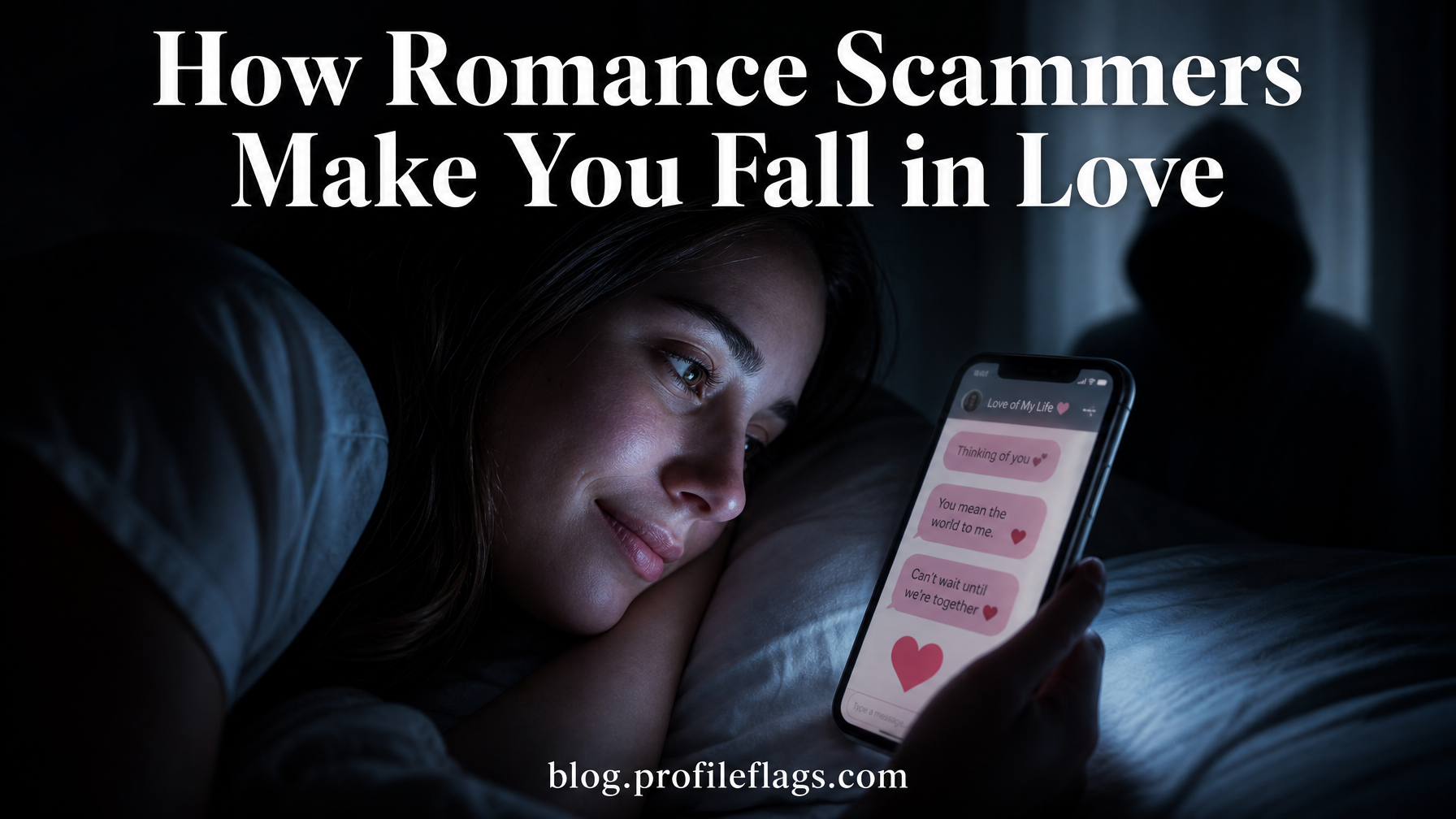
Romance scammers are not bad at what they do. They are extremely good at it. That is the part people forget when they hear these stories — the people who fall for romance scams are not naive or careless. They are targeted, deliberately and patiently, by someone who has refined a specific technique across dozens or hundreds of previous attempts.
Understanding the full playbook is the best defense. Not just a list of warning signs, but the actual sequence — what happens at each stage, why it works psychologically, and what to look for before it costs you anything.
Stage One: The Introduction
It starts before you realize anything is happening. The scammer creates a profile designed to be attractive to a specific type of person. Common personas include successful professionals who travel for work, military personnel deployed overseas, doctors working abroad, or recently widowed individuals. These profiles explain why they are unavailable to meet while also establishing emotional availability and financial credibility.
The first approach is warm but not excessive. Never aggressive. Never desperate. They ask thoughtful questions. They remember what you said. They respond at a natural pace. It feels like someone who is genuinely curious about you as a person — and that is exactly what it is designed to feel like.
This stage can run for days before there is any romantic angle at all. The goal is to build familiarity first.
Stage Two: Mirroring
Once they understand who you are — what you value, what you have been through, what you want in a relationship — they start reflecting it back to you.
You said you want someone who communicates openly? They do too. You mentioned that honesty is non-negotiable for you? Same. You shared that you had a hard time trusting after a past relationship ended badly? They understand that completely. Something similar happened to them.
This technique is called mirroring, and it works because it feels like genuine compatibility. You are not being told what you want to hear — you are discovering that this person is remarkably, almost perfectly aligned with you. That alignment is not a coincidence. It was built from what you told them.
Stage Three: Accelerated Intimacy
Real relationships develop slowly. Romance scammers compress the timeline.
Within a week or two, the conversation becomes more intense and personal. They start sharing things that sound vulnerable — painful experiences, fears, things they say they have never told anyone before. This creates reciprocal disclosure. You share more because they shared more. The emotional depth begins to feel real because, in some ways, it is real — you both shared genuine things. The difference is that they manufactured the process deliberately while you responded honestly.
This is also when daily contact begins. Good morning texts. Late-night conversations. The sense that this person has become part of your routine, even though you have never been in the same room.
Stage Four: The Obstacle
There is always an obstacle to meeting in person. A work contract runs long. A family emergency. A flight delay. A situation that sounds completely plausible and explains why, despite everything being so good between you, you still have not managed to meet face to face.
Video calls get avoided entirely, or when they do happen the connection always drops, the quality is always bad, there is always a reason. They are somewhere remote. The internet is unreliable. Their device broke.
This phase is also when they begin testing your attachment level. A slight pullback to see if you reach out. A small conflict to see how you respond. They are assessing how invested you are before the real ask arrives.
Stage Five: The Ask
Everything before this has been building toward this moment.
The first ask is often small — sometimes not money at all. A favor. A package forwarded. Something minor that establishes a pattern of you doing things for them.
Then there is a crisis. A medical emergency. Legal trouble. Money stuck in a transfer that just needs a small bridge amount to release. A business opportunity that will pay out significantly but needs temporary funding for just a few days. The story is always detailed, always urgent, always framed as something embarrassing for them to ask about. They would not do it if they had any other option.
The key point is that by the time this ask comes, you are not sending money to a stranger. You are sending it to someone you have been emotionally close to for months. Someone you have opened up to. Someone you may have developed real feelings for. The relationship is real in your experience of it, even if the person is not.
Why Smart, Careful People Fall for This
That question misses how these scams actually work. It is not an intelligence problem. It is a social engineering problem — and social engineering exploits things that make people human, not things that make them foolish.
These techniques work on loneliness, on hope, on the entirely reasonable desire to be known and chosen by someone. The more emotionally self-aware a person is, the more they can rationalize the warning signs, because from the inside the connection genuinely feels real. Because they brought their real self to it.
According to the Federal Trade Commission, romance scams are consistently the highest-loss fraud category in the United States. Losses exceeded 1.3 billion dollars in a single year. The median individual loss is over 4,000 dollars. No age group is immune, though older adults tend to lose more per incident. The scale reflects how effective the playbook is, not how gullible the targets are.
What to Watch For
The most reliable signal is not any single element — it is the combination of emotional intensity, inability or unwillingness to meet in person, and any request for money or favors involving finances. Any one of those three alone is potentially explainable. All three together should stop you.
If you want to know more about the specific profile patterns and language signals that show up before scammers ever get to the financial ask, the full breakdown of online romance scammer red flags covers what to look for at the profile level specifically.
It is also worth knowing that financial requests are not the only version. Some romance scams are primarily about collecting personal information. Some involve convincing targets to receive and forward money, making them unwitting participants in money laundering. The full scope of romance scams and dating app money traps covers more of those variations in detail.
If You Think It Might Be Happening
Stop sending money immediately. Run a reverse image search on their profile photos using Google Images or TinEye — scammers regularly use stolen images of real people, and the original source usually turns up somewhere. Tell someone you trust what has been happening. Contact your bank right away if any money has moved.
The shame that follows these situations is one of the main reasons scammers continue operating as effectively as they do. Most people do not report it. They do not warn others. They just carry the loss quietly. You were targeted by a professional running a practiced playbook. That is not a character flaw, and it is worth saying out loud.
Something feel off about a profile you matched with?
ProfileFlags scans any dating profile and flags suspicious patterns, inconsistencies, and signs of fake or scam profiles — in seconds.