How to Spot a Fake Dating Profile Before You Waste Your Time (Or Your Money)
Learn how to spot a fake dating profile with real FTC data, reverse image search tricks, and red flags that save you time and money.

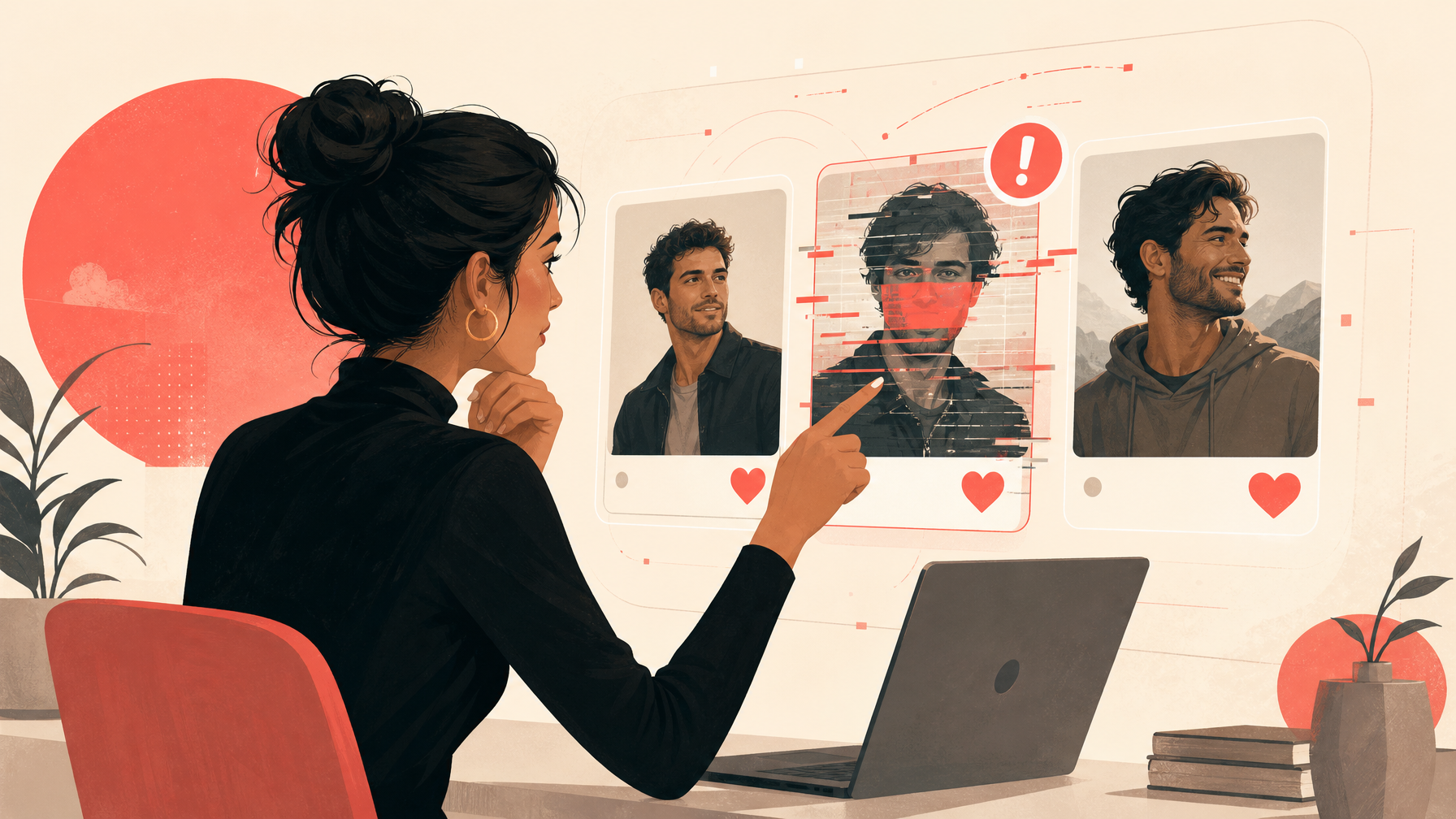
TLDR: Fake dating profiles cost real money. The FTC reported $1.14 billion lost to romance scams in 2023 alone, with a median individual loss of $2,000. Most fakes follow the same playbook: stolen photos, too-perfect bios, love-bombing fast, and a quick pivot off the app. This guide shows you how to spot a fake dating profile in under 2 minutes using reverse image search, bio tells, and behavior checks.
In this post
- Why fake profiles are everywhere right now
- What the FTC says about romance scams
- 7 ways to spot a fake dating profile before you match
- The 30-second photo check
- Bio red flags that scream fake
- Behavior that outs a fake fast
- What to do when you find one
- The verdict: get a system, not just gut
Why fake profiles are everywhere right now
If your feed feels faker than last year, it is not in your head.
Three things happened at once. AI image tools got good enough to generate a hot doctor in front of a tasteful bookshelf in three seconds. Dating app engagement dropped, which makes platforms slower to purge dead or fraudulent accounts. And romance scams moved off just dating apps onto Instagram DMs, Facebook, WhatsApp, and even wrong-number texts.
The FTC's romance scam guidance puts it plainly: romance scammers create fake profiles on dating sites and apps or contact you through popular social media sites. They do not need to be sophisticated. They need you to be tired, lonely, or rushed.
That is why learning how to spot a fake dating profile is not paranoid. It is basic app hygiene, like checking expiration dates.
What the FTC says about romance scams
Numbers make it less abstract.
According to the FTC's March 2025 press release on fraud losses, consumers reported losing more than $12.5 billion to fraud in 2024, a 25% increase over 2023. Romance scams are a chunk of that.
For romance specifically, the FTC reported $1.14 billion in losses to romance scams in 2023, with a median loss of $2,000 per person. That was the highest median loss for any form of imposter scam that year. And in its 2023 Data Spotlight on romance scammer lies, the FTC noted nearly 70,000 people reported a romance scam in 2022, with reported losses hitting $1.3 billion.
Social media made it worse. The FTC's April 2026 update on social media scams shows reported losses on social platforms at $2.1 billion in 2025, up from $1.9 billion in 2024, and about eight times higher than in 2020.
The pattern is simple: fake profile, emotional trust, then money. Sometimes it is crypto. Sometimes it is gift cards. Sometimes it is "help me pay for a flight to finally meet you." It always ends with you paying for someone who never existed.
Which is why we are building your filter first.
7 ways to spot a fake dating profile before you match
You do not need to be a detective. You need 2 minutes and a checklist.
1. The 30-second photo check: how to spot a fake dating profile by pictures alone
Most fake dating profiles fail at photos first.
Look for:
- Only professional or model-level shots. Real people have at least one bad lighting selfie and a group photo where someone is blinking. If every picture looks like a magazine cover, pause.
- Same outfit, same angle, same background. A real camera roll has variety.
- No everyday context. No friends, no messy kitchen, no dog photobomb. Just solo glam.
- Antiquated reverse image test. The FTC recommends it directly: do a reverse image search of the person's profile picture. Is it associated with another name or details that do not match? Same tip shows up in the FTC's military romance scam alert because scammers often steal real service members' photos.
How to do it: Save one photo, go to Google Images or TinEye, upload it. If that same face shows up under three different names, two stock sites, and an Instagram account with 50k followers in a different country, you have your answer.
2. Bio red flags that scream fake
Fake bios read like they were written by a template, because they were.
- Vague but grandiose. "Entrepreneur. World traveler. Looking for my queen. God-fearing." No city, no job detail, no actual opinion.
- Perfect grammar for a "deployed engineer" or weirdly formal English. The contrast between story and syntax is a tell.
- Widowed with a kid, instant depth. The FTC notes this is a common romance scammer story to create sympathy and explain why they cannot video chat.
- Zero hooks you can actually respond to. Real profiles give you something to play off. Fake ones give you nothing, so you fill in the blank with fantasy.
3. Age and location do not add up
45-year-old male model living 3 miles from you but "currently on an oil rig in Norway" is not a logistical problem. It is a script.
If location keeps changing, if he cannot name a coffee shop within 10 minutes of his supposed neighborhood, if her time zone never matches her story, close the door.
This is different from roaching or monkey branching. Those are about real people behaving badly. A fake profile is not a person behaving badly. It is not a person at all.
4. They push you off the app immediately
Every platform tells you to stay in-app until you meet because scams die in the light. Scammers know it.
Line you will see: "I don't use this app much, what's your WhatsApp?" Or Telegram, Google Chat, email. Once you leave the app, you lose reporting tools, screenshot trails, and the app's fraud detection.
If someone refuses to message inside the app for even a day, treat that as a fake until proven otherwise.
5. Behavior that outs a fake fast
Photos lie. Behavior tells the truth faster.
- Love-bombing at lightning speed. Day 2 calls you his wife, his forever, his answered prayer. Real attachment does not move like that. We broke this down in love bombing in dating. Intensity is not intimacy.
- Never available for a live video. Always an excuse: bad camera, military security, offshore work. One real-time video call kills 90% of fake profiles.
- Copy-paste flattery. You get paragraphs that could apply to anyone. Ask a specific question about your profile: "Which hike was that photo from?" A fake will ignore it and send another generic compliment.
- Mirroring without memory. They agree with everything you say but remember nothing you said.
6. The prompt and detail test
If you are on Hinge, use the prompts against them.
Try: "Tell me about the last thing you cooked" or "What's the most overrated spot in [their supposed neighborhood]?" Real people stumble, have opinions, get specific. Fakes stay vague or pivot to romance.
This is also why good prompts matter on your side. If your page actually shows taste, fake profiles have a harder time hooking you. That is where a real personal brand helps. More on that below.
7. The inconsistency sweep
Open the profile like an editor.
- Age 32, job: "Retired military colonel."
- Bible verse in bio, then only shirtless gym pics.
- Claims to live in Austin but all photos have European license plates.
- Says no kids, then mentions "my son needs surgery."
One inconsistency is human. Three is a costume.
What to do when you find one
Do not investigate for sport. Do not play along to "expose" them. You are not law enforcement and you are tired.
Do this:
- Stop engaging. No goodbye speech. Ghost a ghost.
- Screenshot the profile. Save photos, bio, username.
- Report in-app, then block. Every app has a fake profile/scam option.
- Report to the FTC at ReportFraud.ftc.gov. The FTC's own guidance says to do this. It builds the data that powers those billion-dollar loss reports and actually pushes policy, like the 2025 House bill backed by Rep. LaLota requiring dating apps to warn users about fraud.
- Do a reverse image sweep once more after blocking. If that face belongs to a real soldier or a real dad in Ohio, you saved someone else a headache.
If you already sent money, call your bank immediately, then report. Shame keeps people silent and that is exactly how these rings survive.
The verdict: get a system, not just gut
Your gut is good. A system is better. Gut gets tired at 11 pm after a long day. Gut wants to believe the handsome widower who says you have kind eyes.
Here is a 2-minute system you can use every time you learn how to spot a fake dating profile:
Minute 1: Photo scan + reverse image. Stock-perfect only? One face, three names online? Fail.
Minute 2: Bio + behavior check. Vague grandiosity plus pressure to leave the app plus zero video availability? Fail.
Two fails and you unmatch. No debate. No "but what if he's real."
You do not owe a stranger access to your time just because his profile is pretty.
If you spend a lot of time vetting profiles, automate that part. ProfileFlags scans any dating profile for red and green flags, compatibility, and actual response ideas so you stop guessing. It is $19.99 once for unlimited scans. No monthly fee. Run him through it before you get invested.
And if you are tired of playing defense on apps that reward fakes, go on offense. Build a page that makes you un-fake-able. A real site with your story, your standards, your photos that are actually you, and a link that filters out the bots before they get your number. That is what MyDatePage.date does. Custom URL, done-for-you build, you own the first impression instead of renting it from an algorithm.
Want a quick start on what fake-adjacent patterns most people ignore? Grab the free PDF: The 5 Red Flags Most People Miss. Pair it with The Dating Profile Red Flag Checklist if you want a printable you can keep open while you swipe.
Spotting a fake dating profile is not cynical. It is how you save your attention for someone real.