Men Who Make Bad Husbands
He was a great boyfriend. Then you got married. Here are 7 types of men who make bad husbands. Backed by research on the chore gap, Gottman's divorce predictors, and what women actually leave for.

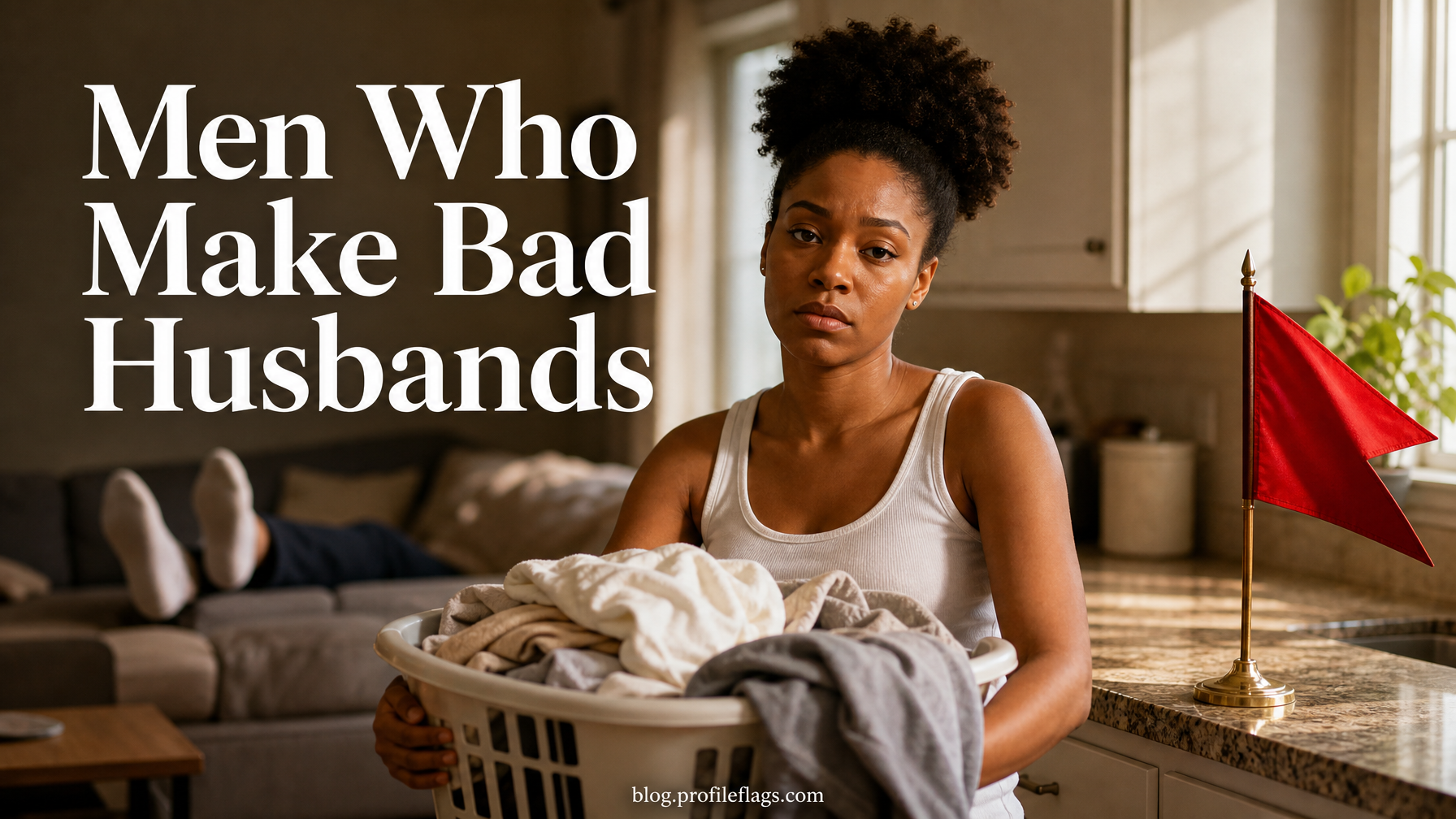
The Chore Gap Is Not a Myth
Before the types, the baseline.
According to the Gender Equity Policy Institute's 2024 analysis of the American Time Use Survey, women spend 12.6 hours per week on household work while men spend 5.7 hours. That's the average. Among married women without children, the gap is even more stark: they do 2.3 times as much household work as their husbands.
Working women who also work full-time do 1.8 times as much household work as their male partners. And women overall have 13% less free time than men. A gap that starts in young adulthood and never fully closes.
This isn't a character flaw in individual men. It's a documented pattern across the population. But within that population, certain types of men are far more likely to drop their share entirely, deny it's happening, or make the woman feel guilty for noticing.
Those are the men this post is about.
7 Types of Men Who Make Bad Husbands
1. The Permanent Guest
He lives in the house like he's visiting. Dishes go in the sink, never the dishwasher. Laundry appears clean without any memory of it being washed. Meals materialize. The toilet paper replaces itself.
He's not lazy in the dramatic sense. He simply doesn't see what needs doing. And when you point it out, he does it once. Making a performance of the effort. Then returns to not seeing.
GEPI's data makes this measurable: married women without children do 2.3x as much household work as married men without children. No kids to explain it. No career gap to justify it. Just a man who never graduated from being taken care of.
2. The Stonewaller
Gottman Institute research identifies contempt as the single greatest predictor of divorce. But stonewalling. Shutting down, going silent, leaving the room when things get hard. Is the behavior that precedes contempt in the majority of failing marriages. And Gottman's research specifically found that men are more likely to stonewall than women.
This man does not fight. He disappears. You try to have a conversation about something real and he goes quiet, picks up his phone, or says "I don't want to talk about this right now" until right now becomes never.
The stonewaller looks low-drama. He markets himself as easygoing. What he actually is: emotionally unavailable in a way that guarantees his partner will spend the marriage parenting him toward basic communication.
3. The One Who Gets Worse When She Gets Better
Bertrand, Kamenica, and Pan's research out of the University of Chicago found that when a wife earns more than her husband, the marriage becomes measurably more unstable. The man's response to her success. Not her success itself. Is the variable.
This type of husband doesn't congratulate her. He competes with her. He undermines her decisions in front of others. He gets quieter at dinner after she gets promoted. He develops a sudden critical relationship with her ambition, her schedule, her "priorities."
She doesn't have a husband. She has a competitor with a joint bank account.
4. The Emotionally Dependent Man Who Calls It Love
He says he just wants to be close. He doesn't have many friends. He doesn't know how to process his feelings without her walking him through it. He calls it love. She calls it exhausting.
This man makes his wife his entire emotional infrastructure. Therapist, best friend, mother, social coordinator, crisis manager. When she needs support, he's unavailable. Because his baseline state is already consuming all available support.
5. The Parent Who Babysits His Own Kids
He "helps" with the children. He "watches" them when she runs errands. He reports back on what happened like he was doing her a favor.
Mothers spend 2.1 times as much time as fathers on the combined unpaid work of childcare and household tasks, according to GEPI's 2024 analysis. Among working mothers, they do 1.6 times as much as working fathers even when both work full-time.
This type of man genuinely believes he's doing his share because he occasionally makes dinner and remembers school pickup twice a month. He has outsourced the mental load entirely.
6. The Man Who Stops Trying After the Ring
He pursued her. He showed up. He remembered things. He made plans. Then the chase was over.
This is the man who conflates commitment with comfort to the point where effort disappears entirely. Date nights become a distant memory. Compliments stop. Curiosity about her life dries up. He's not unhappy. He's just done trying.
Gottman's research shows that men who resist their wives' influence. Who dismiss bids for connection, who don't engage with repair attempts. Are significantly more likely to end up divorced.
7. The Man Whose Ex Was Always the Problem
Every past relationship ended because of her. The ex was crazy. The ex was controlling. The ex didn't appreciate him. He has a detailed case file on every woman he's been with and in every version of events, he's the wronged party.
University of Denver research on relationship patterns finds that prior relationship behavior is one of the strongest predictors of future behavior. A man who has never once reflected on his own role in a failed relationship is not a man who has done the work to be a good partner.
What These Men Have in Common
None of them are necessarily bad people. Most of them would describe themselves as good partners. Several of them genuinely believe it.
What they share: they have never been required to show up equally. The women in their past absorbed the imbalance. Called it love. Made it work. Left eventually. Or stayed and shrank.
Women initiate approximately 69% of divorces. That number doesn't come from nowhere. It comes from years of watching a man who seemed like a partner slowly reveal himself as a dependent.
What to Do With This Before You're Married
You can see most of these patterns before the ring. The permanent guest shows up in whose apartment is always messier. The stonewaller appears the first time you try to have a hard conversation. The competitor reveals himself when you get your first raise.
Marriage doesn't transform men. It removes the incentive structure that kept certain behaviors hidden.
Use ProfileFlags to scan his dating profile for the language patterns that show up in men who present one way and live another. Practice the hard conversations before they're high-stakes at PracticeBae. And if you want the full red flag framework in one place, the 100 Real-Life Red Flags ebook covers 100 documented patterns. Risk-scored and ready.
The version of him you see while he's trying to win you is the ceiling, not the floor.
The Bottom Line
The chore gap is real and documented. The stonewalling pattern is Gottman-verified. The emotional dependency trend fills entire subreddits. The man who stops trying after commitment is so common he barely requires a study.
These aren't worst-case scenarios. They're patterns. And patterns, spotted early, are just information.
A Red Flag in dating is cheaper than a divorce lawyer. Scan smart. Choose deliberately. And if the relationship has already started. PracticeBae is where you practice the conversation that's been sitting in your chest for six months.