The New Romance Scam Every Woman Over 50 Should Know
He said good morning every single day — until he asked for money. The romance scam targeting women over 50 has evolved. Here is exactly what it looks like now, and how to stop it before it costs you everything.

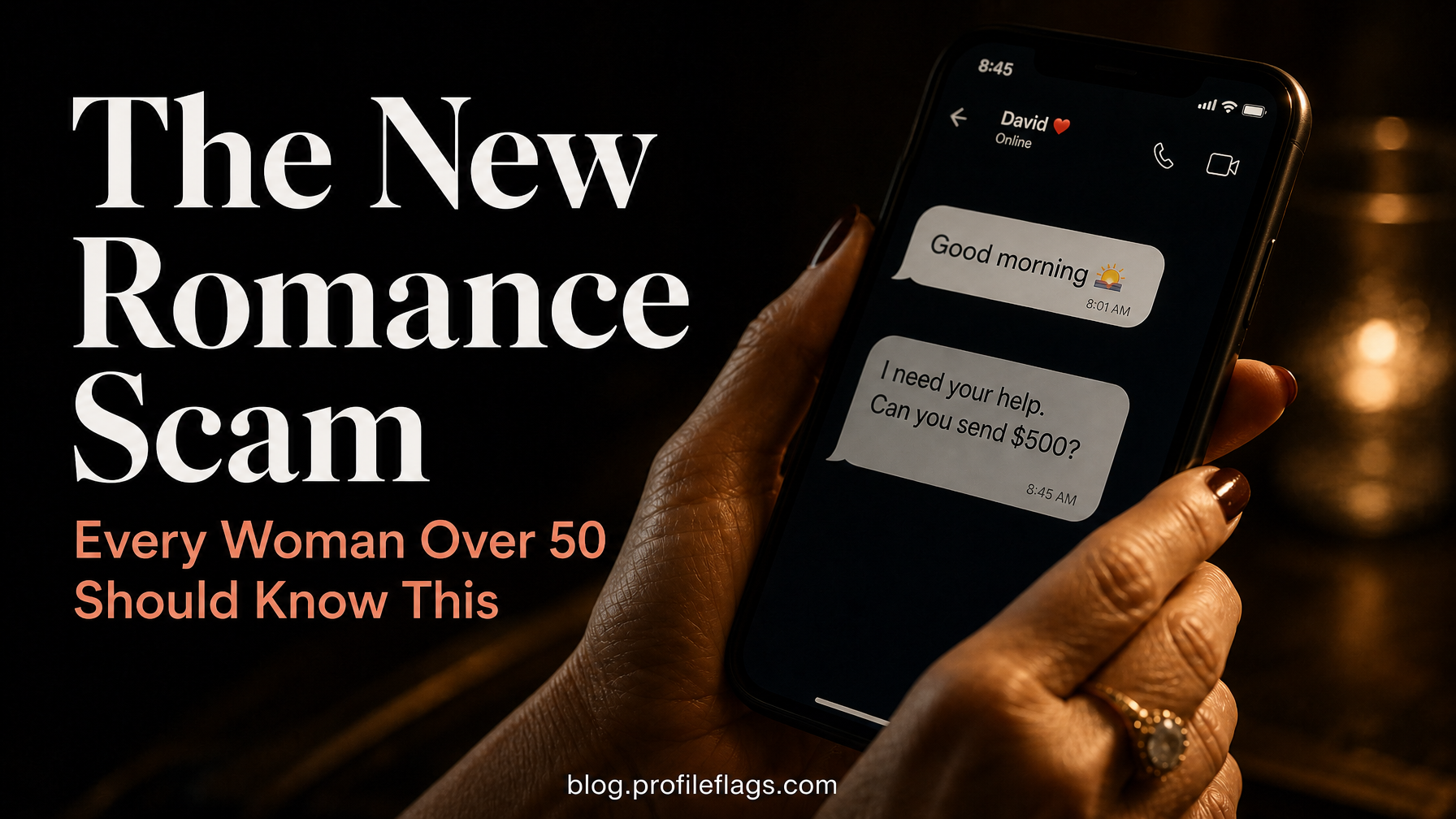
He said good morning every day — until he asked for money.
That sentence contains an entire architecture of manipulation. The good mornings are not affection. They are investment — daily deposits into an emotional account that will eventually be withdrawn in the form of a financial request you never saw coming.
Romance scams targeting women over 50 have become more sophisticated, more patient, and more financially devastating than most people realize. The FBI's Internet Crime Complaint Center reported that romance scam losses in the United States exceeded $1.3 billion in a single year — and women over 50 account for a disproportionate share of those losses. Not because they are naive. Because the scam has been engineered specifically for them.
How the Modern Romance Scam Works
The romance scam targeting women in midlife and beyond has a specific structure that looks nothing like the obvious, poorly written email scams of twenty years ago. Today's version is sophisticated, patient, and emotionally intelligent in ways that make it genuinely hard to detect from the inside.
Here is the full pattern:
Stage 1 — The introduction. The contact usually comes through a dating app, Facebook, or LinkedIn. The profile is polished. The man is professionally accomplished — an engineer, a doctor, a military officer, a businessman working internationally. He is widowed or divorced, with a child he raises alone. He is educated, articulate, and emotionally expressive in a way that feels unusual and appealing. The photos are of a genuinely attractive, credible-looking man.
Stage 2 — The investment period. This is where the good mornings happen. Daily contact. Consistent emotional presence. He asks about your life, your children, your past. He shares his — carefully constructed details that build sympathy and connection. He says things no one has said to you in years. He is attentive, patient, and never pushy. This stage can last weeks or months. The investment is deliberate — the longer it runs, the deeper the emotional attachment, the larger the eventual ask.
Stage 3 — The obstacle. Something goes wrong. He is overseas on a job and there is a complication — a medical emergency, a legal problem, a business deal that falls through at a critical moment, equipment seized at customs. He needs money to resolve it. He does not want to ask — he is embarrassed, he explains. But he has no one else. He trusts you. He loves you. It will be repaid as soon as he returns, which will be soon.
Stage 4 — The escalation. The first request is usually moderate — a few hundred dollars, maybe a thousand. If you send it, the crisis resolves. Then another crisis appears. The requests increase. The reasons become more elaborate. Some women send tens of thousands of dollars across multiple transactions before the pattern becomes undeniable. Some send more.
Stage 5 — The disappearance. When the money stops or the woman starts asking hard questions, the contact ends. Sometimes abruptly, sometimes with an elaborate final story. The man — who never existed as presented — is gone.
Why Women Over 50 Are Specifically Targeted
This is not random. Romance scammers targeting this demographic have identified specific factors that make the approach effective:
Women over 50 are more likely to be recently divorced or widowed, which means they may be experiencing loneliness and a genuine desire for connection — exactly the emotional state the scam exploits. They are often financially established, which means there is more to take. They grew up in a culture where male pursuit and emotional expressiveness were markers of genuine interest, which means the scammer's behavior pattern reads as romance rather than manipulation. And they are less likely than younger women to have grown up with digital literacy that includes scam awareness.
None of this is a reflection of intelligence or strength. It is a reflection of a scam specifically engineered for this audience.
The Profile Flags That Appear Every Time
Romance scammers follow a pattern because the pattern works. Once you know it, it is visible. Here are the red flags that appear consistently:
He is always abroad. The overseas location serves two functions: it explains why he cannot meet in person, and it creates a context for the eventual financial crisis. Military deployment, international business, offshore engineering projects — the specific story varies but the geographic unavailability is constant.
He moves to private communication very quickly. Off the dating app, onto WhatsApp or email, as fast as possible. This removes the record and moves the relationship to a channel he controls more completely.
The emotional intensity is immediate and disproportionate. He says "I love you" within weeks. He talks about the future — moving in together, meeting your family, building a life — before you have ever met in person. This is love bombing: manufactured intimacy designed to accelerate attachment.
He never video calls, or the video calls are brief and poor quality. A man who talks to you every day for months but cannot sustain a real-time video call is a significant red flag. Scammers use stolen photos and cannot appear on camera as the person they are presenting as.
He cannot visit and the reason changes. There is always a reason he cannot come to you — visa issues, the project, the contract, the child's school schedule. Each reason sounds plausible. The accumulation of them is not.
Any request involving money, gift cards, wire transfers, or cryptocurrency. This is the line. No legitimate romantic partner — someone who claims to love you, who is planning a future with you — asks you to wire money, buy iTunes or Google Play gift cards, send crypto, or transfer funds for any reason. Ever. This is true regardless of how long you have been talking, how deep the connection feels, or how compelling the reason sounds.
What to Do If You Think You Are in One
First: do not send any more money. Not for the new emergency, not for the "last time," not to protect the money you already sent. Stop all financial transfers immediately.
Second: do a reverse image search on his profile photos. Go to Google Images, click the camera icon, and upload the photo. Romance scammers use stolen photos of real people — often military officers, doctors, or models. If the photo appears associated with a different name or identity, you have your answer.
Third: report it. You are not the first and you will not be the last. Reporting matters.
- FTC: ReportFraud.ftc.gov
- FBI Internet Crime Complaint Center: ic3.gov
- Elder Fraud Hotline: 1-833-FRAUD-11 (1-833-372-8311)
Fourth: talk to someone you trust. Romance scam victims often feel intense shame, which scammers count on to keep victims quiet. The shame is not yours. The manipulation was deliberate and sophisticated. Telling someone breaks the isolation the scammer worked to create.
If You Have Already Sent Money
Recovery of funds is difficult but not always impossible, depending on the method used. Contact your bank immediately — wire transfers have a short window for potential reversal. If gift cards were used, contact the issuing company directly. If crypto was involved, recovery is extremely unlikely but documenting the transaction fully is still important for reporting purposes.
The Dating After 50 Guided Journal includes a full scam protection chapter with every pattern, resource, and agency contact — written specifically for women navigating dating in midlife. It is available for $19.99 at overstanddating.gumroad.com/l/DatingAfter50.
The Good Mornings Were Not Love
This is worth saying directly: the feeling was real. The connection you felt was real. The hope was real. None of that was wrong or foolish — it was human, and it was exactly what the scammer needed it to be.
The good mornings were a tool. The love declarations were a script. The future he described was fiction written to keep you invested long enough to ask for money.
Knowing that does not make the grief smaller. But it does mean that what happened to you was not a reflection of your judgment or your worth. It was a professional manipulation by someone whose full-time occupation is exploiting emotional vulnerability. That is on them, not you.
Scan any dating profile for scam signals and red flags at profileflags.com before you invest time in a conversation. Two minutes of scanning can tell you a great deal about what someone's profile actually communicates — and what it is hiding.
The 100 Real-Life Red Flags guide covers romance scam patterns, financial red flags, and 98 other warning signs — every flag risk-scored. $12.99 at overstanddating.gumroad.com/l/100RedFlags. More resources at blog.profileflags.com.