Negging in Dating: 9 Signs Someone Is Using Backhanded Compliments to Control You
Negging in dating is a manipulation tactic that disguises insults as compliments to chip away at your confidence. Here are 9 signs it's happening to you — and what to do about it.

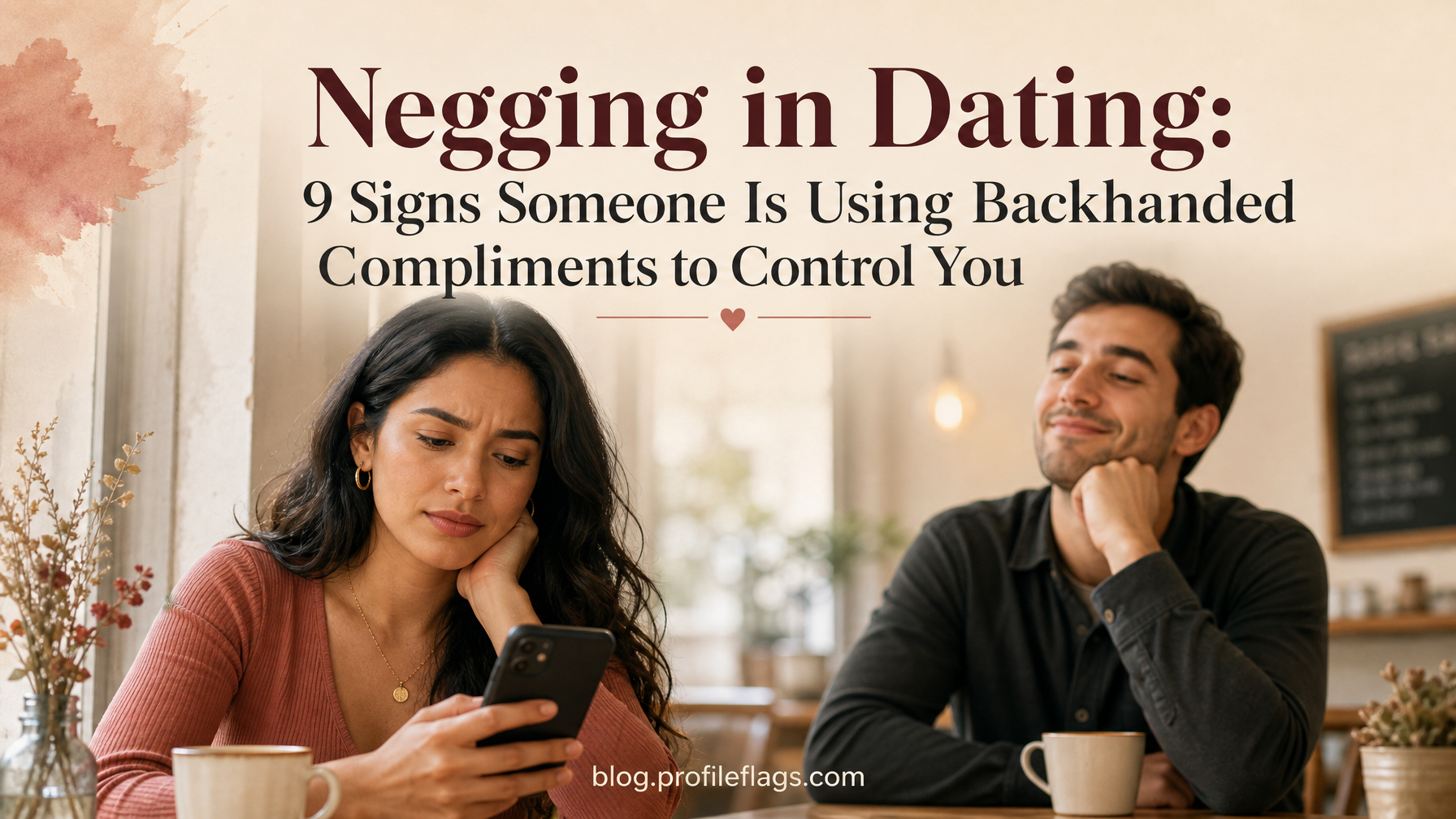
TLDR
Negging is a manipulation tactic where someone insults you under the cover of a compliment — with the goal of lowering your confidence so you chase their approval. It came from the pickup artist community, but it shows up constantly on dating apps and in early relationships. If comments from someone you're dating consistently leave you feeling slightly smaller, that's worth paying attention to.
Table of Contents
- What Is Negging in Dating?
- Where It Came From
- 9 Signs You're Being Negged
- Why It Works (The Psychology)
- Negging vs. Playful Teasing
- How Negging Shows Up on Dating Apps
- What to Do If You're Being Negged
- The Verdict
What Is Negging in Dating?
Negging in dating is a form of emotional manipulation in which someone delivers a backhanded compliment — a comment that sounds like praise on the surface but carries a hidden insult — to undermine your self-esteem and keep you seeking their approval. According to therapist.com, the tactic is "often used to gain control or make a person crave approval."
The mechanics are simple: say something that makes a person feel slightly worse about themselves, so they work harder to earn your validation. It is not a clumsy social mistake. It is a calculated move.
Some examples that show up in real conversations:
- "You look great for your age."
- "I didn't think you'd be into something so sophisticated."
- "You're pretty smart for a girl."
- "You're almost as good at this as my ex."
- "It's brave that you'd wear that out."
- "Wow, you actually look nice today."
Any one of those could leave you questioning whether you just received a compliment or got insulted, and that confusion is the point.
Where It Came From
The term "neg" was popularized by the pickup artist community in the early 2000s, most notoriously through Neil Strauss's 2005 book The Game, which documented the tactics men were being taught to use on women. The logic sold to these men was that attractive women were too used to compliments, so the way to stand out was to give them something that lowered their guard and made them question themselves.
It was framed as flirting. It was manipulation dressed in plausible deniability.
According to Verywell Mind, researchers note that a more evolved and emotionally corrosive form of negging is increasingly being taught in modern dating coaching contexts — one more likely to escalate into controlling relationship dynamics. The tactic did not disappear when "The Game" stopped being popular. It moved online.
9 Signs You're Being Negged in Dating
1. Their compliments always come with a catch
Healthy compliments are clean. "You look great." Full stop. A neg wraps the compliment in a qualifier that undermines it. "You look great for someone who doesn't usually put effort in." If you find yourself thinking "wait, was that a compliment?" after almost every nice thing they say, that is a pattern worth tracking.
2. They compare you to their ex — unfavorably
Bringing up an ex to make you feel like you're coming up short is a textbook negging move. "My ex used to be really good at that" or "You remind me of her, but she was a bit more [anything]" is designed to make you compete against someone you've never met.
3. They express surprise when you do something well
"Wow, I didn't expect you to know about that." "I'm actually impressed you figured that out." These phrases read as compliments but carry the implication that they had low expectations of you to begin with. Over time, that chips away at how you see yourself.
4. Their jokes about you never feel quite right
According to therapist.com, a key difference between playful banter and negging is that genuine banter leaves both people feeling good. If their teasing about you consistently lands differently from their other jokes — if you feel a small sting you can't quite explain — trust that feeling. Playful teasing does not leave you replaying the comment two hours later.
5. They minimize your achievements
"Oh nice, you finished that. I mean, it wasn't exactly rocket science, but still." They acknowledge what you did while making sure you don't feel too good about it. This is a consistent pattern with people who need to stay in a perceived one-up position.
6. They comment on your appearance in ways that sting
"That's a bold choice." "That hairstyle is really ... interesting." "You're pulling it off." Comments that leave your confidence a little lower than before they spoke. They would deny they said anything negative, and that's exactly the design.
7. You find yourself working harder for their approval than they work for yours
This is the outcome negging is engineered to produce. If you notice you're consistently trying to prove yourself, justify your choices, or earn a genuine compliment from this person, step back and ask yourself why that dynamic exists. It did not happen by accident.
8. They question your taste or judgment regularly
"I wouldn't have picked that, but okay." "Interesting choice." Consistently undermining your preferences — your music taste, your style, your opinions on movies — is a slow drip on your self-trust. It is not feedback. It is positioning.
9. You feel slightly worse about yourself after most interactions
This is the clearest signal. Therapist.com points to this directly: "If you frequently feel belittled, confused, or self-conscious after interacting with someone, they might be employing negging tactics." Pay attention to how you feel after you get off the phone or leave a date with them. That is data.
Why It Works
Negging is effective for one core reason: it targets self-esteem at a moment when your defenses are down. Early dating involves a lot of wanting to be liked. When someone says something that makes you feel uncertain about yourself, the natural human response is to try to correct that impression — to prove the doubt wrong. The person negging you has now got you performing for their approval, which is where they wanted you.
Verywell Mind describes it as "a calculated move to make someone feel insecure so they are more likely to seek validation from the person who knocked them down." The manipulator lowers your self-esteem with one hand and positions themselves as the source of your validation with the other.
It is also hard to call out in the moment. The comment is always ambiguous enough to be deniable. That ambiguity is part of why people second-guess themselves — and keep engaging.
Negging vs. Playful Teasing
Not every joke at your expense is a red flag. Real teasing is mutual, light-hearted, and leaves both people laughing. The test is simple: does the comment make you feel worse about yourself, or does it just make the moment funnier? Playful banter builds rapport. Negging erodes it.
The other test is reciprocity. In playful banter, both people can take jabs. With negging, the critical comments only flow in one direction — toward you. Their confidence never seems to get questioned. Yours does, constantly.
If this pattern sounds familiar from someone you're currently talking to, talking stage red flags cover more of what to look for before you even get to a first date.
How Negging Shows Up on Dating Apps
Dating apps gave negging a new home. Hiding behind a screen lowers whatever social inhibitions might otherwise keep these comments in check. On apps, negging often looks like:
- An opening message that's a backhanded observation about your profile ("You seem like the kind of girl guys think is more fun than she actually is")
- Commenting on your photos with qualifiers ("You look better in this one than the others")
- Unsolicited opinions on your profile bio or prompt answers in a way that's vaguely dismissive
- Asking questions that imply you're less intelligent or experienced than they are
A good covert narcissist can do this across an entire conversation without ever saying anything you could point to and call obviously rude. That's what makes it particularly worth knowing how to spot.
If you want to analyze whether someone's profile already signals these dynamics before you match, ProfileFlags scans dating profiles for behavioral red flags and green flags — including the kind of language and framing that tends to come from someone who uses manipulation as a default mode. One-time, $19.99, unlimited scans. Decode Profile Now at profileflags.com.
What to Do If You're Being Negged
The first thing to recognize is that negging says nothing about your actual worth. It is a tool someone uses because they need to feel superior or because they want control. Neither of those things is your problem to fix.
Practically speaking:
Name it, don't absorb it. When a backhanded comment lands, you don't have to let it sit inside you. You can say, plainly, "That comment landed weird. What did you mean by that?" Most people who neg are not prepared for direct, calm accountability. Watch what happens when you ask them to clarify.
Stop performing for their approval. The moment you notice you're working to prove yourself to someone who keeps finding quiet ways to make you feel smaller — stop. That dynamic has already told you something.
Look at the pattern, not just the individual comments. One off comment might be a clumsy moment. A consistent pattern of comments that leave you feeling less-than, combined with someone who seems to enjoy holding your approval? That's a red flag you shouldn't talk yourself out of. Check out why we talk ourselves out of red flags — the psychology behind ignoring what your gut already knows.
Leave. Not dramatically. Just quietly. Someone who needs to chip away at you to feel okay about themselves is not going to make you feel okay about yourself. That math does not change.
And if you are seeing patterns across multiple people you've matched with, it might be worth looking at what signals your own profile is sending. The free guide The 5 Red Flags Most People Miss covers the behaviors that keep showing up across matches that most people only recognize in hindsight. Free download.
The Verdict
Negging in dating is not banter. It is a deliberate tactic designed to make you feel slightly less secure so you work harder for someone's approval. The comments are always ambiguous enough to deny, always just subtle enough that you question yourself before you question them — which is the design.
The pattern is the evidence. If someone consistently leaves you feeling smaller after interactions, that's the answer. You do not need a formal definition to trust it.
Before you invest more time in someone who sends mixed signals, run their profile through ProfileFlags. The AI flags behavioral patterns in dating profiles that often predict exactly this kind of manipulation — before you're already three months in and wondering what happened. Decode Profile Now at profileflags.com.