The Nice Guy Red Flag: If He Has to Tell You He's a Nice Guy, He Probably Isn't
Nice guys do not announce themselves. Here is what the "nice guy" self-label actually signals — and why it is one of the most reliable red flags in dating.

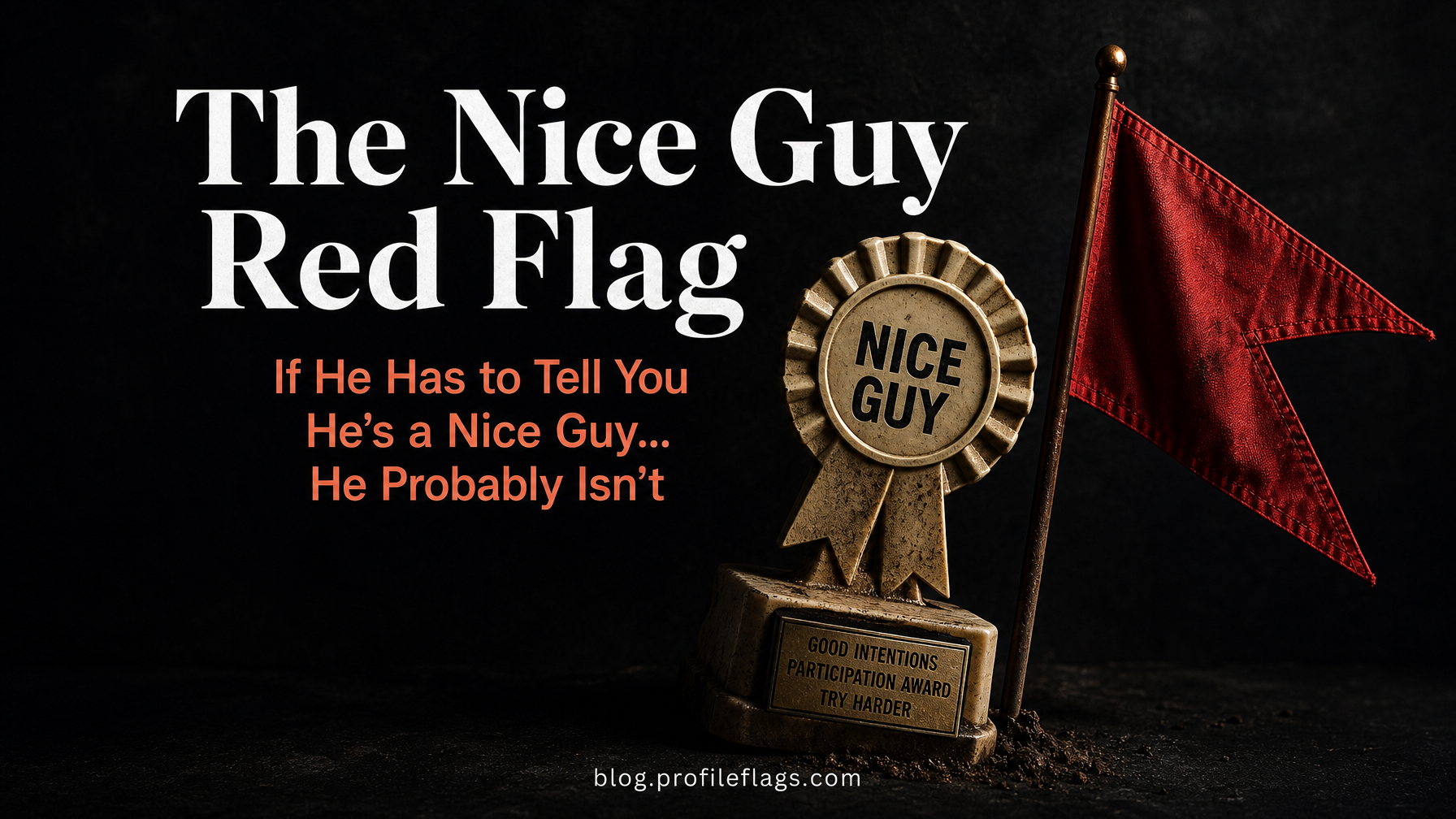
If he has to tell you he's a nice guy... he probably isn't.
This is one of those observations that sounds like a joke until you have encountered it enough times to know it is not. The men who actually treat women well do not spend much time advertising it. They are too busy doing it. The ones who lead with "I'm a nice guy" are almost always trying to convince you of something their behavior has not yet demonstrated — and in many cases, something their behavior will eventually contradict.
The nice guy self-label is a red flag. Not because kindness is bad, but because genuine kindness does not require a press release.
What the Nice Guy Label Actually Signals
When a man calls himself a nice guy — especially early in dating, unprompted, or in response to being questioned — he is usually communicating one of several things:
He believes he is owed something for his niceness. The classic nice guy framework operates on a transaction model: I am treating you well, therefore you owe me your time, your interest, your affection, your commitment. Niceness, in this model, is not a baseline — it is a currency being spent. When the expected return does not materialize, the niceness tends to evaporate and what replaces it tells you what was actually underneath.
He is preemptively defending against criticism. "I'm a nice guy" as an opening position is armor. It is designed to make it harder for you to call out bad behavior later — how can he be a problem if he already told you he was one of the good ones? This is a subtle form of social manipulation, and it works more often than it should.
He has been told otherwise and is arguing against it. Sometimes a man calls himself a nice guy because previous women did not treat him like one — and rather than examining why, he has concluded that the problem is with the women. This man is not kind. He is resentful and he is looking for someone to prove his theory wrong by choosing him, which will not make him less resentful.
He has confused politeness with character. Being polite, not yelling, paying for dinner — these are not evidence of being a good person. They are the minimum requirements for being a functional adult in public. A man who treats baseline courtesy as a defining personal quality has not thought very hard about what actually makes someone worth being with.
What Nice Guy Behavior Looks Like in Practice
The nice guy red flag rarely shows up as a single statement and disappears. It is a pattern. Here is what it looks like across a relationship:
He keeps score. He remembers every favor, every gesture, every time he went out of his way — and he expects these to be acknowledged and reciprocated. Relationships are not ledgers, and someone who treats them like one will eventually present the bill.
His niceness has conditions. He is warm and generous when things are going well and when you are responding to him the way he wants. When you set a boundary, express a need he does not like, or fail to respond with the enthusiasm he expected — the niceness disappears. This is the tell. Real kindness does not evaporate under pressure.
He complains about other men constantly. Nice guys often define themselves in opposition to "other guys" — the jerks, the players, the men who do not treat women right. The implication is always that you should appreciate him by contrast. This is not self-awareness. It is positioning. A genuinely secure man does not need to diminish other men to make himself look good.
He uses his niceness to avoid accountability. When he does something that hurts you and you bring it up, the response is some version of "I don't understand why you're upset — I'm a nice guy." His self-image becomes the argument against your experience. You spend more time defending the validity of your feeling than addressing the actual issue.
He gets bitter when rejected. The entitlement underneath the nice guy framework becomes most visible when he does not get what he wants. A man who is genuinely kind absorbs rejection with grace — not easily, but gracefully. A nice guy who is rejected often becomes hostile, passive-aggressive, or suddenly decides the woman he was treating so well is not actually worth his time. This shift reveals that the niceness was never unconditional.
Why It Works on So Many Women
The nice guy framing is effective because women — particularly women who have dealt with genuinely unkind men — are often actively looking for someone who is not that. When a man presents himself as considerate, emotionally available, and respectful of women, it reads as a green flag. The label lands in the right place.
The problem is that the label and the reality do not always match, and the early presentation is often the best version. The niceness is real in the beginning — or at least the performance of it is convincing enough to be indistinguishable from real. What changes is not him. It is the context: the point at which you stop being a potential reward and start being an actual person with needs, limits, and off days.
That is when you find out whether the niceness was character or strategy.
The Difference Between a Nice Guy and an Actually Kind Man
An actually kind man does not need you to know he is kind. You find out because of how he behaves over time — how he handles disagreement, how he responds when you are having a hard day and have nothing to give, how he talks about the women in his past, how he responds to being told no.
He does not announce his kindness because it is not a position he is defending. It is just how he operates.
The difference in practice:
- A nice guy tells you he is respectful. A kind man is respectful when it costs him something.
- A nice guy is generous when he expects gratitude. A kind man is generous when no one is watching.
- A nice guy is patient until he is not. A kind man's patience does not have a hidden expiration date tied to your compliance.
- A nice guy is hurt when you have needs. A kind man wants to know what they are.
What to Do When You Spot It
The nice guy label in isolation is not always disqualifying. Some men use it loosely without the full transactional framework. What matters is what you see underneath it over time.
Watch how he responds the first time you disappoint him. That moment — when you cancel plans, decline something he wanted, express a preference he does not share, or simply have a bad day and cannot perform happiness — tells you more than any number of nice evenings did.
Watch how he talks about women who did not choose him. Bitterness about exes, contempt for women who "friend-zoned" him, a pattern of framing himself as a victim of female poor judgment — these are not the perspectives of a man who was simply unlucky. They are the perspectives of a man who believes women owe him something and keeps being surprised when they do not deliver.
Use the ProfileFlags scanner at profileflags.com to check his dating profile before you invest time in the dynamic. Nice guy language shows up in profiles — phrases that position him as different from "other guys," emphasis on how much he does for women, the specific framing of himself as underappreciated. The pattern is readable before you ever go on a date.
The 100 Real-Life Red Flags guide covers entitlement patterns, conditional kindness, and 98 other warning signs — every flag risk-scored LOW, CAUTION, or HIGH. $12.99 at overstanddating.gumroad.com/l/100RedFlags. More at blog.profileflags.com.