Orbiting in Dating: When They Ghost You But Never Really Leave
Orbiting in dating is when someone stops texting you but keeps watching your stories. Here's what it means, why people do it, and how to stop letting it mess with your head.

TLDR
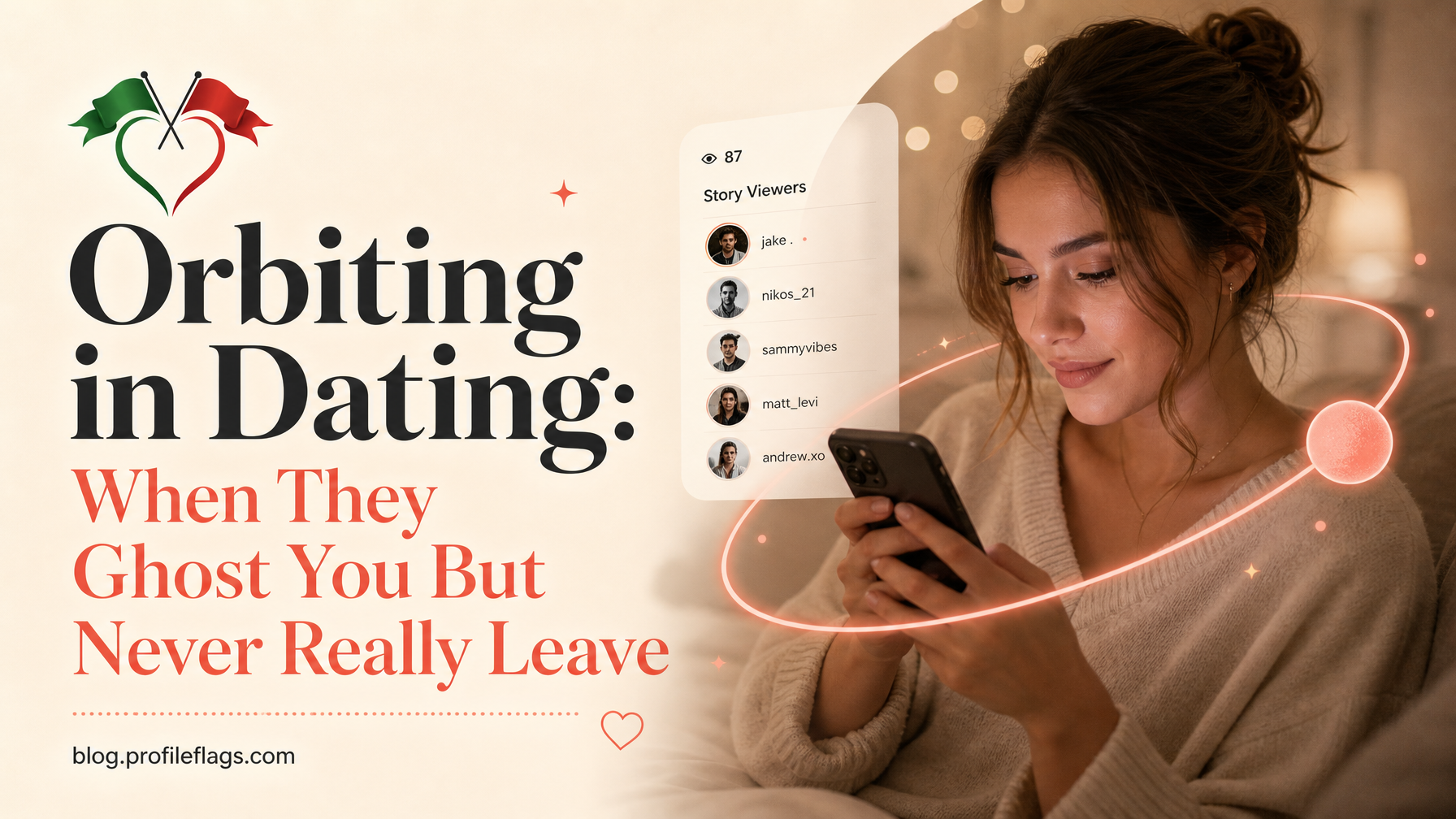
Orbiting is when someone cuts off direct contact with you but keeps showing up as a viewer on your stories, liking your old photos, or engaging with your content just enough to stay on your radar. It's not ghosting, exactly. It's ghosting with a surveillance operation attached. A 2022 study from the University of Milano-Bicocca found that being orbited caused more psychological distress than a straightforward rejection, but less than being fully ghosted — because the ambiguity is its own kind of torment. Here's what's actually happening and what you should do about it.
Table of Contents
- What Orbiting Actually Means
- 7 Signs You're Being Orbited
- Why People Orbit (It's Not About You)
- What the Research Actually Says
- How Orbiting Messes With Your Head
- What to Do When You're Being Orbited
- The Verdict
What Orbiting Actually Means
You matched on Hinge, texted for two weeks, went on a date, and then the messages slowed down and eventually stopped. Normal enough. But then you notice: they watched your entire Instagram story the next morning. And the one after that. And they liked a photo you posted from three months ago at 11pm on a Tuesday.
That's orbiting. The term was coined by writer Anna Iovene in 2018 in Man Repeller and has since been picked up by everyone from Fortune to academic journals. The concept is simple: someone ends or fades out of actual contact with you, but continues to circle your social media presence — watching, occasionally engaging, never actually saying anything.
It sits in an odd category between ghosting and breadcrumbing. They're not texting you (ghosting). They're not sending the occasional "hey stranger" message to reel you back in (breadcrumbing). They're just... there. Hovering. Present enough to notice, absent enough to give you nothing to work with.
7 Signs You're Being Orbited
- They watch every story you post, even weeks after going quiet. If they're first or last on your viewer list consistently, they're not accidentally seeing your content.
- They like photos from deep in your archive. Scrolling back months on your profile takes intent. This isn't an accident.
- They react to your stories but don't follow up. A fire emoji at 1am with zero follow-through is a classic orbit move.
- They comment something vague on a public post. "Love this" or "😂" — enough to acknowledge you, not enough to start anything.
- They show up to watch your Lives or reels. Passive engagement at specific times isn't passive. It's scheduled.
- They accept your follow-back after going quiet. They didn't block you, didn't restrict you, and didn't unfollow. The door stays open on their end.
- Your mutual friends mention them randomly. Orbiters sometimes keep tabs through social circles, not just social media.
The verdict: One or two of these might be coincidence. Three or more, happening regularly, over a period of weeks? You're in orbit.
Not sure if his behavior on dating apps is sending the same mixed signals? ProfileFlags can scan a dating profile and flag exactly this kind of push-pull behavior before you invest any more time. One-time payment, unlimited scans. Decode Profile Now →
Why People Orbit (It's Not About You)
There are a few different reasons someone ends up orbiting, and most of them have nothing to do with how you feel about them.
They want to keep their options open. Removing themselves from your life entirely closes a door. Staying in your periphery — without any of the effort of actually dating you — keeps it cracked. You're a backup plan they don't have to maintain.
They're avoiding discomfort. Blocking you or unfollowing you would require a decision. Watching your stories requires nothing. People who can't handle confrontation or clear endings often just... drift. Orbiting is what avoidance looks like on social media.
They like the validation. Knowing someone is wondering why you're watching their stories — and possibly still thinking about you — feels good. It costs nothing and feeds the ego. According to HER App, orbiters are often driven by a desire for social validation and attention, particularly if they're the ones who ended or faded contact first.
They're genuinely uncertain. Some orbiters haven't fully decided whether they want to pursue something or move on. Watching from a distance lets them stay informed without committing. They can re-enter the conversation at any point if the mood strikes them.
They don't think about it at all. This is the hardest one to accept. Sometimes they're watching your stories because their thumb scrolled past and they didn't think twice about it. You're tracking their viewing patterns; they've already mentally moved on.
What the Research Actually Says
In 2022, researchers at the University of Milano-Bicocca published a study in Cyberpsychology: Journal of Psychosocial Research on Cyberspace comparing the psychological fallout of three types of relationship endings: rejection, ghosting, and orbiting. They assigned 176 participants to recall an experience of one of the three and then measured the emotional impact.
The findings: ghosting caused worse outcomes than a direct rejection — people felt more excluded, more of a threat to their basic needs for belonging, control, and self-esteem. Orbiting sat in the middle. The ambiguous signals from an orbiter seemed to partially soften the sting, compared to being fully ghosted. But orbiting still caused significantly more distress than a clear, honest rejection. [Pancani, Aureli & Riva, 2022, Cyberpsychology Journal]
As a psychotherapist from CU Anschutz Medical Campus explained in an April 2024 piece: orbiting creates ambiguity that keeps the person on the receiving end in a state of uncertainty. "An individual might wonder if the other person is still attracted or might want to return to the relationship. For some people, this uncertainty can be harmful." [CU Anschutz Medical Campus, April 2024]
The same study also noted that people prefer receiving some attention, even ambiguous attention, over being ignored entirely — which is exactly why orbiting keeps working. A little bit of passive engagement is enough to keep someone wondering.
How Orbiting Messes With Your Head
The real damage from orbiting is the story loop it creates.
You see their name in your viewer list and you start analyzing: is this intentional? Do they miss me? Should I text them? Did they watch it right away, or hours later? You screenshot the viewer list and send it to a friend. You post something you know they'll react to and then check to see if they do. You start curating your stories for an audience of one person who hasn't actually spoken to you in weeks.
That loop is exhausting. And it's designed — not maliciously, but functionally — to keep you focused on them.
The CU Anschutz psychotherapist notes that without explanation, people tend to tell themselves negative stories about why someone went quiet. The lack of closure is part of what makes these situations hard to shake. Orbiting gives just enough stimulation to restart that loop every time you post something new.
It also makes it harder to meet someone new. You're half-distracted by someone who isn't actually in your life. They have your attention for free.
If you're noticing this pattern across multiple people you've matched with — someone shows interest, pulls back, but never fully disappears — that's worth examining. Download the free guide, The 5 Red Flags Most People Miss (free PDF), which covers exactly the kinds of low-grade signals that fly under the radar until they've already cost you time.
What to Do When You're Being Orbited
You have a few realistic options.
Option 1: Do nothing differently. Post what you want to post, live your life, and don't track their viewing behavior. This is genuinely the healthiest move for most people. If they're watching your stories, let them watch. You don't owe them a reaction, a text, or a performance.
Option 2: Remove them from your story audience. On Instagram and TikTok, you can hide your story from specific people without unfollowing or blocking them. They won't know you've done it. The orbit ends quietly, with zero drama. This is worth doing if checking whether they've watched your stories has become a habit you're struggling to break.
Option 3: Unfollow or block. If their presence in your digital life is genuinely affecting your ability to move on, removing them completely is a valid choice. It's not dramatic. It's just cleaning up your space.
Option 4: Reach out, once. If there's something genuine and unresolved between you two, one direct message asking where things stand is reasonable. "Hey, I noticed we stopped talking but you're still watching my stories — are we good?" That's clean. If they respond with something real, great. If they don't, you have your answer and you can remove them from your audience without the ambiguity.
What not to do: Post stories specifically to get a reaction from them. Ghost them back while still checking if they're watching. Wait indefinitely for them to re-engage. None of these moves puts you in a better position.
The verdict: Orbiting is a sign of someone who wanted the door to stay open without doing any of the work of keeping it open. That tells you something about how they'd show up in an actual relationship. It's useful information, not a reason to wait around.
The Verdict
Orbiting is one of those behaviors that's easy to rationalize when you're the one doing it ("I just haven't unfollowed yet") and deeply confusing when you're on the receiving end. The research confirms what most people already feel: it sits in an uncomfortable psychological middle ground — not as bad as a clean ghost, but worse than a clear ending.
The fact that dating apps have made it easy to meet someone, lose interest, and never fully disconnect is a design problem, not a character flaw specific to any one person. Still, once you recognize the pattern, you don't have to stay in it.
And if you want to catch this kind of mixed-signal behavior earlier in the process — before you've spent weeks wondering what someone's story views mean — ProfileFlags reads dating profiles and surfaces the behavioral patterns that predict exactly this kind of push-pull dynamic. Decode Profile Now →
Related reads: Ghosting in Dating: The Signs | Breadcrumbing in Dating | Dry Texting: Is It a Red Flag?