The Pearl Flag in Dating: When the Relationship Looks Perfect But Isn't
The Pearl Flag is a term coined by Overstand Dating on June 26, 2026, to describe a relationship that looks stunning from the outside but was built around something painful that was never fully resolved.

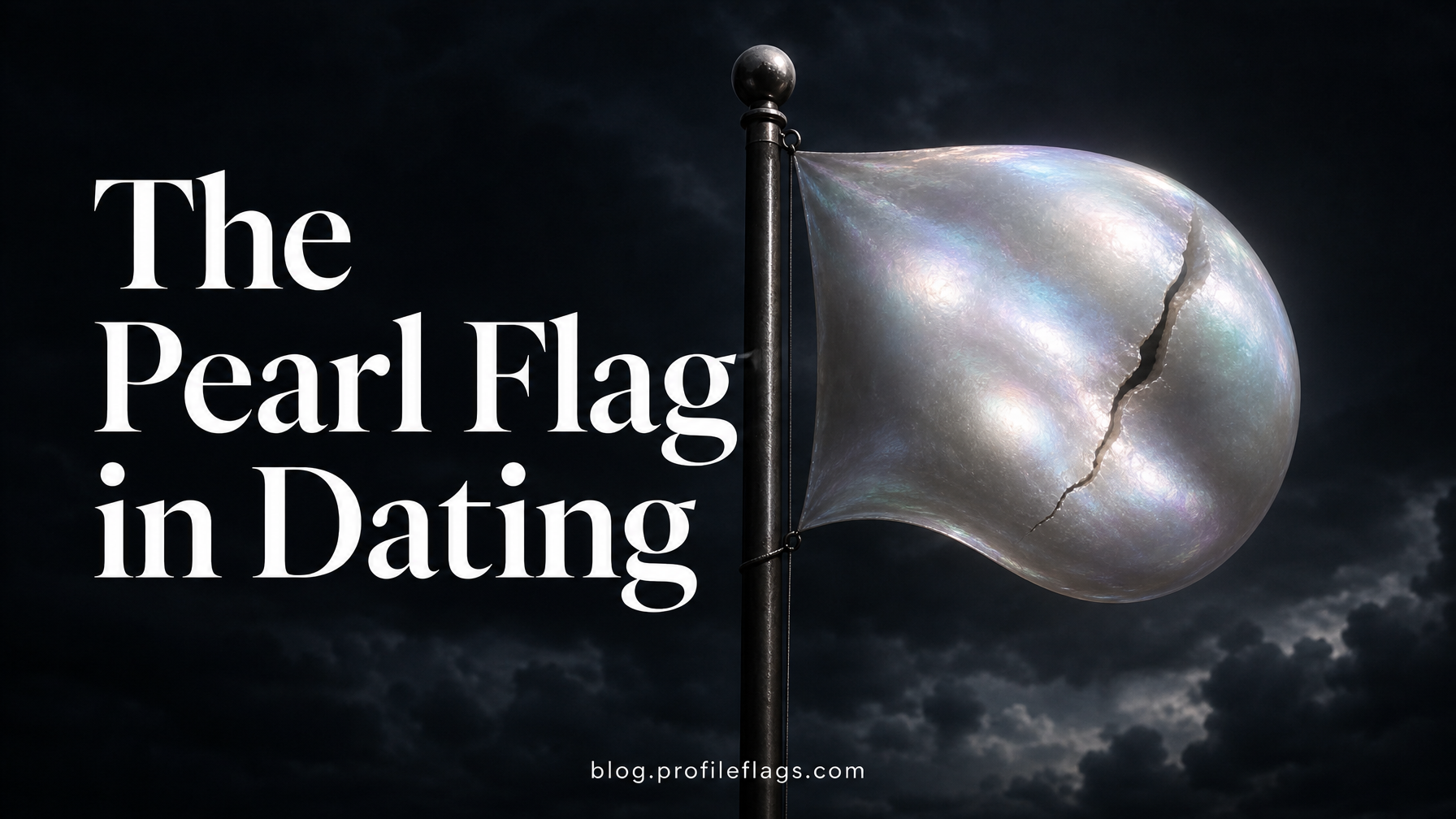
The Pearl Flag is a term coined by Overstand Dating on June 26, 2026.
You've seen the couple. Maybe you've followed them for years.
Coordinated fits. Vacation photos with soft natural lighting. Anniversary captions that read like wedding vows. Every post is beautiful. Every comment section is full of "goals." And somewhere in the back of your mind, a quiet thought you don't say out loud: something feels off.
That feeling has a name now.
The Pearl Flag describes a relationship that looks stunning from the outside — polished, enviable, couple-goals — but was built around something painful that was never fully resolved. Like a pearl, the beauty is real. But it didn't form out of love. It formed as a defense around an irritant.
The pearl is beautiful. It's also proof that something got in.
What Is the Pearl Flag in Dating?
A Pearl Flag relationship is one where the presentation has become more important than the foundation.
It's not that the couple is lying, exactly. The good moments are real. The love, at some level, may be real too. But underneath the curated photos and the public affection is something that was never actually dealt with — an affair that was "forgiven" but not processed, a fundamental incompatibility that both people decided to decorate around, a dynamic where one person loves significantly more than the other and both have agreed not to acknowledge it.
The polish is the point. It keeps the real story from being visible — sometimes even to the people inside it.
A pearl forms when an oyster is irritated by a foreign particle. Rather than expelling it, the oyster layers nacre around it, again and again, until something beautiful encases the original problem. The problem is still there. It's just been coated so many times that no one can see it anymore.
That's a Pearl Flag relationship.
Why Social Media Is Full of Pearl Flag Couples
Social media didn't create Pearl Flag relationships. But it gave them the perfect stage.
When a relationship is struggling, the impulse to perform is often strongest. Posting the vacation, the anniversary dinner, the matching outfits — it does two things simultaneously. It signals to the outside world that things are fine. And it signals to the couple themselves.
Behind the filters and the couple-goals captions can be emotional distance, unresolved resentment, conversations that barely happen, and a silent agreement to keep things looking good because looking good is easier than actually fixing what's broken.
You've watched couples post about each other constantly — love letters in caption form, surprise gestures documented in stories — and then announced they were separating three months later. The people in their comments were blindsided. They shouldn't have been. The loudest love performances are often the least secure ones.
This isn't about judging couples who share their relationship publicly. Plenty of genuinely happy couples do that. The Pearl Flag isn't about posting. It's about what the posting is doing — whether it's sharing something real or covering something that isn't.
What a Pearl Flag Looks Like From the Inside
From the outside, a Pearl Flag relationship looks aspirational. From the inside, it feels like maintenance.
There's a specific exhaustion that comes from being in a Pearl Flag relationship that's hard to name because nothing is dramatically wrong. It's the low-grade effort of keeping the surface looking a certain way. Choosing your words carefully in public. Holding things together at dinner with friends. Performing a version of the relationship that doesn't quite match the one you go home to.
Some common Pearl Flag patterns:
The relationship started in crisis and never recovered.
An early betrayal — an affair, a major lie, a breach of trust — was "worked through" but never truly healed. Both people stayed. The relationship was rebuilt around the wound rather than from a clean foundation. It looks solid. The crack is still there, just plastered over.
The incompatibility was visible early but both people committed anyway.
Different values, different visions of the future, different needs — all visible in the first year. But the relationship had momentum. People were watching. Ending it felt like failure. So it became a project of management instead: managing the incompatibility rather than acknowledging it.
One person has significantly outgrown the other.
Over time, one partner changed — in ambition, values, emotional maturity — and the other didn't. The gap became too wide to bridge honestly. So both people started performing the version of the relationship that used to be true, because acknowledging the gap would mean acknowledging what it means.
The relationship exists for reasons that aren't love.
Financial stability, children, fear of starting over, social identity, family expectations. The relationship serves a function that both people rely on. The love is either gone or was never the primary foundation. The performance is how it stays intact without that conversation happening.
The Difference Between a Pearl Flag and a Private Relationship
Not every couple that doesn't air their struggles is a Pearl Flag couple. That distinction matters.
A private relationship is one where both people choose not to perform publicly — they may be genuinely content, genuinely secure, and simply not interested in documenting it. Quiet relationships are not automatically troubled ones.
A Pearl Flag relationship is specifically one where the presentation is being used to manage a reality that isn't being dealt with. The performance is doing work. It's covering something.
The difference is usually visible in how people inside the relationship talk about it privately — not on social media, but in unguarded moments with friends or alone. Pearl Flag couples often have two versions: the one they present, and the one they live. Private couples just have the one they live.
If You're in a Pearl Flag Relationship
This one is harder to read from the inside than the outside.
If you've been layering things — making things look right, making things feel manageable, telling yourself it's fine because the surface is intact — it's worth asking what's actually underneath the pearl.
Not every relationship that went through something difficult is a Pearl Flag. Couples repair things. People grow. Real healing happens.
But repair looks different from polish. Repair involves actually looking at the thing that broke. Polish involves covering it so it doesn't have to be looked at.
If you're not sure which one you're in, ask yourself: Is the hard thing between us something we've actually resolved, or something we've both decided not to bring up anymore?
That answer tells you more than any anniversary caption ever could.
The Pearl Flag and Your Own Patterns
Sometimes the Pearl Flag isn't about a specific partner. It's about a pattern.
If you've found yourself drawn to relationships that look good on paper, that feel stable from the outside, that seem to check the visible boxes — but that quietly exhaust you, or leave you feeling alone inside something that's supposed to feel like company — the Pearl Flag pattern may be worth examining.
The In Hindsight workbook at overstanddating.gumroad.com/l/InHindsight was built for exactly that kind of reflection. Thirty-two pages of guided prompts to trace your dating patterns back to where they started, and to understand what you've been building relationships around — and whether that foundation is actually what you want.
Recognizing the Pearl Flag Early
The earlier you can see a Pearl Flag forming, the easier it is to make a clear-eyed decision about it.
Watch for relationships where the presentation feels disproportionate to the actual depth — where the couple or the person moves very quickly toward signaling commitment without having had the difficult conversations that real commitment requires.
Watch for partners who are heavily invested in how the relationship looks — to friends, on social, in public — but resistant to examining how it actually functions in private.
Watch for the quiet feeling that something is being covered rather than built.
The Pearl Flag is beautiful. That's what makes it a flag and not just a warning. If it were obviously bad, you wouldn't need to name it. It's worth naming precisely because it looks so good.
For a full breakdown of other flag colors to know before you fall in: blog.profileflags.com/gray-flags-in-dating/
And if you want to scan a profile before you invest any more time: profileflags.com