Puffer-Fishing in Dating: The Red Flag That Works Both Ways
Puffer-fishing in dating has two meanings — and both are red flags worth knowing. Here's how to spot profile inflation and avoidant pushback before you're in too deep.

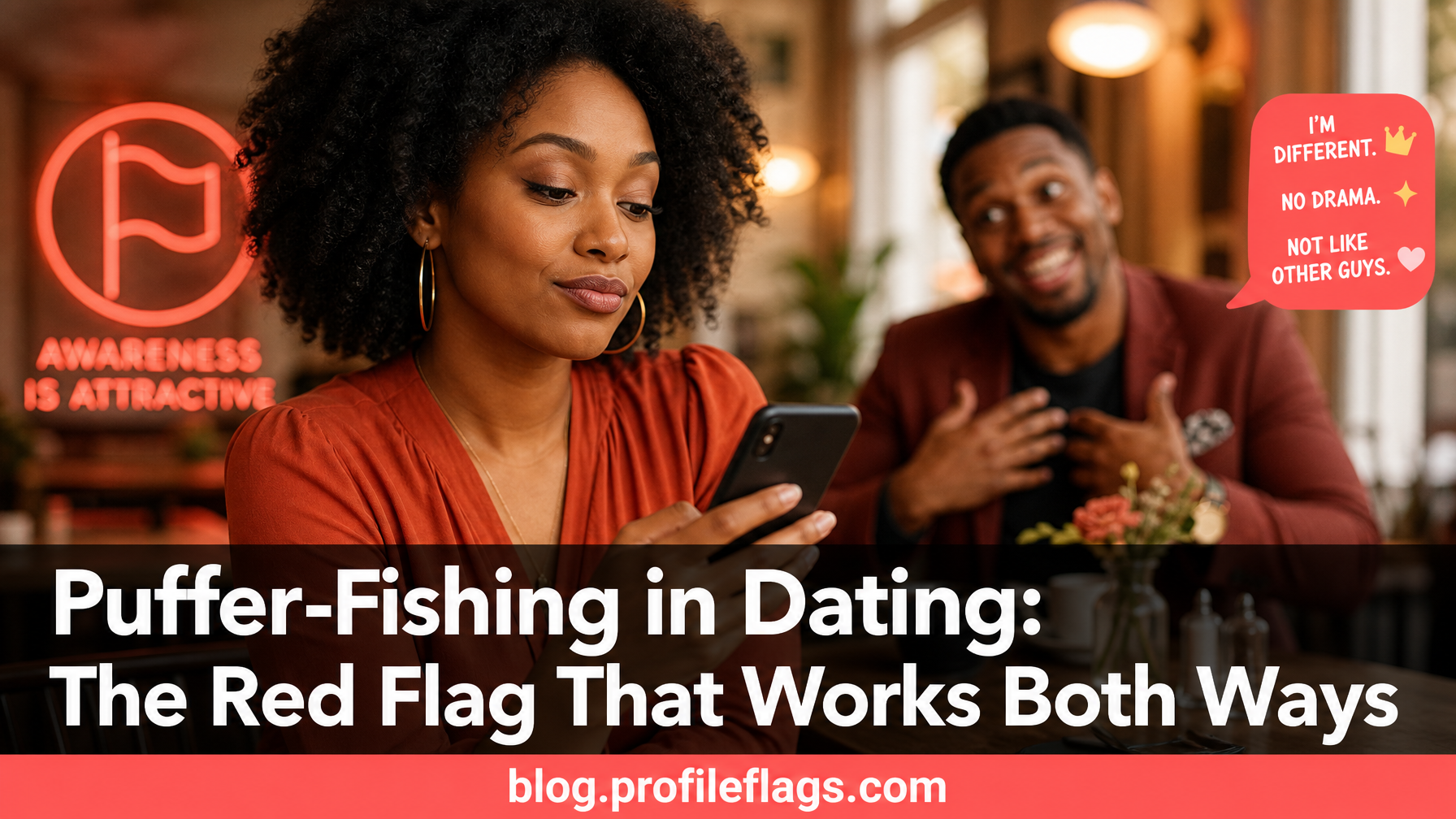
TLDR: Puffer-fishing in dating describes two distinct behaviors that both set you up for disappointment. The first is someone inflating their profile to seem more impressive than they are. The second is someone who acts interested, draws you in, and then gets guarded or cold right when things start feeling real. Both are red flags. This post breaks down how to spot each one and what to do about it.
Table of Contents
- So What Is Puffer-Fishing, Exactly?
- The Profile Puffer-Fisher: When the Person You Meet Isn't the Profile You Swiped On
- Signs You're Dealing with a Puffer-Fishing Profile
- The Relationship Puffer-Fisher: When They Pull Back Right as Things Get Real
- Signs You're Dealing with a Relationship Puffer-Fisher
- Why People Puffer-Fish
- What You Should Actually Do
- The Verdict
So What Is Puffer-Fishing in Dating, Exactly?
The term borrows from how the puffer fish actually behaves in the wild. Normally docile and unremarkable, it puffs itself up to two or three times its size and extends sharp spines the moment it senses a threat. The illusion of size is the whole defense.
In dating, puffer-fishing in dating plays out in two distinct ways:
Version one is about profile inflation. Someone presents a version of themselves online that's noticeably bigger, better, or more polished than reality. Older photos, a job title that's technically accurate but misleadingly impressive, height claims that don't survive an in-person meeting. They've puffed up for the app — and the first date is when the air starts to escape.
Version two is behavioral, and it happens mid-relationship. According to Psychology Today, this is when someone becomes "less and less available, more and more critical, and more and more confusing in general" right as a relationship gets closer. They puff up defensively. The playful, interested person you were getting to know turns guarded and distant the moment things get real.
Both versions feel like a bait-and-switch. And both are worth knowing how to spot.
The Profile Puffer-Fisher: When the Person You Meet Isn't the Profile You Swiped On
Profile inflation is more common than most people want to admit. A 2023 study published in BMC Psychology noted that research on dating platforms has consistently found profiles to be inaccurate on height, weight, and age, with underreporting of weight and overreporting of height being the most frequent patterns. Photos are also frequently older or edited in ways that don't survive face-to-face contact.
Most profile puffer-fishing isn't outright catfishing. It's subtler. The person is recognizably themselves — just the Saturday version, not the Tuesday one. The problem is that they're marketing a life they don't actually live, which means the relationship is starting on a foundation of managed impressions rather than reality.
And you can usually pick up on it before the first date, if you know what you're looking for.
Signs You're Dealing with a Puffer-Fishing Profile
- All photos are from the same angle or era. No variation in setting, lighting, or apparent age across multiple photos is a flag. People who are comfortable in their skin post recent, varied images.
- The bio is vague but aspirational. "Entrepreneur" with no specifics. "World traveler" with no travel photos. "Dog dad" but no dog in sight. Puffer-fishers often imply a lifestyle rather than show it.
- The profile is heavy on group shots where it's unclear who they are. This is sometimes intentional — if every solo photo is one specific one and the rest are group shots, they may be using the ambiguity.
- They deflect when you ask specific questions. "So where are you working these days?" gets answered with something breezy and noncommittal. Puffer-fishers tend to pivot away from anything that anchors them to the reality behind the profile.
- They rush to meet in person before you can ask many questions. Sometimes this is genuine enthusiasm. Sometimes it's because the profile version of them won't survive too many follow-up texts.
If you're already past the swiping stage and something feels slightly off, tools like ProfileFlags can help you decode what a profile is actually telling you before you invest any more time. It scans for the signals that aren't immediately obvious.
The Relationship Puffer-Fisher: When They Pull Back Right as Things Get Real
This version is harder to catch early because nothing about the profile tips you off. They seemed genuine. The early conversations were warm. You had a few great dates. And then, somewhere around the point where things started to feel like something, they changed.
Suddenly they're less available. Arguments start over small things. They go quiet for stretches with vague explanations. The person who seemed so interested in you is now distant, and you can't quite figure out what shifted.
That's the relationship puffer-fisher. And according to psychologist Bruce Y. Lee writing in Psychology Today, this behavior often stems from one of two things: either they never wanted something serious to begin with, or they do want commitment but are so afraid of getting hurt that intimacy itself triggers a defensive response.
The second version is tied to avoidant attachment, a pattern that often develops when someone grew up with caregivers who were emotionally distant or dismissive. They learned early that closeness leads to pain, so they unconsciously self-sabotage when a relationship gets too real.
Neither version is your problem to fix. But knowing which one you're dealing with changes what your options are.
Signs You're Dealing with a Relationship Puffer-Fisher
- Availability drops sharply right after a milestone. A really good date, a vulnerable conversation, meeting their friends — anything that made things feel more real triggers a noticeable pullback.
- Conflict increases over trivial things. This is one of the more subtle signs. When someone is puffer-fishing emotionally, they often manufacture low-stakes friction as a way to create distance without explicitly saying they're pulling away.
- They go hot and cold without explanation. This overlaps with intermittent reinforcement — the unpredictable pattern that keeps you hooked because you never know which version of them you're getting.
- They avoid future planning. Any mention of next month or next year gets brushed aside or answered in non-committal terms. Puffer-fishers resist anything that implies the relationship has a trajectory.
- They're great at the beginning, then slow to respond after progress. The early investment was real, but it was also the easy part. The closer you get, the more they retreat.
- They frame commitment as pressure. If bringing up where you're headed gets labeled as "rushing" or "too intense," pay attention to whether that reaction is proportionate to what you actually said.
- They apologize but don't change. Some puffer-fishers are self-aware enough to acknowledge the behavior, apologize warmly, and then repeat the cycle. This is worth distinguishing from actual growth.
If you recognize this pattern and feel stuck trying to decode what's happening, the free 5 Red Flags Most People Miss PDF covers the subtler behavioral signals that are easy to rationalize away when you're in the middle of them.
Why People Puffer-Fish
For the profile version, the motivation is almost always fear of rejection before connection even starts. If their real stats — height, job, the fact that they still rent in a shared apartment at 37 — feel like disqualifiers, they inflate to get through the door. The logic is that the real person can win someone over once they're in the room. The profile is just a marketing problem to solve.
The problem is that it starts a relationship on dishonesty, and the person you attracted made decisions based on information that wasn't accurate. That's a bad foundation regardless of how likable the real version turns out to be.
For the relationship version, the motivation is usually self-protection. Closeness is a threat. Not because you're the problem, but because closeness is always a threat to someone who's been hurt enough times to build a wall around it. The puffing is a defense mechanism, and it happens automatically, often before the person is even aware they're doing it.
That doesn't make it acceptable to stay in. It just explains why it happens.
What You Should Actually Do
For profile puffer-fishing, the answer is simple: calibrate your expectations before you meet. Look for inconsistency in photos, vagueness in the bio, and deflection in early conversation. Trust what the profile is actually saying, not just what it's advertising. If you're on Hinge or Bumble and something feels slightly off, check out common Hinge red flags and Bumble profile red flags to sharpen what you're looking for before you agree to meet.
For relationship puffer-fishing, Lee's advice in Psychology Today is worth taking seriously: ask directly whether the person wants a committed relationship. If they say no, believe them the first time. If they say yes but their behavior says otherwise, name the gap clearly and without blame. If nothing changes after that conversation, you have the information you need.
You cannot love someone out of avoidance. And you shouldn't have to.
If you want to get ahead of both versions before investing more time, ProfileFlags gives you an objective read on what someone's profile is actually communicating. Sometimes a second set of eyes, even an AI one, catches things that are obvious in retrospect and invisible in the moment.
The Verdict
Puffer-fishing is worth knowing about because it shows up in two stages of dating where you're most likely to ignore the signs. Early on, when you're optimistic about a profile. And later, when you're already emotionally invested in someone who suddenly seems less available than they used to be.
The puffer fish defense works in the ocean because it's a survival mechanism. In dating, it's just a pattern that costs you time.
Spot it early. Name it when you see it. And use the profile-check stage to filter out as much of it as you can before you sit down across from someone who's already half a step out the door.
Ready to decode what a profile is actually telling you? Run it through ProfileFlags before you match. One-time payment, unlimited scans.