She Documented Every Red Flag. Then She Mailed Them to His New Girlfriend.
In 2024, Denise Carter spent three months building a 32-page laminated binder of her ex's red flags — then mailed it to his new girlfriend. She got arrested. But the real story is the 32 pages.

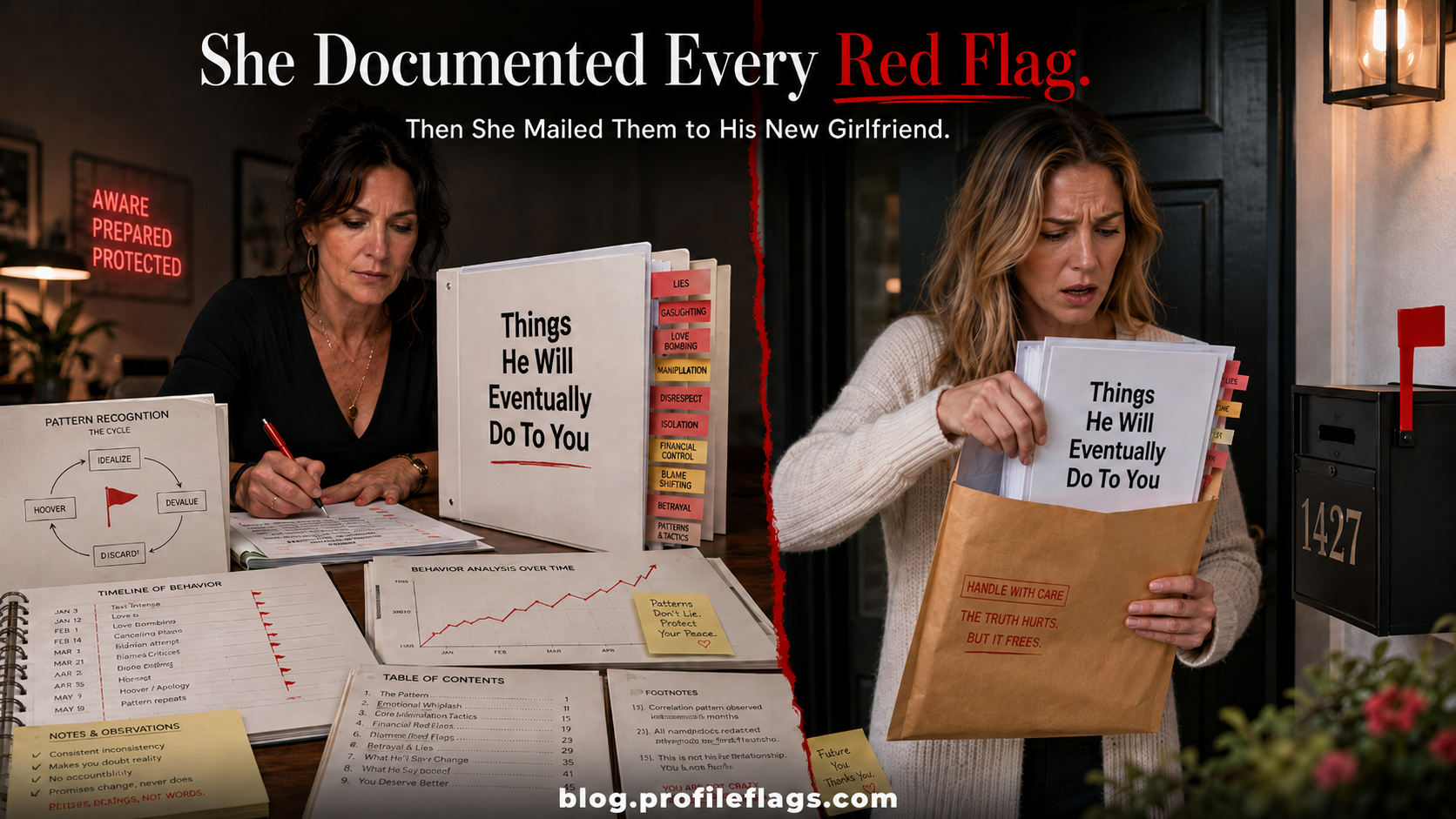
*This story has been widely reported across social media since 2024. Names and details are based on circulating reports and have not been independently verified by Overstand Dating. We present it as reported.
Three months. Laminated pages. A table of contents. Charts, timelines, and footnotes.
When Denise Carter, 41, mailed her ex-boyfriend's new girlfriend a 32-page binder titled "Things He Will Eventually Do To You," the internet could not decide whether she was a hero or unhinged. She was arrested on harassment charges. The debate raged. Podcasts covered it. Comment sections split clean down the middle.
But here's the part nobody stopped to sit with long enough: she had 32 pages of material.
Not 32 feelings. Not 32 suspicions. Thirty-two documented, organized, laminated pages of patterns she lived through firsthand. That binder didn't come from nowhere. It came from a relationship that generated enough red flags to fill a binder — and a woman who, instead of burying them, wrote them down.
What Was In the Binder
According to reports, the binder wasn't a chaotic emotional rant. It was organized. Methodical. She described the contents as "important behavioral trends that should not be ignored." There were reportedly charts. A timeline. Documented incidents with dates and context.
She didn't write it overnight. She spent three months building it after the relationship ended — which means she spent three months processing what she'd been through and trying to make sense of the pattern. The binder was her attempt to name what she'd lived through. And then, in a move that crossed a legal line, she decided the next woman deserved to know.
You can debate the method. But you cannot debate that she had receipts.
What 32 Pages Actually Means
Thirty-two pages isn't an overreaction. Thirty-two pages is what happens when someone ignores enough flags across enough time that the body count of incidents fills a document.
A one-time bad moment doesn't fill 32 pages. One argument doesn't fill 32 pages. A rough patch doesn't fill 32 pages.
Thirty-two pages is a pattern. It's a man who lied in a specific way, repeatedly. Who pulled away in a specific way, repeatedly. Who reacted to accountability in a specific way, every single time. It's behavior that was consistent enough to document, predictable enough to chart, and recognizable enough that she knew — with confidence — that the new girlfriend was going to see the same thing.
That's what a red flag actually is. Not a one-off. A pattern. Something that shows up often enough, and consistently enough, that you start to see the shape of it. Something that, if you were documenting honestly, would keep appearing on the same pages, in the same handwriting, for the same reasons.
The Red Flags Behind the Binder
We don't have the full contents of what Denise wrote. But we know enough from the framing — a survival guide, behavioral trends, a document she felt compelled to laminate and mail — to read between the lines.
The flags she was likely documenting are ones that show up in every relationship where a woman eventually feels the need to warn the next person.
He rewrote history. A man whose behavior generates 32 pages of documentation is almost certainly a man who, in the moment, denied what was happening. "I never said that." "You're remembering it wrong." "You're too sensitive." The binder is what happens when a woman decides to stop relying on her memory and starts writing things down instead.
His behavior was predictable in a specific direction. She titled it "things he will eventually do to you" — not "things he did to me." That word, eventually, is the tell. She wasn't just cataloguing her own experience. She was describing a pattern she understood well enough to predict. He doesn't just do these things once. He does them in sequence. He does them in every relationship. She knew the playbook because she'd watched him run it.
He moved on fast. The fact that there was already a new girlfriend — one Denise felt urgently needed to be warned — suggests the overlap was either quick or suspicious. Men who cycle through relationships without processing what went wrong are men who bring the same unresolved patterns into every new situation. The new girlfriend wasn't starting fresh. She was starting chapter one of a book Denise had already finished.
Nothing was ever his fault. Thirty-two pages of documented behavior from one relationship implies a man who never looked inward. Who never changed course. Who never adjusted when confronted. The kind of man who generates 32 pages of patterns is the kind of man who, when shown a mirror, turns it around.
He was charming enough to keep you second-guessing. She stayed long enough to have 32 pages of material. That means he was also good at the reset — warm when he needed to be, present when it suited him, convincing enough in his best moments that she kept explaining away the worst ones. That's not weakness on her part. That's a specific and effective manipulation pattern that shows up in flags we've covered here before: love bombing, placeholder dynamics, and the Pearl Flag — the person who's stunning on the surface and built entirely around something they've never dealt with underneath.
He was already with someone new. Quick replacements are a flag in themselves. A man who moves from one relationship to the next without time to reflect carries the same unexamined patterns into every new situation. The new girlfriend wasn't getting a fresh start. She was getting act two of the same show.
The Part That Got Her Arrested
Let's be direct about this: mailing unsolicited material to someone you don't know, about their new partner, crosses into harassment. The arrest was real. The legal consequences were real. And no matter how accurate the binder was, the delivery method was a red flag of its own.
There's a difference between processing what you've been through and making someone else responsible for acting on it. The new girlfriend didn't ask for the binder. She didn't request the warning. And receiving a 32-page laminated document from a stranger about the man you're dating is, objectively, a terrifying thing to find in your mailbox — regardless of what's inside it.
Denise had every right to document what happened to her. She had every right to talk about it, process it, share it with people who asked. What she didn't have the right to do was insert herself into someone else's relationship uninvited — even with good intentions.
The flags she saw in him were real. The way she acted on them created a flag of her own: the inability to disengage. The need to control what happened next. Three months of obsessive documentation that, instead of being used for her own healing, became something aimed at a stranger. His behavior broke something in her she hadn't finished putting back together yet. That's understandable. It's also worth naming.
What This Story Is Actually About
The internet turned this into a comedy bit. A viral moment. A "she did what?" story for the group chat.
But underneath it is a woman who was genuinely hurt by someone whose behavior was documented, recurring, and predictable — and who had no good outlet for it. No framework for naming what she'd lived through. No community that validated what she'd seen. No tool that could have helped her identify the patterns earlier, before she'd accumulated 32 pages of material.
She saw every flag. She documented them with more rigor than most people apply to their own dating experiences. She just saw them too late — after years inside the relationship, instead of weeks into it.
That's the part worth talking about. Not the arrest. The 32 pages.
Because most women who've dated a man like this don't write it down. They carry it. They explain it away in real time. They question their own read of situations that are, in fact, exactly what they look like. And by the time the relationship ends, they're left with a feeling they can't fully articulate — a sense that something was off, that the pattern was real, that they should have trusted themselves sooner.
Denise trusted herself. She just started documenting two years too late.
Trust Yourself Before You Need a Binder
The flags in a relationship like this don't appear at month 18. They appear in the first few conversations, the first few weeks, the first few interactions where you notice something and then talk yourself out of noticing it.
The ProfileFlags scanner is built for that exact moment — before you're invested, before you've explained away the pattern three times already. It reads behavioral signals in a dating profile and tells you what they indicate before the first date. Before the first red flag becomes the first chapter in a very long document.
And if you want to know what patterns to look for — the specific behaviors that show up in men who generate 32-page binders worth of incidents — 100 Real-Life Red Flags covers exactly that. Risk-scored from low to high, with response scripts for when you spot one. $12.99 on Gumroad.
You deserve to see the pattern before it fills a binder.
Have a real red flag story? Send it to support@overstanddating.com. We share real stories because real stories are what actually help people recognize what they're in.