The Romance Scam Doesn't End When the Relationship Ends
The scammer is gone. The relationship is over. But the debt is still real, the credit is still wrecked, and the shame doesn't just disappear. Here's what romance scam aftermath actually looks like — and how long it follows you.

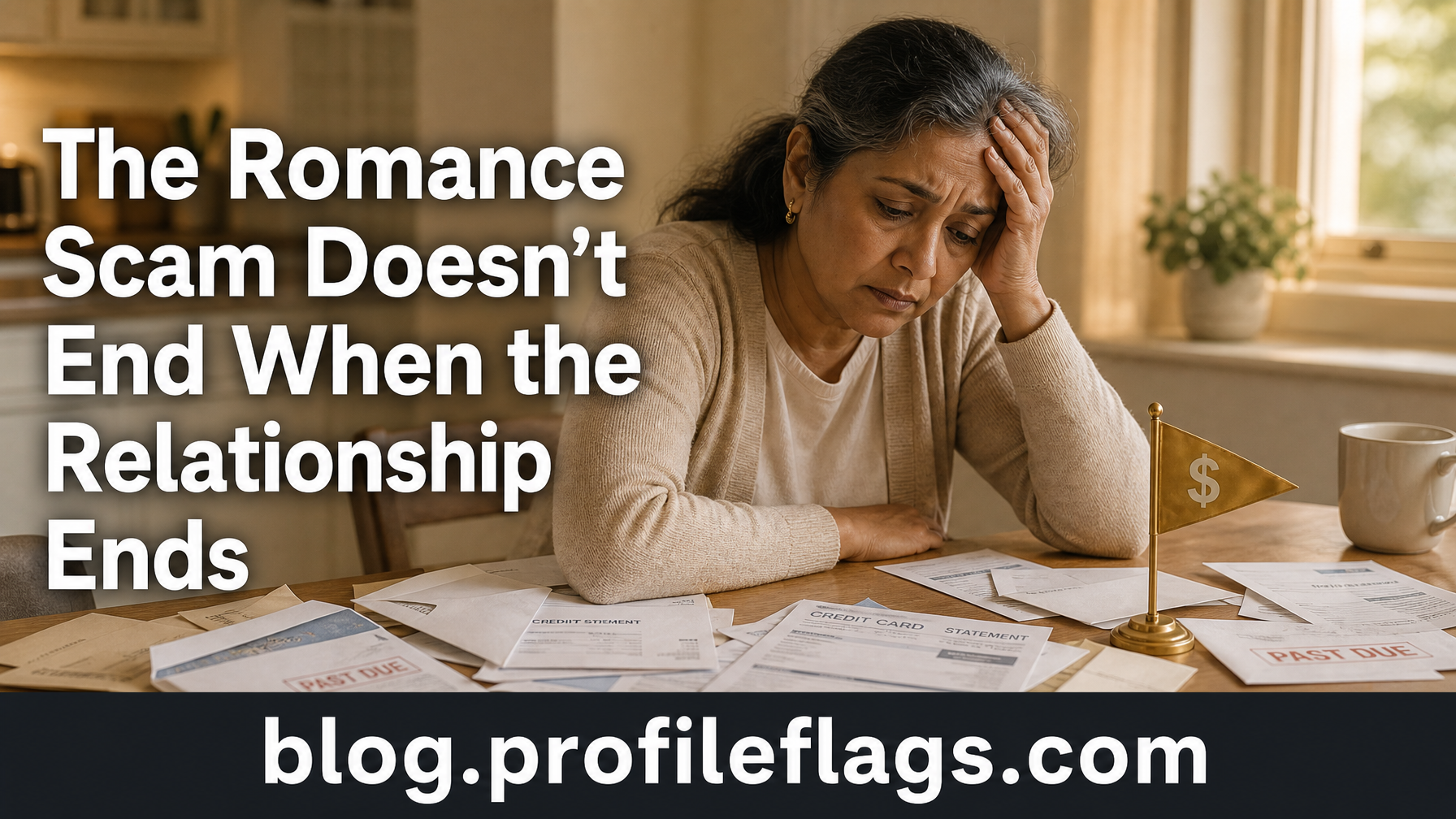
The scammer is gone. The last message was weeks ago, or months ago. You know now what happened. The relationship — the thing you believed in, the person you were building something with — was a performance. There was no him. There was only the money he took and the debt he left.
And now everyone acts like the hard part is over.
It isn't. For most romance scam victims, the relationship ending is the beginning of a different kind of damage — one that doesn't make the news, doesn't get documented in the police report, and doesn't come with a timeline for recovery. The financial wreckage follows you into rental applications, credit checks, loan denials. The psychological wreckage follows you into every new conversation with a stranger, every moment of trusting someone new.
Cecilie Fjellhøy, one of the women featured in Netflix's The Tinder Swindler, lost approximately $250,000 to Simon Leviev and spent three weeks in a psychiatric hospital in the aftermath. She was bankrupt for years. In a September 2025 interview with Cosmopolitan UK, she described the long tail of it plainly: "There are so many long-term consequences to romance fraud that people aren't always immediately aware of. You have the mental health aspect, the lack of support, and the heavy burden of self-blame. You lose your confidence, as well as your trust in yourself and your instincts. You ask: 'Am I worthy of love again?' You're battling all these things on top of financial destruction."
That sentence — "on top of financial destruction" — is doing a lot of work. Because the financial destruction doesn't resolve when the scam is exposed. It sits on your credit report. It shows up on your bank statements. It follows you into the next apartment you try to rent, the next car loan you apply for, the next time someone pulls your credit and the number staring back at them is the story of something that was done to you.
The Debt Is Real Even Though the Relationship Wasn't
One of the most specifically cruel features of romance scam debt is how it works legally. In most cases, the victim is the one who took out the loans, opened the credit cards, signed the lease, or initiated the wire transfers. They did it under false pretenses — manipulated, deceived, often love bombed into emotional dependency before any money was requested. But the bank doesn't care about that. The creditor doesn't care. The debt is in your name, and it belongs to you.
AARP documented one case in detail in July 2025: a widower who lost nearly $500,000 to a romance scammer over several years. By the time his family discovered what had happened, he had taken out a reverse mortgage on a fully paid-off home, maxed out multiple credit cards, defaulted on several bank loans, and was receiving daily calls from debt collectors. His utilities were close to being cut off. The home he and his late wife had designed together for their retirement had essentially no equity left.
Recovering from it required his daughter to take a year off her own life — hiring a lawyer, filing for bankruptcy, moving her father to another state, fighting to have his name removed from leases the scammer had put him on after the bankruptcy filing. Clinical geropsychologist Regina Koepp, founder of the Center for Mental Health and Aging, described the aftermath: "It's not just about cutting off a scam. It's about grieving a relationship that felt real, while simultaneously processing betrayal, shame and loss of trust in oneself. It's incredibly destabilizing."
Bankruptcy, when it's the only path out, stays on a credit report for seven to ten years. During that window, renting an apartment becomes a negotiation. Getting a car loan means higher interest rates or flat-out denial. Opening a new credit card is harder. Every financial step forward carries the weight of a decision made under manipulation.
The FTC reported in 2025 that the median individual loss from romance scams now exceeds $10,000. That's the median — meaning half of all victims lose more. For many, it's not savings that were lost but debt that was created. There's a significant difference between losing what you had and owing what you never actually spent on yourself.
The Credit Damage That Outlasts the Scam
Romance scammers are skilled at getting victims to take financial actions that appear, on paper, to be voluntary. They don't steal from your account. They convince you to send money to theirs. They don't forge your signature. They charm you into signing.
This matters because the legal framework for fraud recovery was not built with romance scams in mind. Traditional fraud protections cover unauthorized transactions — someone using your card without your knowledge. They don't automatically cover authorized transactions made under emotional manipulation, even when that manipulation was deliberate, sustained, and sophisticated. In many cases, victims are left holding debt that credit agencies have no mechanism to flag as fraud-related.
The practical result: a woman who took out a $30,000 personal loan to send to a man she believed was in danger has a $30,000 personal loan default on her credit report. The story behind it is irrelevant to the algorithm that calculates her score. She can explain it to a human loan officer. She cannot explain it to a credit pull.
Some banks and credit unions have begun building more nuanced processes for romance scam victims — the UK's mandatory reimbursement regime for authorized push payment fraud is the most significant structural change to date, requiring banks to reimburse victims in certain cases even when the transaction was technically authorized. But in most places, for most victims, recovery is a personal project with no institutional support.
The Shame That Makes Everything Harder
A 2025 peer-reviewed study published in MDPI found that romance scam victims experience severe emotional distress including depression, anxiety, shame, embarrassment, and PTSD. A January 2026 scoping review published in Sage Journals documented victim outcomes including shame, mistrust, depression, insomnia, weight changes — and suicidal ideation.
Fifty-five percent of romance scam victims never report the crime. The primary reason is shame.
That shame is not irrational. It emerges from a culture that treats fraud victims as people who should have known better — who were naive, lonely, desperate, foolish. The subtext in how these stories are covered, how they're discussed at family dinners, how they play out in comment sections, is that smart people don't get scammed. That someone who fell for it must have had something wrong with them to begin with.
None of that is true, but it doesn't need to be true to do damage. The shame sits on top of the financial wreckage and the grief, and it prevents people from seeking help, from reporting to law enforcement, from telling their doctors what happened, from accessing the support that might actually move them forward. Fjellhøy described it directly: "the lack of support, and the heavy burden of self-blame."
The self-blame is specific and persistent. Victims replay the relationship looking for the moment they should have known — the red flag they missed, the story that didn't add up, the instinct they ignored. This is partly a natural human response to a traumatic loss. It's also partly manufactured by the scammer, who spent weeks or months building a relationship specifically designed to disable that kind of scrutiny. The grooming process in a romance scam — the love bombing, the emotional dependency, the manufactured urgency — is not accidental. It is the product.
You were not outsmarted. You were worked on.
The Trust That Doesn't Come Back Easily
Of all the aftermath, the damage to trust is the most invisible and the longest-lasting. And it operates on two levels simultaneously — trust in other people and trust in yourself.
The trust in other people is the more obvious one. After investing in a relationship that turned out to be entirely fabricated, the idea of investing again feels genuinely dangerous. Every new person who shows interest is a potential threat. Every warm message from a stranger is a potential script. The emotional openness required to connect with someone new is the exact same openness that was exploited. It doesn't feel safe to be open again.
The trust in yourself is subtler and often more damaging. You believed him. Your gut said he was real. Your judgment — the same judgment you use to navigate your entire life — told you this was genuine. And it was wrong. That realization doesn't stay contained to the scam. It bleeds into other areas. You second-guess your reads on people. You distrust your positive feelings about new connections. You pull back from certainty in all kinds of situations where confidence used to come naturally.
Regina Koepp described the combined effect of all of this as "incredibly destabilizing." That word is precise. It's not just pain. It's that the foundations that support ordinary daily functioning — your financial stability, your sense of your own judgment, your capacity to trust — have been specifically and deliberately undermined by another person for their own gain.
What the Recovery Actually Looks Like
Recovery from a romance scam is not a linear process, and it doesn't follow the timeline other people expect. The financial piece can take years, sometimes a decade, to fully resolve. The psychological piece has no fixed endpoint.
What helps, based on documented recovery accounts and mental health professional guidance:
Report it. To local law enforcement, to the FBI's Internet Crime Complaint Center (IC3) at ic3.gov, and to the FTC at ReportFraud.ftc.gov. Even if nothing comes of the individual report, documented cases build the picture that drives policy change and public awareness. Not reporting because of shame protects the scammer and leaves the next victim without warning.
Talk to your bank immediately. The sooner you report to your financial institution, the better the chances of stopping or reversing any transactions still in process. Some banks have fraud specialists with specific romance scam experience. Ask for them by name.
Get debt-specific help. A nonprofit credit counselor (look for NFCC-certified organizations) can help you map out what's recoverable, what requires bankruptcy consideration, and what a realistic path forward looks like. This is different from a for-profit debt settlement company — be careful to distinguish between the two.
Find people who understand what happened. AARP's Fraud Watch Network Helpline (877-908-3360) connects victims with trained volunteers. The AARP Fraud Victim Support Group runs free online sessions for victims and family members. These are spaces where the shame conversation doesn't apply — people in these groups understand exactly how these scams work and why intelligent people fall for them.
Give yourself time to grieve the relationship. It was real to you. The feelings were real. The hope was real. Grieving something that turned out to be a fabrication is not the same as being foolish for having felt it. As Koepp notes, it requires "grieving a relationship that felt real, while simultaneously processing betrayal" — and that is genuinely hard work that takes real time.
Protect yourself going forward without closing yourself off. Fjellhøy noted in September 2025 that she's still on dating apps, still looking for love — but with sharper eyes. The goal of recovery is not permanent guardedness. It's rebuilding the capacity to connect while carrying better information than you had before.
The ProfileFlags scanner exists for exactly that purpose — to give you a structured way to evaluate what someone's profile and early communication is actually showing you before you're emotionally invested. Patterns that precede scam behavior are visible in the language before the first money request ever comes. The more you know what you're looking at, the less you have to rely on gut instinct alone.
And PracticeBae lets you practice recognizing manipulation tactics in real conversations — the escalating emotional pressure, the urgency, the isolation — before the stakes are real savings and real credit scores.
The scam doesn't end when the relationship ends. But recovery does eventually come. Not because the damage didn't happen — because you built something on top of it.