Scorekeeping in Dating: 7 Signs He's Running a Tab, Not a Partnership
Scorekeeping in dating turns care into a ledger. Here are 7 signs he's keeping score in a relationship, what the research says, and how to stop paying the tab.

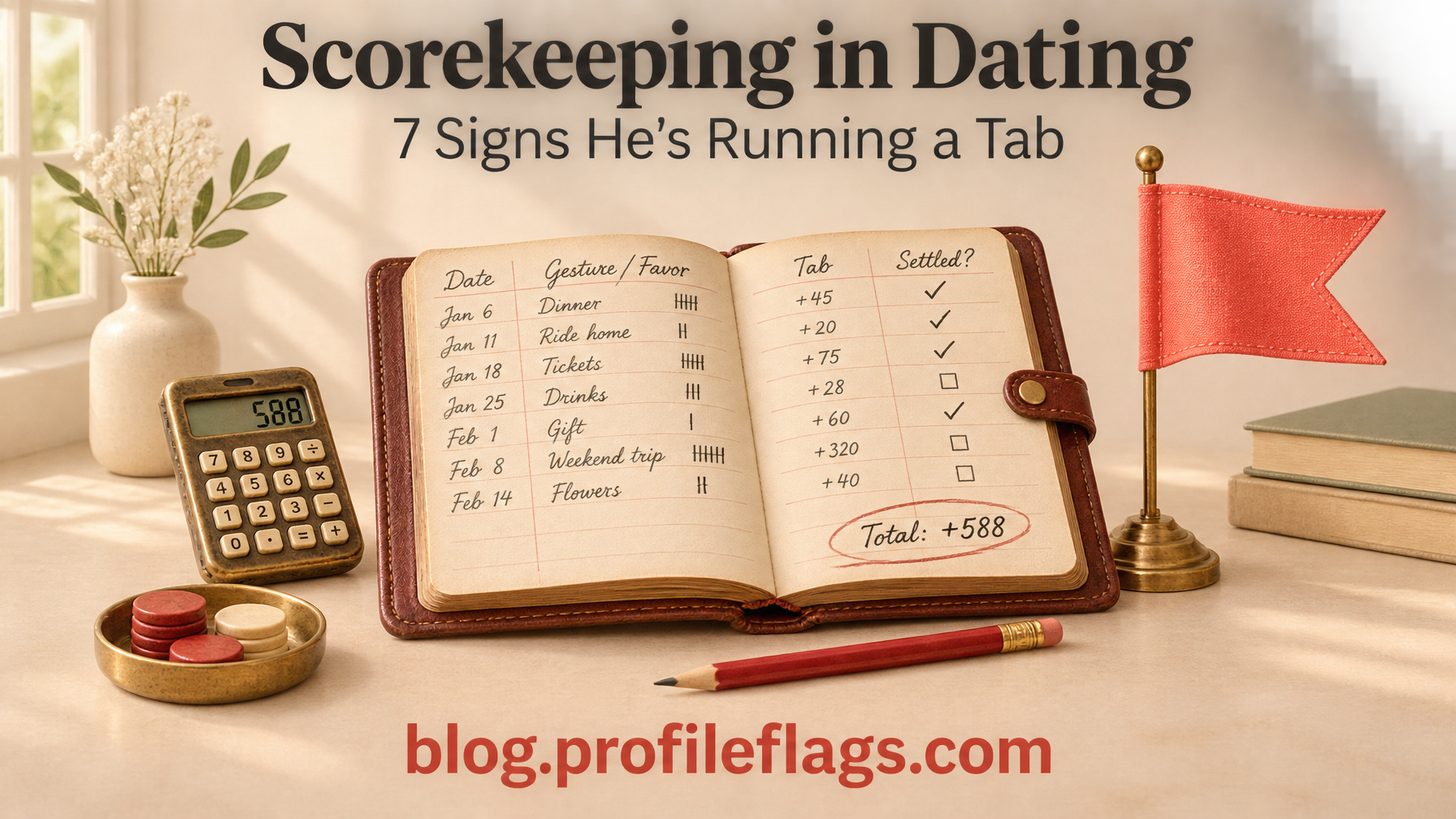
TLDR: Scorekeeping in dating is when he treats every text, dinner, ride, and favor like a line item you owe him back. Fairness is healthy. A running tab is not. A long German couples study found that when one partner leans harder into keeping score, satisfaction drops later. Scan the profile that still sells "easygoing" with ProfileFlags and Decode Profile Now before you keep paying interest on his ledger.
Table of Contents
- What Scorekeeping in Dating Actually Is
- 1. Every Favor Comes With an Invoice
- 2. He Remembers His Wins and Forgets Yours
- 3. Affection Gets Rationed Like Points
- 4. Arguments Turn Into Audits
- 5. You Start Prepaying to Avoid Debt
- 6. Fairness Only Runs One Direction
- 7. The Relationship Feels Like Work With a Boss
- Scorekeeping vs Healthy Boundaries
- The Verdict
He bought dinner. You heard about it for three weeks. You drove him to the airport. That never made the highlight reel. He calls it "fair." Your gut calls it a spreadsheet.
That is scorekeeping in dating. He is not building a partnership. He is running a tab.
This sits on the Red Flag. Wanting balance is normal. Using "who did more" as a weapon is how care turns into control.
What Scorekeeping in Dating Actually Is
Psychologists call the underlying mindset exchange orientation: the habit of tracking what you give and what you get, then treating the relationship like a payback system. Communal partners give because they care. Exchange-oriented partners give and wait for the receipt.
In August 2025, researchers Haeyoung Gideon Park and Emily A. Impett summarized their own long-term work for the Society for Personality and Social Psychology. With co-authors Matthew D. Johnson and Amie M. Gordon, they published in Personality and Social Psychology Bulletin (2025): "Pay Me Back": Testing the Implications of Long-Term Changes and Partner Similarity in Exchange Orientation Within Intimate Relationships. They followed more than 7,000 German couples across up to seven survey waves over 13 years using the pairfam panel.
What they found is blunt. Most people become less transactional as a relationship matures. When someone stays locked on payback, or becomes more score-focused than usual, relationship satisfaction tends to drop, including up to two years later. Feeling unhappy first did not clearly push people into scorekeeping. Scorekeeping lined up with later dissatisfaction. Matching each other on the ledger did not help. If either partner kept score hard, satisfaction suffered.
As Park put it in a PsyPost interview covering the same paper: keeping score is not just a reaction to struggle. It can foreshadow it. Their line is the one worth tattooing on a sticky note: love does not thrive on ledgers.
Psychology Today (Nov 10, 2025) walked the same findings for a general audience: when one partner's exchange orientation rises, satisfaction falls. Partners who cling longest to "who owes what" pay for it in exhaustion and lost spontaneity.
Dating versions show up earlier than marriage. He tracks who texted first. Who planned the date. Who paid. Who apologized. Who "deserves" a weekend. The currency is not always money. Sometimes it is attention, sex, patience, or your silence.
A July 25, 2025 Forbes Health / OnePoll survey found 78% of dating app users felt emotionally, mentally, or physically exhausted by the apps sometimes, often, or always. Scorekeeping thrives in that fatigue. When everyone already feels short on energy, a partner who invoices every kindness feels like another job.
If his bio still says "no drama" while every kindness comes with terms, run the profile through ProfileFlags and Decode Profile Now before you treat his ledger like love.
The verdict: Fairness is a conversation. A permanent tab is a trap.
1. Every Favor Comes With an Invoice
He drives you home. Next week he wants a ride, a favor, or a softer tone "because I did that for you." He is not asking. He is cashing a chip.
Park and Impett's SPSP write-up uses a clean example: Maya gives James a ride and expects repayment. When the favor is not returned on her timeline, resentment shows up. That is exchange orientation in street clothes.
Healthy partners notice imbalance and talk about it. Scorekeepers collect. The difference is the receipt. If the kindness only exists so he can spend it later, it was never kindness.
Grab the free PDF The 5 Red Flags Most People Miss if you keep mistaking invoices for investment.
The verdict: A gift with a due date is a loan.
2. He Remembers His Wins and Forgets Yours
His memory is selective. He can list every dinner he paid for. Your late-night airport run, your emotional labor after his fight with his boss, your three canceled plans so he could sleep: blank page.
In Psychology Today (June 8, 2026), the Love. Crash. Rebuild. team describes how exhaustion makes partners track failures more than effort. Both people can feel overworked and underseen at once. Resentment replaces appreciation. The fight stops being about the dishwasher and becomes about who feels invisible.
In early dating, this looks smaller and meaner. He weaponizes the one time he "showed up" and erases the ten times you did. You leave every check-in feeling behind on a test you never agreed to take.
The verdict: If the highlight reel only stars him, you are the unpaid crew.
3. Affection Gets Rationed Like Points
Warmth shows up after you "earn" it. Coldness shows up when you "owe" him. Sex, compliments, plans, and even replies become rewards for compliance.
John Gottman's Love Lab work, summarized by The Gottman Institute, found masters turned toward bids for connection 86% of the time and disasters 33%. A bid is a reach: a joke, a hand, a "look at this." Scorekeeping turns bids into points. You stop reaching because reaching costs. He stops reaching unless he is collecting.
That is how a soft early connection hardens into a marketplace. You feel less chosen and more graded.
If you need a low-stakes place to practice saying "I am not trading affection for peace," PracticeBae lets you rehearse with personalities who keep score on purpose.
The verdict: Love that only unlocks after payment is a vending machine.
4. Arguments Turn Into Audits
You bring up one issue. He opens the archive. March. Your tone. That text. The night you were late. Suddenly you are defending five old cases instead of the one on the table.
This overlaps with guilt tripping in dating and defensiveness in dating. Guilt tripping makes you the villain. Defensiveness makes him never wrong. Scorekeeping supplies the paperwork. He does not repair. He litigates.
Gottman's bids research is useful here too. Turning toward a bid is a deposit. Turning an argument into a forensic audit is a withdrawal with fees. Masters stay on the problem. Disasters stay on the scoreboard.
The verdict: If every hard talk needs a lawyer, you are not dating. You are on trial.
5. You Start Prepaying to Avoid Debt
You text first so he cannot claim you are distant. You plan the date so he cannot claim you never try. You soften your needs so he cannot call you "high maintenance." You are not connecting. You are managing your balance.
That is the quiet damage of scorekeeping in a relationship. The ledger moves into your body. You monitor his mood like a credit score. You over-function so the "you owe me" speech never starts.
Park and Impett warn that fairness still matters. Nobody should accept chronic one-sided giving. The red flag is the mental tally that never closes, plus the fear that asking for care will cost you later.
The verdict: If you are working off a debt that never zeros out, leave the bank.
6. Fairness Only Runs One Direction
He wants equal effort when it benefits him. When you need equal effort, he calls you needy, dramatic, or "keeping score." The double standard is the tell.
The Park, Johnson, Gordon, and Impett study found couples did not get a satisfaction boost from matching on exchange orientation. Two bookkeepers do not make a healthier couple. Lower scorekeeping overall did. In dating terms: two people obsessed with "even" still feel worse than two people who give without a stopwatch, as long as the giving is mutual over time, not one person carrying the whole month.
Watch what happens when you ask for the same standard he demands. If fairness is only his tool, it was never a value. It was leverage.
The verdict: Rules that only apply to you are not rules. They are a cage.
7. The Relationship Feels Like Work With a Boss
You leave dates tired. Not from fun tired. Performance-review tired. You brace for the "I did X, so you should Y" talk. You rehearse explanations. You dread asking for anything because the cost is higher than the ask.
Forbes Health's 78% app-fatigue finding sits next to this for a reason. Modern dating already feels like unpaid labor for a lot of people. Add a partner who treats connection like payroll and your nervous system clocks out.
Gottman's masters bid constantly in tiny ways. Disasters miss or reject those bids. Scorekeeping multiplies the misses. Every small reach becomes a negotiation. Spontaneity dies first. Softness dies second. You start missing a version of yourself that did not need a spreadsheet to feel safe.
When you are ready for a dating presence that is not built on app games and ledger energy, a custom page at MyDatePage.date is one way to stand outside the swipe economy. Create My Page if that is the season you are in. First, though, stop auditioning for a man who grades you.
The verdict: A partner is not a manager. If you need PTO from the relationship, something is wrong.
Scorekeeping vs Healthy Boundaries
Not every "this feels uneven" is scorekeeping. Naming a pattern is adult. "I planned the last four dates. Can you take the next two?" is a boundary. "I planned the last four dates, so you owe me sex, silence, and a better attitude" is a tab.
Healthy check-ins look like curiosity and repair. Scorekeeping looks like certainty and punishment. One opens the door. The other keeps a lock and a key log.
If contempt is already in the mix, read contempt in dating. Contempt plus a ledger is how partners stop seeing each other as teammates and start seeing each other as opponents.
The verdict: Ask for balance. Refuse a bill.
The Verdict
Scorekeeping in dating is keeping score in a relationship with romantic branding. The Park and Impett team, with Johnson and Gordon, gave the field a long, clear signal: exchange orientation is not a cute personality quirk. In thousands of couples over 13 years, heavier scorekeeping tracked with lower satisfaction later. Matching ledgers did not save anyone. Most people ease off the tab as love matures. The ones who do not feel the drag.
You do not need a German panel to recognize the daily version. He invoices kindness. He forgets your labor. He rations warmth. He audits fights. You overpay to stay out of debt. Fairness is one-way. The whole thing feels like a job.
Put the pencil down. Ask once, clearly, for mutual care without a receipt. Watch what he does. If he doubles the tab, believe the math.
Decode the profile that still markets low-maintenance ease on ProfileFlags. Practice the hard sentence on PracticeBae. Keep the free guide The 5 Red Flags Most People Miss on your phone for the next "I did so much for you" speech. And if you want a dating life that is not built on swipe ledgers, look at MyDatePage.date.
The verdict: Love keeps receipts for repair, not for revenge. If he is running a tab, close the account.