Podcast: Situationship Survival Guide: How Did We Get Here?
Eight months in and still don't know what to call it? Maya and Jasmine break down situationships, mixed signals, and when it's time to walk away.

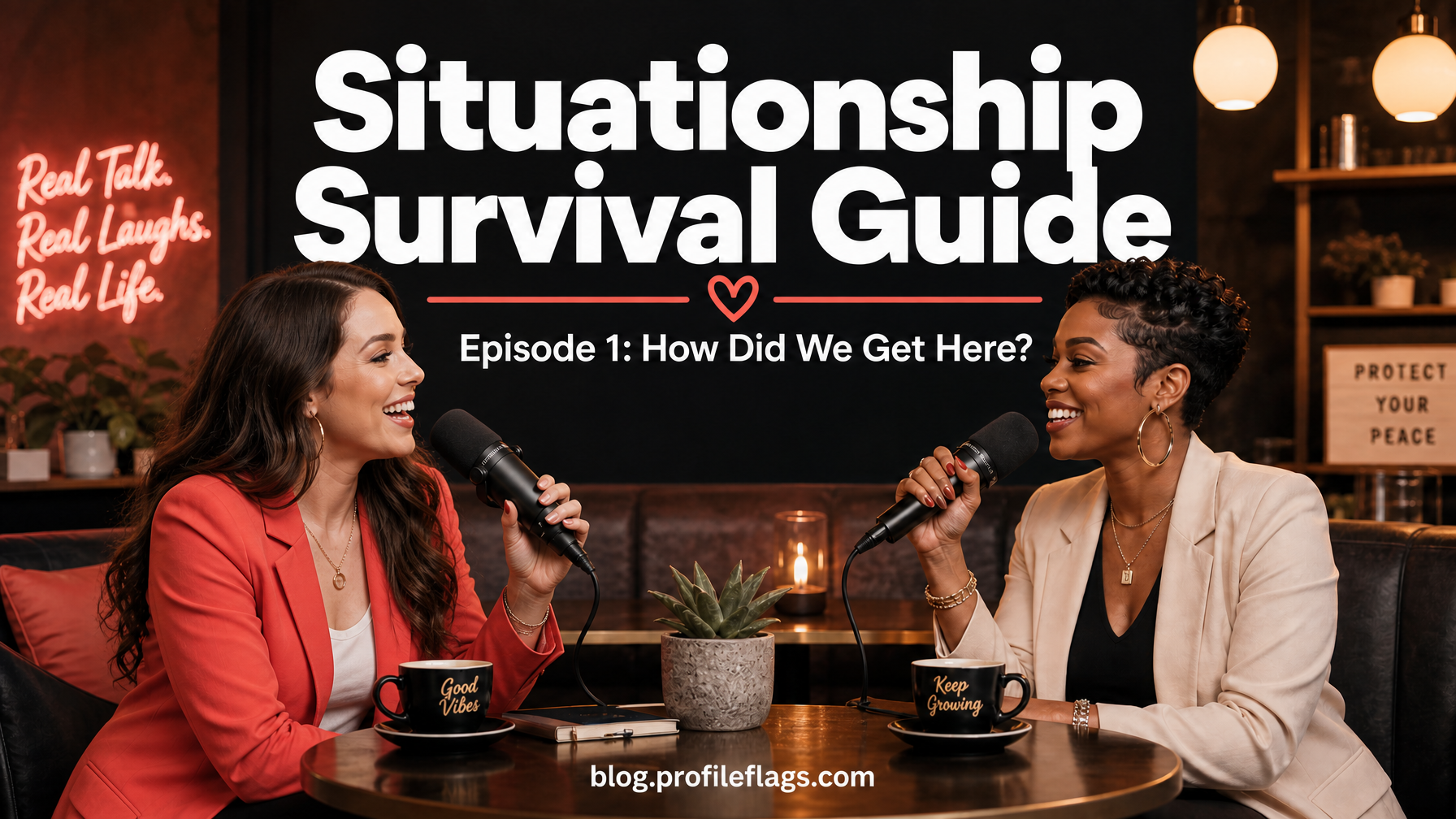
If you have been talking to somebody for eight months and still don't know what to call them — welcome. You may have accidentally adopted a situationship. And if you're afraid to ask where things are going because you don't want to "scare them away," this episode was made specifically for you.
In the debut episode of the Situationship Survival Guide podcast, hosts Maya and Jasmine sit down to talk through one of the most common — and most emotionally exhausting — patterns in modern dating. No jargon, no lectures. Just two women who have seen the playbook and are not letting it slide.
Here's everything they covered, broken down for anyone who wants the receipts.
What Is a Situationship, Exactly?
A situationship is a romantic arrangement that has all the feelings of a relationship — the texting, the seeing each other, the emotional investment — but none of the clarity. No label, no defined expectations, no real conversation about what this actually is.
It is not casual dating, because casual dating usually involves two people who have agreed to keep things casual. A situationship involves two people where at least one of them wants more but has quietly accepted less, usually because the alternative is losing the connection entirely.
As Maya put it: "It's a relationship that refuses to clock in. You do all the work of a girlfriend but you don't get the title, the security, or the right to be upset when they act single."
Signs You Are In One
- You have been "talking" for more than two months with no conversation about what this is
- You edit yourself — your tone, your opinions, how often you reach out — to avoid seeming too much
- You justify their behavior to your friends more than you enjoy the actual relationship
- The relationship only moves forward when they feel like it
- You have never been introduced to anyone important in their life
- Plans happen last minute or not at all
- You feel anxious more often than you feel secure
- You have been waiting for them to "be ready" for longer than feels reasonable
Jasmine added one that tends to get overlooked: "If you have rehearsed the conversation about where this is going but never had it because you're scared of the answer — that fear is telling you something. Healthy connections don't make you afraid to ask basic questions."
Why People Stay Too Long
People stay in situationships because the good moments are genuinely good. Situationships are not terrible all the time — if they were, leaving would be easy. The problem is intermittent reward. Good enough days followed by confusing days, followed by just enough warmth to keep you from walking out. It is the same mechanism that makes certain games addictive. You stay because you are always almost winning.
There is also the sunk cost. You have already invested time, emotion, and vulnerability. Walking away means accepting that none of that is going to pay off. That is a genuinely hard thing to absorb.
And then there is hope. The idea that they just need a little more time. Hope is useful in most areas of life. In a situationship, it is the thing keeping you stuck.
Situationship vs. a Real Relationship
The clearest way Jasmine framed it: a real relationship has mutual clarity. Both people know what this is. Both people have chosen it out loud, not by default.
In a real relationship, you do not have to wonder how someone feels about you. In a situationship, the ambiguity is often the point. Ambiguity gives one person all the benefits of closeness without the accountability that comes with commitment. If you have never had the conversation, they can never be held to anything they said in it.
Mixed Signals and Breadcrumbing
Breadcrumbing is when someone gives you just enough — a text, a compliment, a half-made plan — to keep you engaged without actually investing in you. It is attention used as currency. They spend the minimum amount to keep the connection alive without ever actually building anything.
Maya's take: "Mixed signals are not a personality. At some point, confusion is a choice. And when someone keeps you confused long enough, it stops being accidental."
Why People Ignore Obvious Red Flags
Because the red flags show up alongside things that feel real. Warmth, chemistry, good conversation, moments that make you think this is it. The flags do not cancel the good parts — they coexist with them.
Jasmine made a distinction worth keeping: "There is a difference between someone who has a complicated situation and someone who uses complexity as a permanent excuse. One has an end point. The other does not."
The Emotional Cost of Uncertainty
Sustained uncertainty — not knowing where you stand, not knowing how someone feels, not knowing if this is going anywhere — is genuinely taxing. It keeps you in a low-grade state of vigilance. You read into texts. You overanalyze silences. You manage your own behavior constantly to avoid triggering whatever it is that makes them pull back.
That energy has a cost. It takes up space that could go toward your work, your friendships, your own goals. People in situationships often describe feeling exhausted in a way they cannot fully explain, because the source of the exhaustion is invisible.
How Dating Apps Make This Worse
Dating apps created a context where perpetual almost-relationships are easy to maintain. You can have multiple people in various stages of vague. You never have to fully commit to one because there is always another option loading on the screen.
Maya's observation: "The apps gamified dating and then we acted surprised when people started treating other people like options. You built a slot machine and you're wondering why everyone's pulling the lever."
When It Is Time to Walk Away
When the cost of staying is consistently higher than what you are getting back. When you have had the conversation — clearly and directly — and nothing changed. When the relationship only moves forward when the other person decides they feel like it. When you are working harder to maintain the connection than they are.
Jasmine said something in this section that cut through: "You do not have to wait until it gets bad enough to leave. You are allowed to leave simply because it is not good enough. That is a complete reason."
Green Flags: What It Looks Like When Someone Is Actually Serious
They bring up the future without you having to prompt it. They introduce you to people in their life. Plans are made in advance, not just when they feel like it. They communicate when something is off. They are consistent — not perfect, but consistent.
Most importantly: they make it easy to ask questions. When someone is serious about you, the "what are we" conversation is not something to be afraid of — it is something they want to have too.
Final Advice from Maya and Jasmine
Maya: "Ask the question. Whatever answer you get — whether it's good or bad — is more useful than the story you've been telling yourself. The truth, even when it hurts, gives you something to work with. The uncertainty just keeps you stuck."
Jasmine: "You deserve someone who is certain about you. Not someone who needs constant convincing, constant patience, constant benefit of the doubt. Uncertainty is not a personality quirk. It is information."
The Situationship Survival Guide is a podcast about the real, messy, often hilarious experience of modern dating — hosted by Maya and Jasmine. New episodes drop regularly.
For more on the patterns discussed in this episode, read the situationship red flags guide and the behavioral red flags breakdown.
Trying to decode a real profile?
ProfileFlags uses AI to break down the red flags, green flags, and behavioral patterns worth knowing about — before you invest your time and energy.
Analyze a Profile Now