The Slow Fade in Dating: 8 Signs You're Being Faded Out (And What to Do)
The slow fade in dating is harder to recognize than ghosting — and more damaging. Here are 8 clear signs you're being faded out, and exactly what to do about it.

TLDR
The slow fade in dating is when someone has quietly decided to end things but doesn't tell you. Instead of saying it's over, they gradually withdraw — shorter texts, longer gaps, vague excuses — until you're left wondering what happened. It's not the same as ghosting. It's often worse. Here's how to recognize it and what to actually do.
Table of Contents
- What Is the Slow Fade in Dating?
- Slow Fade vs. Ghosting: What's the Actual Difference?
- 8 Signs You're Being Slow Faded
- Why People Do It
- What to Do When You're Being Faded Out
- The Verdict
What Is the Slow Fade in Dating?
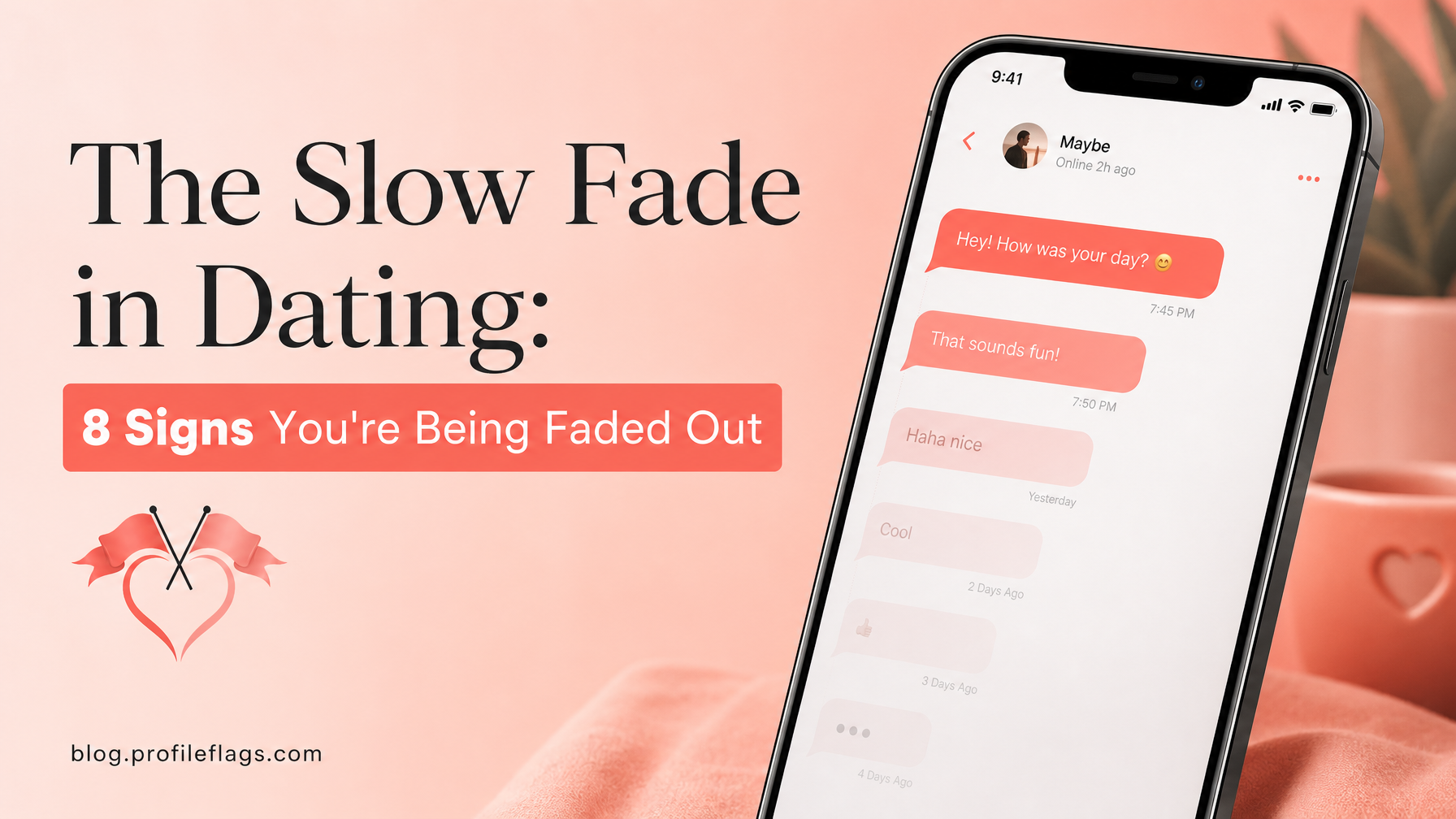
The slow fade in dating is exactly what it sounds like: someone exits the connection so gradually that you almost don't notice it's happening. One week the texts are flowing, the plans are being made. A few weeks later, you're checking your phone wondering why they take three days to reply to a simple "how are you."
According to Dr. Jennice Vilhauer, former Director of Emory University's Adult Outpatient Psychotherapy Program, the slow fade is essentially a charade. The person has already decided to end things. But instead of saying so, they keep up the pretense of the relationship while sending mixed signals and gradually withdrawing — hoping you'll eventually get the hint so they don't have to have the uncomfortable conversation. (Psychology Today)
What makes it rough is that it's designed to look accidental. And because there's no clear ending, your brain keeps looking for explanations. Are they busy? Did you say something wrong? Are they just a slow texter? That uncertainty is the actual damage.
Slow Fade vs. Ghosting: What's the Actual Difference?
Ghosting is abrupt. One day they're there, the next day they aren't. No explanation, no warning. It's brutal but at least it's clear.
The slow fade is drawn out. It can go on for weeks. The person feigns interest — or maybe they did have genuine interest at some point — but for whatever reason it's tapered off. They're still technically present. They just keep pulling the bandwidth down until the signal dies.
As sex and relationship therapist Cate McKenzie explains: most people aren't taught how to handle conflict. Avoidance is a default setting for a lot of people, and the slow fade is avoidance dressed up as consideration. (Feeld)
Dr. Vilhauer puts it more directly: ghosting is mean but clean. The slow fade is mean and messy. Research published in the journal Emotion by Bar-Anan, Wilson, and Gilbert (2009) found that uncertainty intensifies emotional reactions — making an already unpleasant situation significantly worse. The slow fade weaponizes that uncertainty, even if unintentionally.
If you've already read our post on ghosting in dating, you know how disorienting a sudden disappearance can be. The slow fade hits differently because there's nothing definitive to point at.
8 Signs You're Being Slow Faded in Dating
1. Response times have stretched out noticeably
They used to reply within an hour. Now it's same-day if you're lucky. This on its own doesn't mean much, but when it's paired with other shifts on this list, it matters.
2. Their texts got shorter
Not just shorter — flatter. Full paragraphs became one-liners. Enthusiasm became "haha yeah." The energy in their messages has dropped without explanation. This is one of the clearest early signals, and it often shows up well before people consciously register what's happening. Our post on dry texting covers this specific shift in detail.
3. Plans keep getting vague or cancelled
The last two times you tried to make plans, they said "maybe this weekend" and then the weekend came and went with no follow-up. Or they cancelled last minute with an excuse that felt thin. One cancelled plan is life. A pattern of vague non-plans is a signal.
4. They've stopped initiating
You're now the one who always texts first. Always. When you wait a few days to see if they'll reach out, they don't. The dynamic has shifted from mutual to one-sided, and you're doing all the maintaining.
5. Their social media activity went up while their communication went down
They posted three Instagram stories today but haven't replied to your text from yesterday. That specific combination is a tell. They're not offline and they're not swamped. They're just not prioritizing you.
6. The depth of conversation has flattened
You used to talk about actual things. Now every conversation is surface-level at best. They've stopped asking you questions, stopped sharing anything real, stopped following up on things you told them about. It feels like talking to a version of them that's just going through the motions.
7. Excuses have become a recurring pattern
Everyone goes through busy stretches. But when every week has a new reason why they can't talk properly or see you, and the reasons never quite add up to any kind of plan, that's not a busy schedule. That's managed distance.
8. Your gut has been flagging something for a while
You've been here before — that low-level background awareness that something is off, even though you can't point to a single moment where it went wrong. That instinct is worth paying attention to. It's usually tracking a pattern your conscious mind hasn't fully assembled yet.
If you're trying to make sense of a specific person's behavior, running their profile or messages through ProfileFlags can give you a clearer read. The AI flags behavioral patterns across communication style, response habits, and engagement signals — so you're working with signal, not just your own interpretation. One-time payment, unlimited scans. Decode Profile Now.
Why People Slow Fade Instead of Just Saying Something
The honest answer is conflict avoidance. Most people find it easier to let something fizzle out than to have a direct conversation about not wanting to continue. They tell themselves it's kinder, that a slow exit is gentler than a direct one.
It isn't. What actually happens is that the person on the receiving end spends weeks analyzing everything they said and did, wondering if they're imagining it, trying to figure out the right way to respond. The fader gets to walk away clean. The person being faded carries the confusion.
Cate McKenzie, sex and relationship therapist, notes that it doesn't always mean the person is a bad person. They may be dealing with their own stress, conflict aversion from childhood, or simply not know how to end something gracefully. That context is worth holding. It still doesn't make it okay.
Dr. Vilhauer frames it clearly: even if the fader thinks they're being kind, what they're actually doing is gaslighting. They're keeping the other person invested in something that's already over, without their knowledge or consent.
What to Do When You're Being Slow Faded
First: stop over-functioning. If you're already the one initiating every conversation, don't ramp that up. Doing more to try to keep someone engaged who is actively pulling back almost always makes it worse, not better.
Second: name what you're noticing. Not with a big confrontational message, but something direct and low-pressure. Something like: "Hey, I've noticed things have gotten quieter between us. Is everything okay with you?" This gives them an opening to be honest. If they brush it off with a vague "yeah just busy," that's your answer.
Third: decide if you want clarity or you want to match their energy. Some people prefer to send a clean message: "I'm getting the sense you've pulled back and I'm not sure where things stand. Totally fine if the vibe has changed, just prefer to know." Others prefer to simply stop initiating and let silence confirm what they already know.
Either approach is valid. What doesn't help is spending weeks in the analysis loop, hunting for the thing you said that caused this, or convincing yourself they'll come back around if you just wait long enough.
And while you're in that uncertain window, it's worth remembering what you're actually looking for. The 5 Red Flags Most People Miss is a free PDF that walks through the early behavioral signals serious people tend to overlook. Download it at overstanddating.gumroad.com/l/5redflags — free, no strings.
If you're in the talking stage and want to decode what's actually going on, our post on talking stage red flags and our breadcrumbing in dating post both cover the overlap between these behaviors in detail.
The Verdict
The slow fade in dating is a coward's exit dressed up as a gentle one. It's not kind. It's not considerate. It keeps you in the dark while the other person quietly moves on, and it leaves you doing the emotional work of a breakup without the clarity that a breakup would give you.
Recognize the signs early. Stop over-functioning. Ask a direct question once. And if the answer is silence or another excuse, take that as your answer.
You deserve someone who's actually present, not someone who's figured out how to leave in slow motion.
Want to know what someone's communication style is actually telling you? ProfileFlags analyzes dating profiles and messages for red and green flags, compatibility signals, and response prompts when you're not sure how to reply. One payment, unlimited scans. Decode Profile Now.