The Soft Ghost: When They Leave Without Leaving
You didn't get ghosted. You didn't get broken up with either. But something changed — and now you're stuck in the gray zone, waiting for someone who's already half gone.

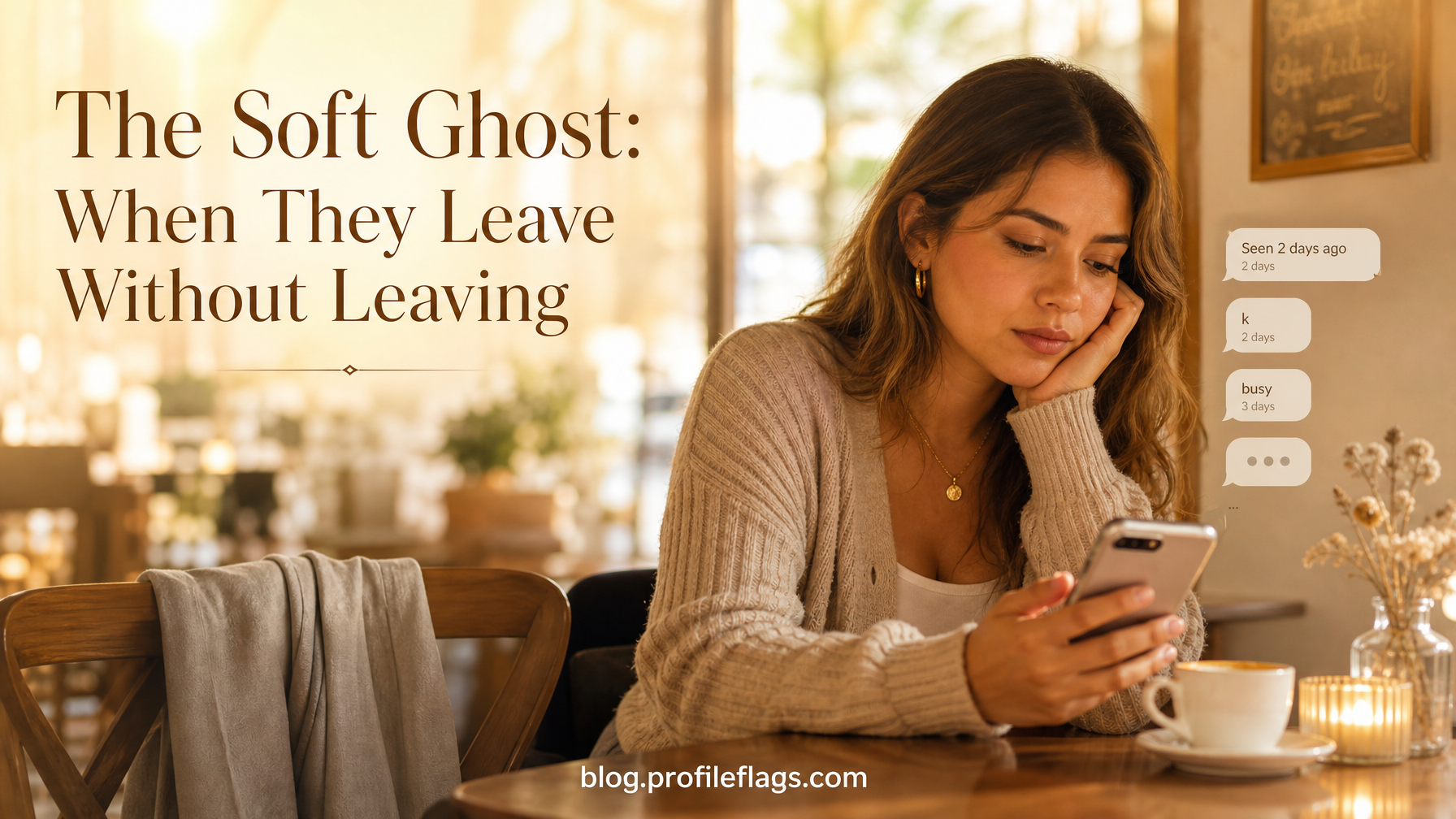
You're Not Imagining It
He didn't disappear. He's still there — technically. Still responding to your texts, still liking your posts, still saying "we should hang out soon" with no follow-through. But somewhere in the last few weeks, something shifted. His replies went from fast to slow. His texts went from paragraphs to one word. The plans he used to initiate? Now they only happen when you bring them up. The conversations that used to go until 2am now end with "lol yeah" and silence.
You keep scrolling back through the thread trying to figure out the exact moment it changed. Was it something you said? Something you didn't say? You start adjusting — texting less, pulling back, trying to seem unbothered — hoping the version of him who showed up at the beginning will come back if you just stop wanting too much.
He's not coming back. You're being soft ghosted.
What Is Soft Ghosting?
Soft ghosting is when someone doesn't vanish — they fade. They pull back slowly enough that there's never one clear moment you can point to and say "this is where it ended." The relationship technically continues, but it's running on fumes. Just enough contact to keep you hoping, not enough to give you anything real.
The key difference from regular ghosting: the soft ghost never actually leaves. They keep one foot in the door. They reply — just not quickly, not warmly, not with any real investment. They say yes to plans they never follow through on. They're present enough to deny that anything is wrong if you bring it up, but absent enough that you can feel the distance in every exchange.
The slow fade is the tactical version of the same thing. Instead of one person going quiet, the whole interaction just gradually depressurizes — longer gaps between texts, shorter conversations, fewer plans, until you're both just watching each other's stories with no real contact left.
Both patterns have the same outcome: you're left without closure, without a conversation, without even the dignity of a breakup.
Signs You're Being Soft Ghosted
The tricky thing about soft ghosting is that every individual sign has a reasonable explanation. Busy week. Stressed at work. Going through something. Taken all at once, though, the pattern is hard to dismiss:
- Replies that used to come in minutes now take days. And there's no explanation, just a shorter answer than you expected.
- You are always the one initiating. Stop texting first for a week and see how long you go without hearing from them.
- Conversations that used to have depth now hit a wall. "Yeah," "haha," "K," "busy rn" — repeated until you give up.
- Plans are floated and never confirmed. He says "we should do that" and never follows up. If you don't push, it disappears.
- He's still watching your stories. The soft ghost almost always keeps passive tabs — viewing, maybe even liking, but never actually reaching out.
- Physical or emotional warmth is gone. No inside jokes, no callbacks to things you've talked about, no real engagement.
- You feel anxious after every exchange. Because you're doing all the work of reading tea leaves just to figure out if someone still cares about you.
If you're running your profile through ProfileFlags before you even match, some of these avoidant patterns show up earlier than you'd think — in how someone writes their profile, what they emphasize, what they leave out.
Why the Soft Ghost Is Harder Than Actually Getting Ghosted
A real ghost is brutal, but it's clear. When someone goes completely silent, you know. It hurts, you grieve it, and eventually you move on. The soft ghost doesn't give you that clarity. The relationship technically still exists, which means you have no real permission to grieve it — or to call it what it is.
Instead, you stay in a state of suspension. You can't move on because nothing is officially over. You can't bring it up cleanly because every time you try, there's a plausible explanation ready. You start to wonder if you're the problem — if you're "too much," too needy, too sensitive to the perfectly normal fluctuations of someone who's just been busy lately.
That self-doubt is not accidental. It's a byproduct of the pattern. When someone is managing your expectations just enough to keep the door open without walking through it, your confusion is part of the design — even if they're not consciously manufacturing it.
From r/AvoidantBreakUps, a commenter described it this way: "An avoidant will usually come out strong, be all over you, promise you the moon, then slowly fade away until there's nothing left while assuring you that they love you, breadcrumb you and gaslight you into believing you're the problem — then disappear when you finally stand up for yourself."
Another user: "You could never read him. One moment he'd be in love, and the next you questioned whether he even liked you because of the emotional distance. It was exhausting... I went from secure to anxious."
That last line is important. The soft ghost doesn't just waste your time — it can actually change your attachment style. You enter the relationship with a healthy baseline and leave it anxious, second-guessing yourself in ways you weren't before.
Why They Do It
There's rarely a single reason, but a few patterns come up again and again:
Avoidant attachment. Closeness triggers anxiety for avoidantly attached people. When a relationship starts to feel real and demanding, the instinct is to create distance — not through a direct conversation, but through behavior. Pulling back, going quiet, becoming emotionally unavailable. According to Empathi, avoidant attachment frequently leads to ghosting or fading on people who genuinely care about them — not out of cruelty, but because emotional withdrawal is how they self-regulate.
Conflict avoidance. Saying "I'm not feeling this anymore" requires a hard conversation. A soft ghost requires nothing — just less of yourself, gradually, until the other person gets the message or gives up. It's cowardice wrapped in plausible deniability. As Breeze Wellbeing notes, avoiding conflict is one of the most common drivers of ghosting behavior across all its forms.
Keeping options open. The person who soft ghosts often hasn't fully decided anything. They're not sure they want to end things — they just don't want to invest in them either. Keeping you at low heat costs them nothing and preserves their option to come back around when it's convenient.
Plausible deniability. If you ever call it out, they can say: "I've just been busy," "I didn't realize I was being distant," "I'm not ghosting you, we literally just texted." The soft ghost can never quite be confronted because nothing definitive ever happened. That's the whole point.
This Is a Gray Flag
The soft ghost lives entirely in gray flag territory. Nothing has been confirmed, nothing has been ended, and the relationship exists in deliberate ambiguity. That's not a neutral state — the gray zone is its own kind of flag. When someone keeps you suspended between "we're okay" and "I'm not sure what this is," that uncertainty is the message.
A person who wants to be with you makes that clear through consistent action. Not grand gestures — just showing up. Replying. Initiating. Following through. When those basics go missing, you're not in a relationship anymore. You're in the waiting room of one.
What to Do About It
Name the pattern to yourself first. Stop explaining it away. A soft ghost is a choice — even when it's unconscious, it's still a pattern of behavior that tells you where you actually stand.
Stop over-functioning. The moment you start carrying the entire weight of a relationship — initiating every conversation, filling every silence, planning every interaction — you've already lost what the relationship was supposed to be. Put the weight down and see what happens. If the contact stops, you have your answer.
Watch behavior, not explanations. "I've just been busy" means nothing if busy looks the same as checked out. What someone does is the actual story. Everything else is commentary.
Decide what you need. You're allowed to ask directly: "Hey, I've noticed things have felt different lately — are you still into this?" You're not being needy. You're communicating like an adult. How they respond to that question tells you everything.
Practice having that conversation. If confrontation feels hard or you're not sure how to say it without it coming out wrong, PracticeBae lets you rehearse it first — including with an Avoidant Bae personality that mimics exactly the kind of deflection you're likely to get. You can practice holding your ground before the real moment comes.
You Deserve an Actual Answer
The soft ghost never gives you one. That's its defining feature. It keeps you in the gray until you either accept less than you deserve or exhaust yourself trying to get back to something that's already over.
You're not too much for asking where you stand. You're not too needy for noticing that someone stopped showing up. The relationship either has investment from both people — or it doesn't. If you're the only one carrying it, it isn't a relationship. It's a habit they haven't bothered to break.
Know the difference. Then act like it.
Before your next match, run their profile through ProfileFlags — avoidant patterns, mixed signals, and low-effort communication styles often show up before the first conversation even starts.