Soft Guy Scams: When He Uses Therapy Language Without Actually Changing
He says "I'm healing." He says "I have trauma." He says "I'm protecting my peace." But healing isn't an excuse to treat you badly — and therapy language without behavior change is its own kind of red flag.

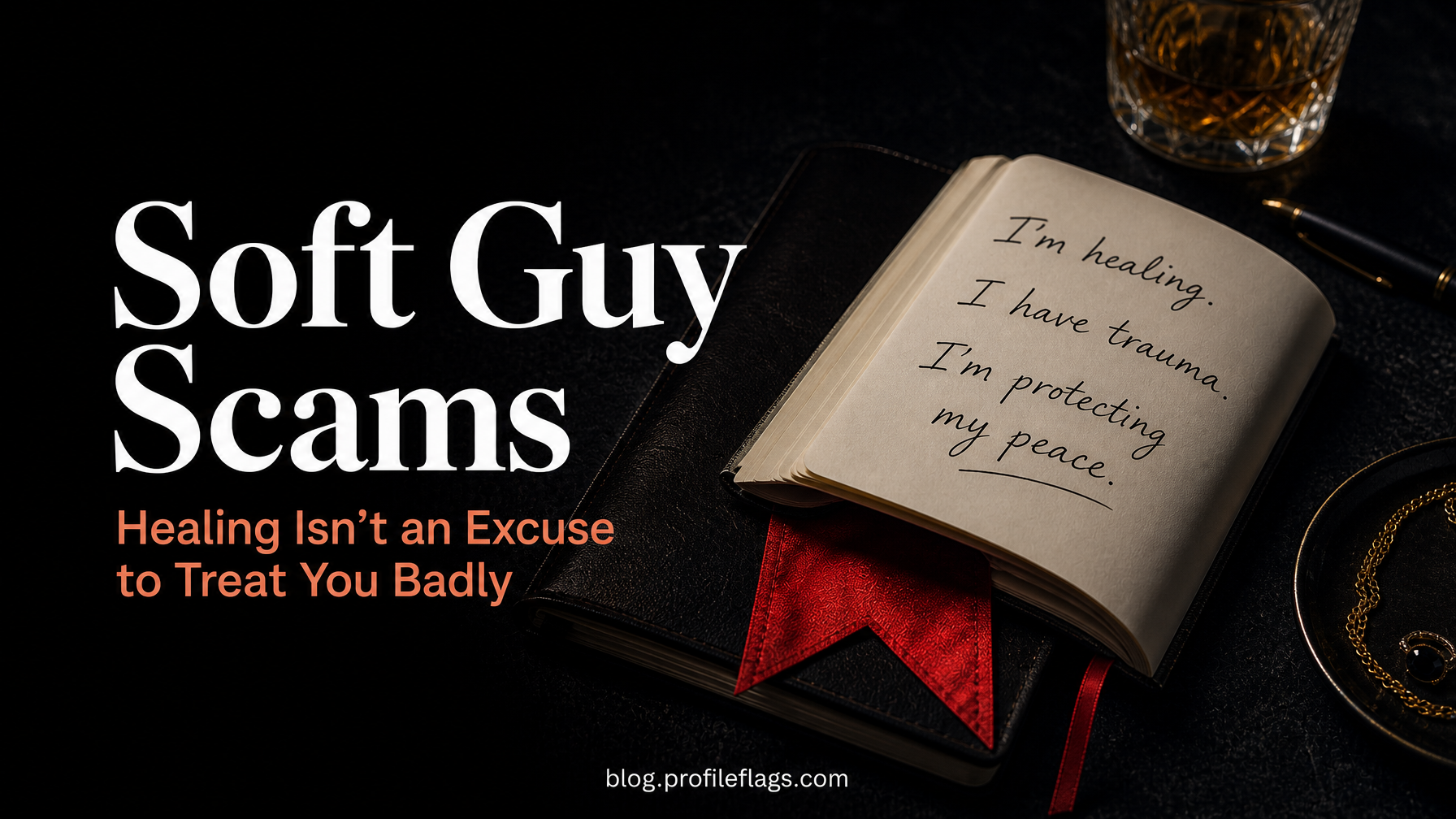
Healing isn't an excuse to treat you badly.
There is a new kind of red flag that is harder to name than the obvious ones because it arrives wearing the language of self-awareness. He knows the right words. He talks about his attachment style, his triggers, his healing journey. He uses "boundaries" and "emotional labor" and "safe space" in the right contexts. He sounds like a man who has done the work.
But the behavior tells a different story.
This is the soft guy scam — and it is one of the more sophisticated patterns showing up in modern dating, specifically because the vocabulary of emotional intelligence has become widely accessible without the actual emotional intelligence being required to use it.
What the Soft Guy Scam Is
The soft guy scam describes a pattern where a man uses therapeutic language, emotional vocabulary, and self-awareness framing as a shield — to avoid accountability, to justify poor behavior, and to present himself as evolved while continuing to operate in ways that are harmful or simply immature.
It is not about men who are genuinely working on themselves. Real healing exists and real growth exists and it is possible to be both in process and worth dating. This is specifically about men who have adopted the language of that process without any of the substance — who have learned that saying "I'm healing" ends difficult conversations, that "I have trauma" explains away patterns without requiring change, and that "I'm protecting my peace" is a phrase that sounds healthy while functionally meaning "I don't want to be held accountable for anything."
The soft guy scam is the emotional equivalent of greenwashing. The packaging says one thing. What is inside is something else entirely.
The Phrases and What They Actually Mean
These phrases are not inherently red flags — they are legitimate concepts that genuine people use in legitimate ways. The red flag is in the pattern of how they are used. Here is the distinction:
"I'm healing."
Legitimate use: acknowledging that past experiences have had an impact and that active work is being done to address them.
Soft guy scam use: deployed whenever behavior is called into question. "I'm healing" as a conversation-ender. As an explanation that requires no further detail and accepts no follow-up. As a way of framing any expectation you express as an unfair demand on someone who is already dealing with enough.
The tell: if he is healing, what specifically is he doing? Therapy? What kind? What has actually shifted in the past six months? Healing that cannot be described in any concrete terms is a feeling, not a process.
"I have trauma."
Legitimate use: naming real past experiences that have created specific, identifiable patterns worth being aware of in a relationship.
Soft guy scam use: a blanket explanation for any behavior that causes you discomfort. Cancels plans without notice — trauma. Pulls back emotionally without warning — trauma. Gets defensive when asked a direct question — trauma. Cannot follow through on commitments — trauma. The trauma is real but the logic is that it explains everything and excuses everything, permanently, with no expectation of growth.
The tell: trauma that explains behavior without ever changing it is not being worked on. It is being maintained as a justification.
"I'm protecting my peace."
Legitimate use: setting genuine limits around situations or dynamics that are genuinely harmful or draining.
Soft guy scam use: refusing any uncomfortable conversation, any accountability conversation, any moment where your needs create friction. "Protecting my peace" applied to you — your emotions, your questions, your reasonable expectations — means his comfort is always the priority and yours is always the disruption.
The tell: whose peace is being protected? If the phrase only ever appears when you want something from him — clarity, follow-through, a conversation about where things stand — it is not peace. It is avoidance with better branding.
"I need space to process."
Legitimate use: taking time to think through something before responding, rather than reacting immediately.
Soft guy scam use: disappearing for days after any conversation that requires something from him. Using "processing" as a way to avoid resolution indefinitely. Returning when the urgency has passed without actually addressing what prompted the space request in the first place.
"I'm working on my boundaries."
Legitimate use: learning to identify and communicate personal limits in relationships.
Soft guy scam use: all of his limits are firm and enforced. Yours are regularly described as threatening, controlling, or an attack on his healing. His boundaries are sacred. Your needs are pressure.
Why This Is Particularly Hard to Call Out
The soft guy scam is effective for a specific reason: the women most likely to encounter it are often the ones who have done real personal work themselves. They understand therapy language. They believe in healing. They have empathy for trauma and they know that growth takes time.
That empathy gets weaponized. Calling out the pattern feels like attacking someone's healing journey. It feels like being the person who does not believe in therapy, who does not understand trauma, who is not willing to give someone the grace they need to grow. The framing makes you the unreasonable one before you have said anything.
This is by design — not always consciously, but structurally. The vocabulary creates a defensive perimeter around the behavior.
The Difference Between a Man Who Is Actually Healing and One Who Isn't
A man who is genuinely working on himself:
- Can tell you specifically what he is working on and what he has noticed changing
- Acknowledges when his patterns have affected you and takes responsibility for that, not just the pattern
- Does not use his healing as a reason your needs should wait indefinitely
- Welcomes accountability conversations rather than framing them as attacks
- Shows behavioral change over time — not just language change
- Applies the same empathy to your experience that he asks you to apply to his
A man running the soft guy scam:
- Talks about healing constantly but cannot describe what that looks like in concrete terms
- Uses therapeutic vocabulary to end conversations rather than open them
- His patterns stay the same regardless of how much language around them changes
- Your needs and emotions regularly get framed as too much, too heavy, or bad for his peace
- The accountability always flows one direction — toward you
What You Actually Deserve
You are allowed to want a partner who is both working on himself and capable of showing up for you now. Those things are not mutually exclusive. Growth is not a reason to be treated as optional, to have your needs consistently deprioritized, or to participate in a dynamic where his emotional comfort is always the organizing principle.
Healing is real. Therapy works. Trauma is legitimate. None of that changes the fact that how someone treats you is information — regardless of why they do it. A man in genuine healing takes responsibility for the impact of his patterns even while working to change them. A man running the soft guy scam uses the language of healing to avoid that responsibility entirely.
The difference is accountability. Watch for it.
Scan his dating profile for consistency signals, commitment language, and emotional availability patterns at the ProfileFlags scanner at profileflags.com before you invest time in figuring out which one you are dealing with.
The 100 Real-Life Red Flags guide covers accountability avoidance, emotional unavailability, and 98 other patterns — risk-scored LOW, CAUTION, and HIGH. $12.99 at overstanddating.gumroad.com/l/100RedFlags. More at blog.profileflags.com.