Dating App Verification Scams: The Fake Safety Link That Steals From You
He said it was for safety. It was really to steal your information. A full checklist of red flags that identify fake dating app verification scams — and exactly what to do if you already clicked.

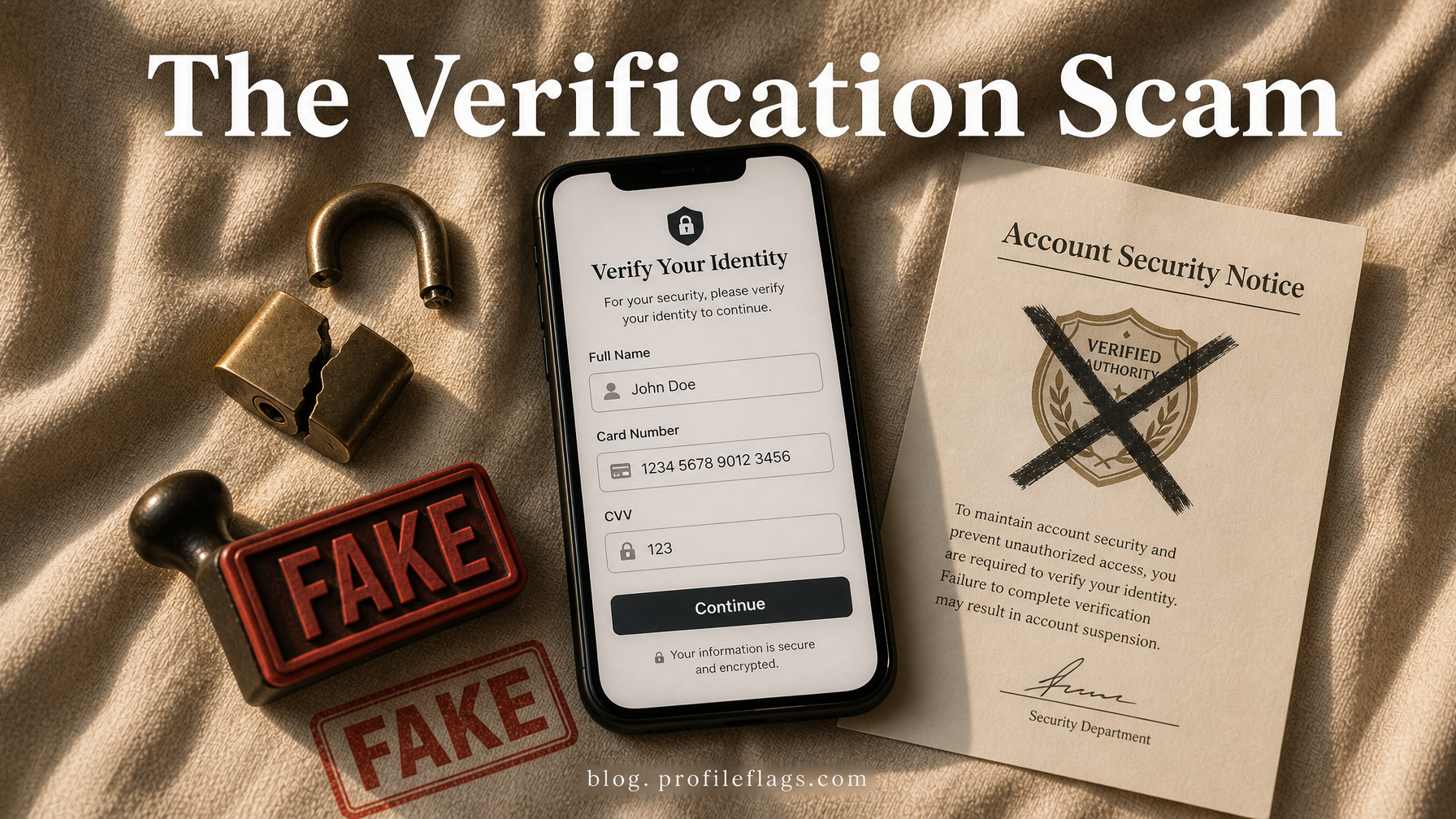
He said it was for safety. It was really to steal your information.
That one sentence is the entire architecture of the dating app verification scam — and it works because it weaponizes something reasonable. Of course you want to make sure the person you're about to meet is who they say they are. Of course safety sounds like a good reason to click a link. The scam depends on that logic. It dresses theft up as protection, and it does it so convincingly that thousands of people enter their real name, real card number, and real personal details before they realize there was never a date coming.
The FTC reported over $12.5 billion in fraud losses in 2024. The FBI's IC3 logged 47,054 identity theft complaints and 41,557 credit card and check fraud cases in the same year. Dating apps are one of the primary pipelines feeding those numbers — and the fake verification link is one of the most consistent tools used to do it.
This post breaks down exactly how the scam works, what they're actually taking from you, and a checklist of every red flag that tells you a verification request is not what it's claiming to be.
What the Verification Scam Is
Real dating apps — Tinder, Bumble, Hinge, Grindr — have their own in-app safety features. Photo verification. Identity badges. Community reporting. None of them require you to leave the app, click an outside link, or enter a payment card to prove who you are.
The fake verification scam runs on a completely different track. A match — usually attractive, usually responsive, usually moving fast — sends you a link and explains that you need to verify yourself before they'll agree to meet. The framing varies but the core message is consistent: I need to know you're safe. This is just for both our protection. It's free, it only takes a second.
The link goes to a site that looks official. It uses language that sounds professional. It asks for your name, your email, sometimes your date of birth, and almost always a payment card number — usually described as "just to confirm your age" or "to unlock the free verification." The site may even generate a fake confirmation badge.
What actually happens: your card gets charged recurring subscription fees that are difficult to cancel. Your personal information — name, email, date of birth, card details — gets harvested. In more aggressive versions, those details are sold or used for downstream identity theft.
There was never a safety check. There was never a date. There was only the form.
How It Works, Step by Step
Step 1: The profile. Scammers build profiles designed to attract and hold attention fast. Stock photos, stolen images from social media, or AI-generated faces. The profile is usually appealing — conventionally attractive, minimal red flags, a bio that reads as warm and genuine.
Step 2: Fast connection. The conversation moves quickly. Compliments come early. There's strong apparent interest and a push toward meeting. The speed serves a purpose: get you emotionally invested before the ask comes.
Step 3: The verification request. Common framings include:
- "I had a bad experience before, I just need to make sure you're real"
- "My friend told me about this — it's just a safety app, takes two minutes"
- "I can't meet anyone who hasn't verified, it's just how I stay safe now"
- "It's totally free, they just need a card to confirm you're 18+"
Step 4: The fake site. The site looks credible. Official language. Padlock in the browser bar (that means nothing — scam sites have SSL certificates too). The form asks for name, email, sometimes date of birth, and a card number. Fine print buried in the terms discloses recurring subscription charges of $39.99–$49.99 per month.
Step 5: The disappearing act. Once the form is submitted, the "match" either goes quiet or sends a fake confirmation badge and gradually disengages. The date never happens. The charges start appearing. The information is stored or sold.
What They're Actually Taking
The scam has two theft mechanisms running simultaneously.
Financial theft. Recurring monthly subscriptions buried in fine print, often cycling through multiple affiliated sites from the same scam network. Victims frequently don't notice for months. The FTC documented credit card fraud as one of the fastest-growing online fraud categories.
Identity data. Name, email, date of birth, and partial card data is a package with real value on the fraud market. Even if the victim cancels their card immediately, that personal information has already been collected — used for phishing follow-ups, credential stuffing, or sold to third-party data brokers.
The more sophisticated versions also ask for a photo ID "to complete verification" — at which point there's enough to open accounts, apply for credit, or facilitate full identity theft.
The Checklist: Red Flags That Tell You It's a Scam
They ask you to leave the app. Legitimate verification happens inside the platform. Any request to click an outside link or visit a third-party site is a flag. Real apps do not route safety checks to external websites.
The link doesn't belong to the app. Tinder's verification is at tinder.com. Bumble's is at bumble.com. If the link goes anywhere else — even something that looks similar, like tinder-safety-verify.com — it is not real. Check the domain carefully.
They need your card "just to verify your age." No legitimate free verification service requires a payment card to confirm you're an adult. That phrasing next to a card field is a subscription trap, not a safety check.
The urgency is disproportionate. Real safety preferences don't come with a deadline. "I won't meet you if you don't do this right now" — that urgency is manufactured to stop you from pausing to think.
The conversation was unusually warm before the ask. The verification request almost never comes cold. It follows a period of manufactured connection. That warmth is the setup.
The profile has no community history. New account, no mutual connections, photos that reverse-search to stock image sites or someone else's social media.
They get evasive when you push back. Ask directly: "Can we just verify through the app's built-in feature?" A genuine person agrees. A scammer redirects or pressures. That response is the answer.
The "verification" site looks professional but the URL is strange. SSL padlocks and clean design mean nothing. Check who owns the domain. Google the site name plus "scam" — if it shows up in fraud forums, it's already documented.
What Real In-App Verification Looks Like
Real verification on major dating platforms does not require you to leave the app or enter financial information.
Tinder uses in-app photo verification — a real-time selfie matched against your profile photos. No external link. No card.
Bumble has a photo verification badge earned through an in-app selfie process. Internal, free, no payment.
Hinge offers in-app verification through their safety features. Stays inside the app.
Any platform that has introduced verification keeps it inside the app. Routing users to external sites would violate their own terms of service. If someone is sending you to a third-party site to verify, the platform they're on does not know they're doing it — because the platform would not allow it.
What to Do If You Already Clicked
If you entered your card number on a verification site, move immediately.
1. Call your bank or card issuer now. Report the charge as fraud. Ask them to block the merchant and issue a new card. Your bank can force a reversal and block future charges.
2. Check statements for recurring charges. These scam networks often charge under multiple business names. Look back 1–3 months for any charges from adult content, "safety," or "verification" services you don't recognize.
3. Report to the FTC at reportfraud.ftc.gov. The FTC uses these reports to build enforcement cases.
4. Report to the FBI's IC3 at ic3.gov. For online fraud, identity theft, and dating app scams.
5. Monitor your credit. If you gave your name, date of birth, and card information together, place a fraud alert or credit freeze through Equifax, Experian, and TransUnion. This is free and prevents anyone from opening new credit accounts in your name.
6. Change passwords on any account using the same email address. Scammers test harvested email/password combinations across multiple platforms.
If you gave a photo ID, consider filing a police report in addition to the FTC and IC3 submissions.
The Broader Pattern
This scam fits neatly inside what the flag system calls a Dollar Flag situation — financial exploitation dressed up as something that has nothing to do with money. The Dollar Flag isn't always obvious. It often comes wrapped in warmth, urgency, or in this case, the language of mutual safety.
It also connects to the AI catfish patterns covered in our post on how fake photos, voices, and feelings are changing dating apps. The profile behind the verification request is almost never a real person — it's a constructed persona designed to reach the ask as efficiently as possible.
You can scan a profile's behavioral patterns before you're deep in a conversation using the ProfileFlags scanner. The way a profile is written and the patterns in its language surface signals that help you identify what you're actually dealing with before any asks arrive.
The complete breakdown of financial manipulation tactics in dating — including this one and a dozen more — is in the Romance Scams, Soft Life Lies & Dating App Money Traps ebook at overstanddating.gumroad.com.
The One Rule That Covers Everything
No legitimate dating app verification will ever ask you to leave the platform, visit a third-party website, or enter payment card information to confirm your identity.
That is not a guideline. It is a rule with no exceptions. Any request that violates that rule is a scam — regardless of how reasonable the framing sounds, how attractive the profile is, or how much momentum the conversation had before the ask arrived.
He said it was for safety. Safety does not require your card number.