Kittenfishing vs Puffer-Fishing vs Catfishing: The Three Types of Liars on Dating Apps
Not every liar on a dating app is a catfish. Some are kittenfishing. Some are puffer-fishing. Rae and Ava break down all three — and how to spot each one before you're already invested.

Listen to the Episode
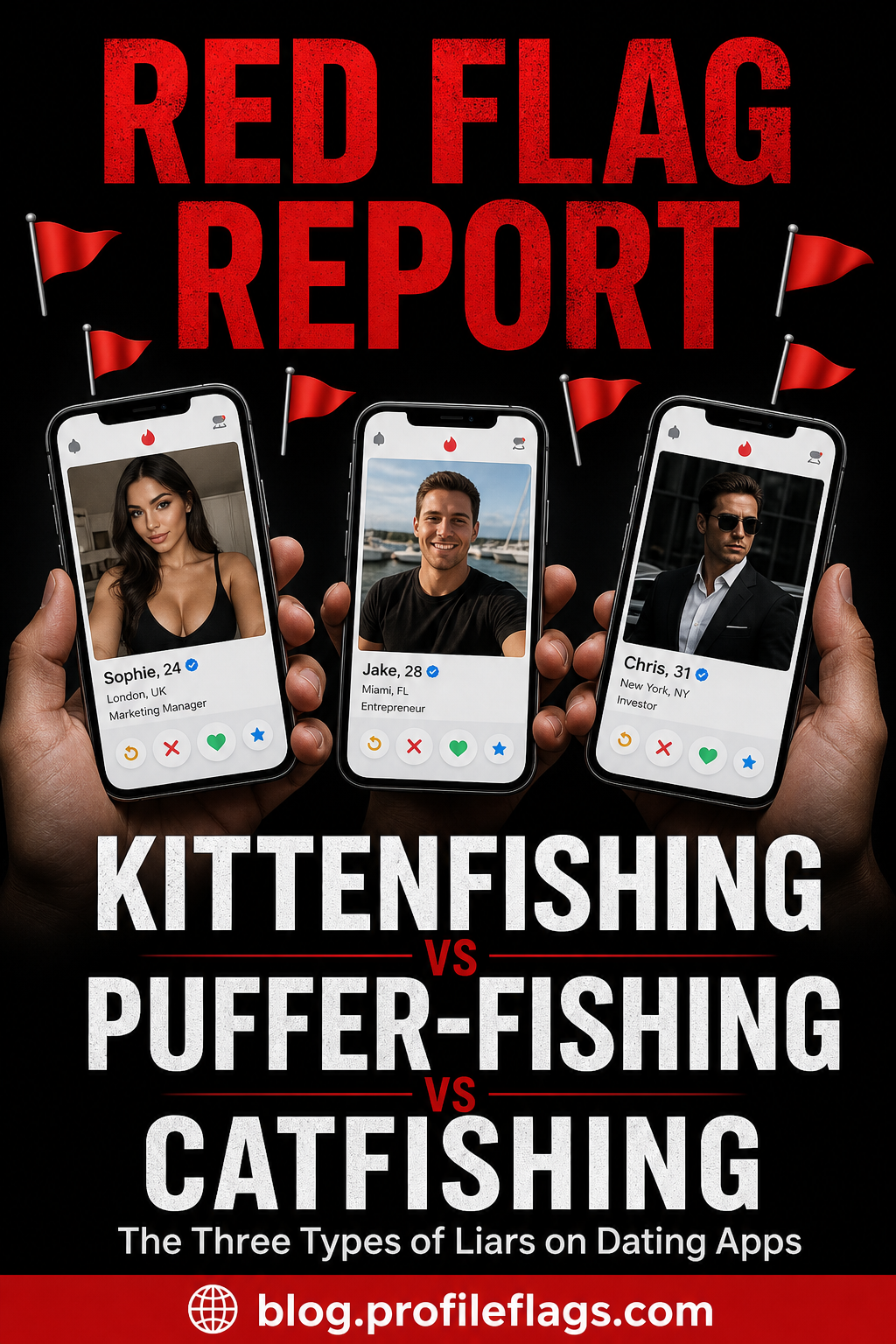
This post is the written companion to Episode 3 of the Red Flag Report podcast. Hosts Rae and Ava break down three distinct types of misrepresentation happening on dating apps right now — kittenfishing, puffer-fishing, and catfishing — and why most people can only name one of them.
The full breakdown is below. If you've ever shown up to a first date and thought "this is not who I was talking to," you'll want to read this.
Why Dating App Deception Is More Complicated Than "Catfishing"
Most people know what catfishing is — someone creates a fake identity online and uses it to build a relationship with someone who thinks they're talking to a real person. It's dramatic. It's the subject of an entire MTV show. And it's also not the most common form of deception on dating apps.
The more common versions are quieter. Subtler. Technically defensible. And that's what makes them harder to name, harder to call out, and easier to end up on the receiving end of without realizing it until you're already emotionally invested.
Kittenfishing and puffer-fishing — both trending terms as of 2026 — fill that gap. They describe the deception that doesn't rise to the level of catfishing but still costs you real time, real trust, and real emotional energy.
Catfishing: The One Everyone Knows
Catfishing is when someone uses a completely fabricated identity — fake photos, fake name, fake life — to build a relationship with someone online. The person on the other end has no idea who they're actually talking to.
It's the most extreme form of dating app deception, and the most recognizable. The motivation is usually one of three things: loneliness (genuine connection under a false identity), manipulation (financial scams, emotional exploitation), or malice (targeting someone specifically).
Red flags that you might be talking to a catfish:
- They have very few photos, and the ones they do have look like stock images or are suspiciously perfect
- They refuse to video call — ever — despite weeks of conversation
- Their story doesn't add up on details: job, location, family, timeline
- They escalate emotionally very fast — deep feelings, strong attachment, declarations of love — before you've ever met
- There's always a reason they can't meet in person
The ProfileFlags scanner can help identify profile inconsistencies before you've spent weeks building a connection with someone who doesn't exist.
Kittenfishing: The Everyday Version
Kittenfishing is a term coined by the dating app Hinge. It describes smaller-scale misrepresentation — the kind where someone is real, but the version of themselves they're presenting isn't quite accurate.
Think: photos that are five years old. A listed height that's off by two inches. A job title that's technically true but heavily inflated. Presenting as more financially stable, more emotionally available, or more over their ex than they actually are.
According to Psychology Today, kittenfishing is widespread precisely because it exists in a gray zone. People justify it as "putting your best foot forward." And some of it genuinely is harmless. The problem is when the gap between the presented version and the real person is wide enough that the person you meet on the first date isn't who you agreed to meet.
Common kittenfishing behaviors:
- Old or heavily filtered photos. Not one or two — the whole profile. Photos where they look noticeably different from how they'll appear in person.
- Inflated credentials. "Entrepreneur" when they're between jobs. "Consultant" for work that isn't currently happening.
- Selective omission. They have a kid they don't mention. They're not actually divorced yet. They still live with an ex.
- Personality misrepresentation. Funny and warm in text, flat and guarded in person. Presented as emotionally available, actually just looking for something casual.
Kittenfishing is a red flag not because the deception is necessarily malicious, but because it tells you something about how this person handles discomfort. If they can't be honest on a profile, what happens when honesty gets harder?
Puffer-Fishing: The Newest One — and the Most Defensible
Puffer-fishing is a newer term that started gaining traction in mid-2026. Where kittenfishing involves misrepresenting who you are, puffer-fishing involves inflating your life to seem more impressive than it is — specifically to attract matches above your usual range.
The puffer fish inflates itself to appear bigger as a defense mechanism. On a dating app, a puffer-fisher does something similar: they use borrowed status, rented settings, or carefully constructed optics to project a lifestyle they don't actually have.
Examples:
- Profile photos taken at a luxury hotel or event they attended once, presented as their regular environment
- Posing with a car, house, or boat that isn't theirs
- Professional headshots presented as casual photos to look more polished
- Implying a level of wealth, travel, or success through visual context that doesn't reflect their actual life
Puffer-fishing is distinct from kittenfishing in motive. Kittenfishing is usually about minimizing insecurities. Puffer-fishing is about actively projecting a status upgrade. And it tends to attract matches who are specifically looking for what's being projected — which sets up a relationship built on a false premise from day one.
This one connects directly to financial red flags in dating. If someone is projecting wealth they don't have to attract partners, that dynamic doesn't disappear once the relationship starts. The Love, Money & Red Flags ebook covers exactly what happens when financial misrepresentation bleeds into a relationship and how to protect yourself.
How to Spot All Three Before You're Already In It
The honest answer is that some of this is only visible in person. A photo can look current. A job title can be technically accurate. Puffer-fishing is almost impossible to verify before a first date.
But there are tells, even early:
- Inconsistency across platforms. If someone's Instagram, LinkedIn, and dating profile tell different versions of the same story, that gap is worth noting.
- Resistance to video calls. Not a dealbreaker once — a pattern of avoidance is different.
- Details that shift. The city they said they lived in changes to "nearby." The job description gets vague when you ask follow-up questions. The timeline of things they've told you doesn't quite line up.
- Profiles with no specificity. Generic bios, very few photos, nothing that pins them to a real, specific life. Real people have specific lives. Vagueness is a choice.
Before you invest weeks of conversation into someone, running their profile through the ProfileFlags scanner can surface inconsistencies and flag patterns that are easy to miss when you're already interested.
The Bigger Question: Does It Matter?
Some people argue that everyone curates their dating profile and the line between self-promotion and deception is blurry. That's fair. The question isn't whether someone put their best photos forward. The question is whether the version of themselves they presented matches the person who shows up — and whether they take responsibility for the gap when it comes out.
Someone who kittenfishes with a photo that's two years old and looks basically the same is different from someone who used photos from ten years and a different body ago. Someone who describes themselves as an entrepreneur while working on a real project is different from someone who uses the title to cover unemployment they're embarrassed about.
The spectrum matters. What also matters: how they respond when you notice the discrepancy. Defensiveness, deflection, or turning it around on you are all red flags in themselves.
Related Reading
- The Pig Butchering Scam — When Dating App Deception Turns Into Financial Fraud
- Bumble Red Flags to Spot Before You Even Message
- POF Red Flags — What Plenty of Fish Profiles Are Hiding
- Red Flags in Texting After You Match
Listen to the full episode above — Rae and Ava get into real examples and it's worth the listen. More episodes of the Red Flag Report are on Spotify.