Online-Only Relationships: When the Screen Is the Relationship
55% of daters are open to a relationship that never goes offline. Here's when that's a valid choice — and when staying online indefinitely is the red flag itself.

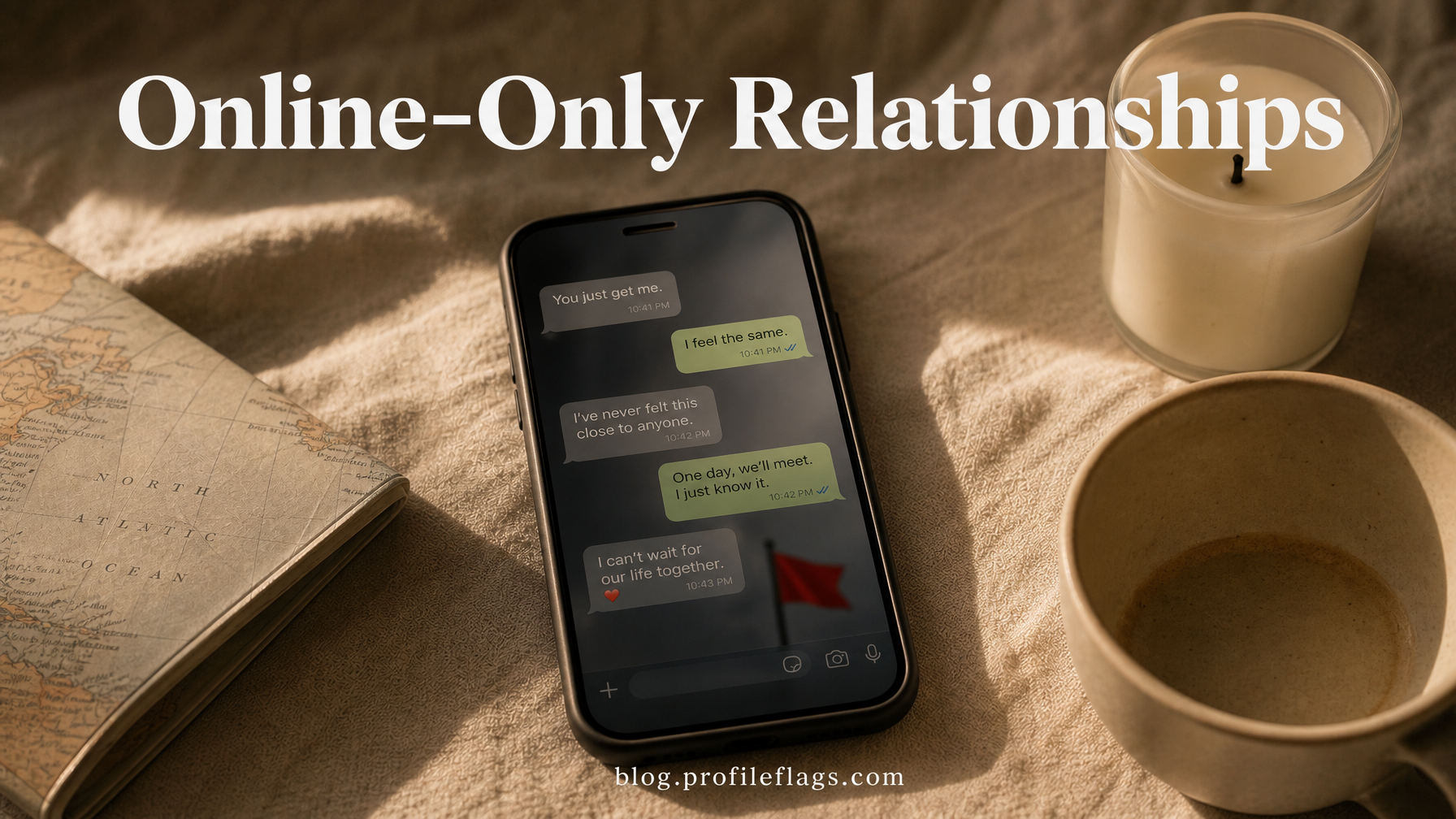
55% of daters say they're open to a relationship that never goes offline. According to The Everygirl, part of the reason is emotional fatigue — the exhaustion of in-person dating, the vulnerability it demands, the toll of putting yourself out there and getting hurt in real life.
That's a real and valid reason. In-person dating is genuinely hard, and the emotional math of getting dressed up, showing up somewhere, and hoping the person matches their photos and their energy — all while managing your own nervous system — is tiring in a way that online connection isn't.
But "open to online-only" and "using online-only as a way to never have to show up" can look identical from the outside. And the difference matters more than most people realize before they've spent three months investing in something that was never going to become real.
This post is about both sides — when online-only is a genuine preference and when it's a flag.
What an Online-Only Relationship Actually Is
An online-only relationship is a romantic connection that exists entirely through digital communication — texts, calls, video chats, DMs — with no in-person component and, in many cases, no stated intention to ever meet.
For some people, this is a deliberate choice. Disability, chronic illness, social anxiety, geography, or a genuine preference for emotional intimacy without physical proximity can make online-only relationships a sustainable and satisfying arrangement — when both people have chosen it consciously and honestly.
For others, "online-only" is a default they've fallen into, often without naming it. They match with someone, the conversation is good, weeks pass, and the relationship deepens — but no one ever books a flight or suggests a coffee. The connection feels real. The progress feels real. And yet somehow, nothing is ever moving toward anything offline.
That gap between how it feels and what it actually is — that's where the flags live.
When Online-Only Is a Genuine Preference
Before getting into the red flags, it's worth being honest about when this arrangement is legitimate.
Some people are genuinely happy with connections that live online. They're not hiding anything. They're not running a scam. They're not married or otherwise unavailable. They simply find online communication more natural, less draining, or more compatible with how they live.
If someone tells you upfront — early, clearly, and without pressure — that they prefer online connection and aren't looking to meet in person, that's honesty about what they want before you've invested anything. You can decide if that works for you.
The problem isn't online-only relationships. The problem is when "online-only" isn't a stated preference — it's just what keeps happening, with no explanation and no conversation about why.
The Online-Only Red Flags
1. It Was Never Discussed — It Just Became the Reality
The clearest flag isn't someone who tells you they prefer online-only. It's someone who never brings it up while the relationship quietly stays that way. Weeks become months. The connection deepens. But the topic of meeting in person either never comes up or gets consistently deflected without a real conversation.
Real preferences get stated. Situations that are being managed get avoided. If you've been talking for two or three months and meeting has never been seriously addressed, that's worth naming directly.
2. Every Attempt to Move Offline Gets Redirected
You suggest a call — they prefer to text. You suggest a video chat — bad timing, always. You suggest visiting — they pivot to "let's plan it soon" with no follow-through. You bring up meeting — suddenly the conversation shifts.
This pattern, where every movement toward real-world contact meets soft resistance without explanation, is one of the most consistent signs that the online-only arrangement is being maintained intentionally. Not because they prefer it as a lifestyle — but because meeting in person would expose something.
3. The Emotional Intensity Moves Faster Than the Relationship
Online-only connections have a specific acceleration problem. Without the natural pacing of in-person interactions — the awkward silences, the physical reality of another person, the time it takes to actually be in the same space — emotional intimacy can escalate fast.
Deep conversations at 2 AM. Daily voice notes. The feeling of knowing someone completely. And then you realize: you've never seen them on video. You don't know what their laugh sounds like in a room. You've never watched them navigate an uncomfortable situation.
Fast emotional escalation in an online-only context is a yellow flag. It's not automatically a scam — but it's a signal to slow down and ask what the relationship is actually built on. Read more on this pattern in our post on love bombing in dating.
4. They Have No Verifiable Offline Existence
Real people have dimensions. They mention coworkers. Their background during a call looks like an actual space. Their stories have the mundane specificity of someone living a real day — traffic, a frustrating meeting, a good meal.
Someone who maintains an online-only relationship without any verifiable offline existence — no video, no social media you can cross-reference, no details that feel grounded and real — is either extremely private or presenting a version of themselves that wouldn't survive being checked.
The FBI's guidance on romance scams notes that scammers "may propose marriage and make plans to meet in person, but that will never happen." The common thread across nearly all romance scam cases is a relationship that stays online indefinitely, with meetings promised but perpetually delayed.
5. The Reason for Staying Online Keeps Changing
First it was the distance. Then it was work. Then a family situation. Then a health issue. Then the timing wasn't right.
Each reason is plausible on its own. But reasons that keep evolving and compounding — with no actual meeting ever happening — aren't logistics. They're a pattern of maintenance. The relationship stays online because something about going offline doesn't work for them, and they'd rather manage the reasons than be honest about why.
6. They Use "Emotional Fatigue" as a One-Way Shield
The 55% statistic is real and the emotional fatigue behind it is real. Dating in person is exhausting, particularly for people who've been hurt, ghosted, or burned by showing up physically and emotionally for something that went nowhere.
But here's the flag: emotional fatigue that only protects one person isn't a preference — it's a control mechanism. If they're not emotionally fatigued when it comes to receiving your vulnerability, your attention, and your investment — but they are when it comes to meeting you in person or being seen — the fatigue is selective. Selective fatigue is a flag.
7. Money, Hardship, or Urgency Enters the Picture
An online-only dynamic where financial need surfaces is one of the most documented red flag combinations in modern dating. According to the FBI, romance scammers specifically build online-only connections before introducing a crisis — a frozen account, a medical emergency, a business deal that fell through.
They never ask immediately. The ask comes after weeks or months of genuine-feeling connection, when you're emotionally invested enough to want to help. If someone you've never met in person introduces financial need into the relationship, stop and research before you respond. Our post on the new romance scam covers how these setups work in detail.
The Emotional Fatigue Argument — What It's Really Saying
It's worth sitting with the 55% stat a little longer, because the emotional fatigue angle is honest in a way that matters.
People are tired. Dating apps have made rejection faster, more frequent, and more anonymous than any previous generation of daters has experienced. The emotional cost of showing up in person — being evaluated, rejected, disappointed in real time — is high. Online connection feels safer because the stakes are lower and the control is higher.
That's understandable. The problem is that lower stakes and more control aren't the same thing as a real relationship. A connection that's been kept online specifically to manage vulnerability isn't intimacy — it's the appearance of it, at a comfortable distance.
If you recognize yourself in that — choosing online-only partly because it hurts less — that's worth being honest about, with yourself and with whoever you're talking to. Keeping someone emotionally invested in something that will never go offline, without telling them that's the plan, is its own kind of red flag.
Questions to Ask Before You Go Deeper
- Have we been on video, face to face, in real time? Not a photo. Not a voice note. Live video. If not, make it happen before the connection goes further.
- Has the topic of meeting in person come up, and what happened? If you've never brought it up, bring it up now. Watch what happens when you do.
- Does this person have a verifiable offline existence? Real people leave traces — social media, mutual connections, verifiable location or workplace details.
- Is the emotional intensity moving faster than the relationship? If you feel closer to this person than to people you've known for years in real life but have never been in the same room — slow down.
- Would you be okay if this stayed online forever? If the answer is no, have that conversation now. Don't let hope delay it.
The Bottom Line
Online-only relationships aren't automatically wrong. But they require the same transparency and intention any other relationship does — more, actually, because the usual checks that in-person contact provides aren't there.
55% of daters being open to them doesn't make them safe by default. It makes the flags harder to see, because the arrangement has become normalized enough that staying online indefinitely can feel like a preference rather than a warning sign.
A relationship that exists only in a screen can be real. But a real relationship eventually wants to be in a room.
Before you go any deeper with someone you've never met in person, scan his profile at profileflags.com — the scanner reads the behavioral and language signals that indicate whether you're dealing with a genuine person or a managed presentation. And if the situation already feels off, 100 Real-Life Red Flags includes the specific online-pattern red flags that are easiest to rationalize away.