The Dating App Trap: When Flirting Turns Into Blackmail
The FBI received 75,000+ sextortion complaints in 2025 alone. Here's exactly how the dating app sextortion trap works, who it targets, the warning signs before it closes — and what to do if it happens to you.

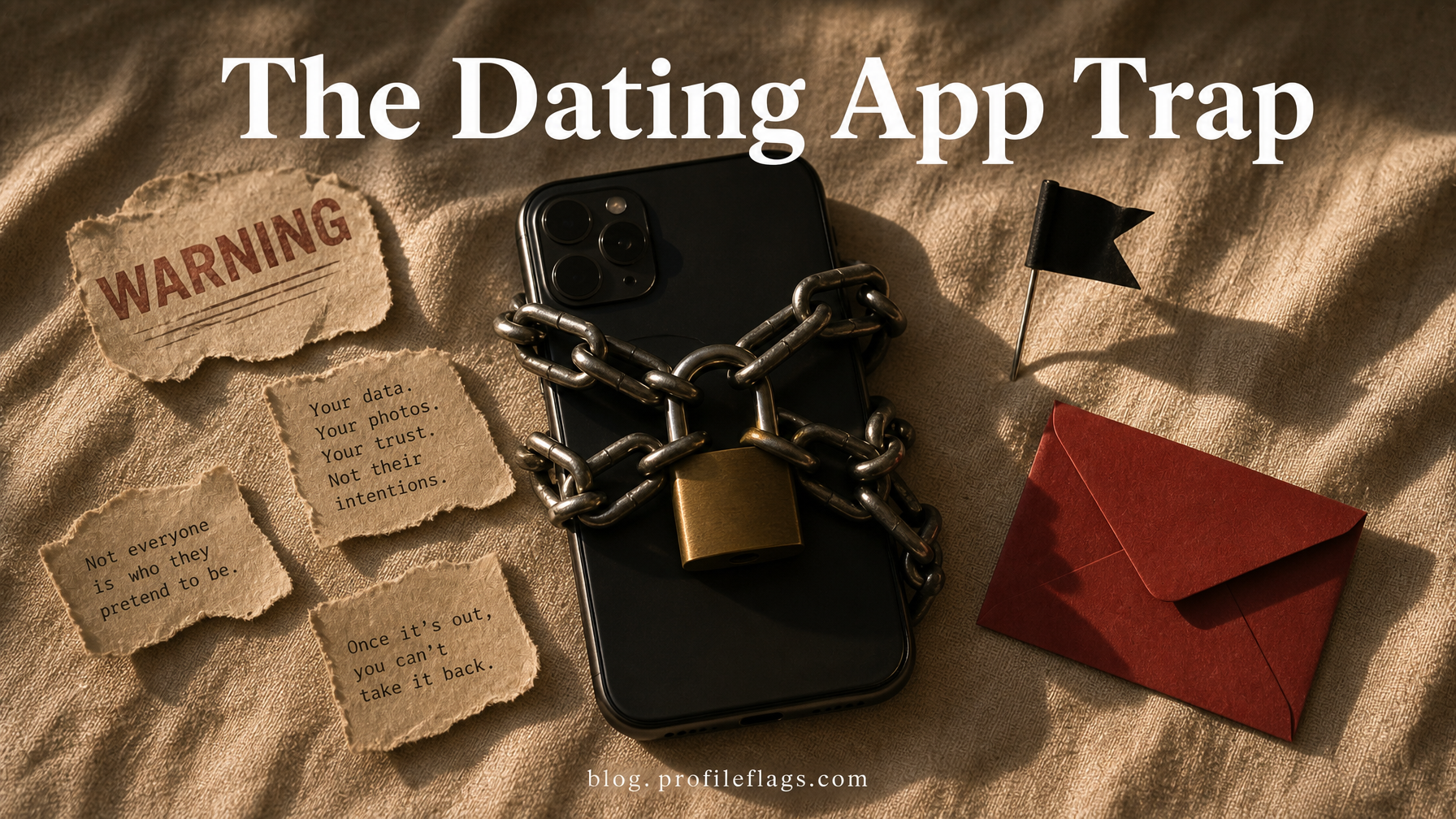
One private photo can become a weapon.
Not in the way most people think about privacy risk — a vague worry about data, somewhere in the back of your mind. This is direct. Targeted. Someone you were flirting with two weeks ago now has a photo of you and a list of your contacts, and they're telling you exactly what happens if you don't pay.
This is sextortion. And according to ESET's 2026 dating app safety guide, it's one of the most common scams currently running on dating platforms. The FBI received more than 75,000 sextortion complaints in 2025 alone. The number keeps climbing.
This post covers what sextortion looks like on dating apps, who it targets, the warning signs before the trap closes, and exactly what to do if it happens to you.
Why This Is a Black Flag
Most red flags in dating are about patterns — someone who breadcrumbs, love bombs, keeps things vague, avoids commitment. Those are serious, and they cause real harm. But they exist on a different level from this.
The Black Flag category is for threats that escalate fast, carry real-world consequences, and can cause damage that outlasts the relationship. Sextortion is a Black Flag because the moment it activates, you're no longer dealing with a bad dating experience. You're dealing with a crime.
The fear it produces — the shame, the urgency, the feeling that you have to act immediately or your life falls apart — is the entire mechanism. Understanding that clearly is the first step to not getting trapped by it.
What Sextortion on Dating Apps Actually Looks Like
Sextortion via dating apps follows a specific pattern. It's a scripted operation, often run by organized criminal groups, designed to move you from "matched" to "compromised" as efficiently as possible.
Stage 1: The match. You match with someone attractive. The conversation moves quickly — warm, flirtatious, interested. They suggest moving off the dating app to a private messaging platform. WhatsApp, Telegram, Snapchat. This is the first flag: pressure to leave the app early. Dating platforms run continuous checks for suspicious activity. Private messaging apps don't.
Stage 2: The escalation. The conversation becomes increasingly intimate. They share something first — a suggestive photo, a private detail — to establish mutual vulnerability. They make it feel reciprocal and safe. Then they ask for something in return.
Stage 3: The trap. Once they have what they asked for, the tone shifts. They reveal they have screenshots, recordings, or saved content. They tell you they've gathered your contacts — from your social media, your mutual connections, your linked profiles. They give you a number and a deadline.
Stage 4: The demand. Pay up — in cash, gift cards, wire transfer, or cryptocurrency — or they send what they have to your friends, family, employer, or partner.
ESET describes the setup directly: "Scammers posing as attractive matches suggest taking the conversation onto a private app. They persuade you to send compromising photos or videos and then threaten to forward them to friends, family and colleagues if you don't pay up."
Who Gets Targeted
Both men and women are targeted, though the tactics differ.
Men are the majority of financially motivated sextortion victims on dating apps. The typical setup involves an attractive profile initiating flirtatious contact, escalating quickly to intimate conversation, and requesting or exchanging explicit content. The demand for money follows almost immediately.
Women are more often targeted through relationship-based sextortion — where the scammer builds a longer connection, sometimes over weeks or months, before the manipulation begins. The content may have been shared in what felt like a genuine relationship context, which adds a layer of betrayal and shame on top of the threat itself.
In both cases, the emotional response — shock, shame, fear of exposure — is the lever. The scammer doesn't need to be technically sophisticated. They need you to be afraid enough to pay before you think clearly.
The Warning Signs Before the Trap Closes
They push you off the dating platform immediately. Any pressure to move to a private app within the first few conversations is a red flag. Legitimate people are happy to keep chatting on the platform where you matched. Scammers need to exit it.
The attraction is immediate and intense. The profile is usually very attractive. The interest is unusually direct and fast. Within days you feel a strong connection you can't quite explain. That manufactured pull is intentional — designed to lower your guard quickly.
They share intimate content first. This is the reciprocity setup. They send something to make you feel that sharing is safe and mutual. What they send costs them nothing. What you send gives them leverage.
They ask for content in a specific format. If someone you met two weeks ago on a dating app is asking for explicit photos or videos, the risk is real regardless of how genuine they seem.
They gather your contact information. Before the threat is made, many scammers gather publicly visible contacts — your Instagram followers, your Facebook friends list, your LinkedIn connections. "Are you on LinkedIn?" or "can I follow you on Instagram?" is not always curiosity. That's building the threat.
What NOT to Do If It Happens
Do not pay. Paying does not end the threat — it proves the threat works. Once you pay, you become a confirmed target. Organized sextortion operations do not honor payment as an agreement. They treat payment as the start of a longer extraction.
Do not delete the evidence. Shame creates the impulse to erase everything. Don't. Screenshots, conversation history, usernames, payment requests — all of it is evidence you'll need if you report it.
Do not comply with additional requests. If the first demand leads to a second — more content, more money — cut contact immediately.
Do not isolate yourself. The shame spiral sextortion produces is designed to keep you alone and compliant. Telling someone you trust breaks the isolation the scammer depends on.
What to Do Instead
Stop all contact immediately. Do not respond to threats, negotiate, or try to reason with them. Block on every platform — but save the evidence first.
Screenshot and save everything before blocking. Capture the conversation, the threats, the username, any payment information they provided.
Report to the FBI's IC3. The FBI's Internet Crime Complaint Center at ic3.gov handles sextortion cases. ESET specifically recommends reporting to the FBI if intimate images were involved. Reports help investigators track organized operations and build cases.
Report to the dating platform. Report the profile on the app where you matched. Reporting prevents the same account from targeting someone else.
Report to the FTC at reportfraud.ftc.gov.
Contact the Cyber Civil Rights Initiative at cybercivilrights.org if intimate images were shared without your consent or used to harass. They offer direct support and guidance on content removal.
ESET notes that over 55% of romance scam victims who lose money never report it — because of shame. The FBI is clear: being targeted is not something to be ashamed of. These are organized criminal operations. Reporting is how they get shut down.
How to Protect Yourself Going Forward
Never move off the dating platform early. Keep conversations on the app you matched on for as long as possible. Dating platforms have safety infrastructure private messaging apps don't.
Be skeptical of any request for intimate content before you've met in person. If the connection is real, it will survive the conversation about waiting.
Scrub your social media of obvious contact lists. On Facebook, set your friends list to private. The more a scammer can see before the threat, the more convincing the threat becomes.
Run AI detection checks on profile photos. As covered in our post on the AI catfish, standard reverse image search doesn't catch AI-generated faces. Use tools like Hive Moderation or Google's "About this image."
Use the ProfileFlags scanner before you engage. The ProfileFlags scanner analyzes dating profiles for the behavioral and language red flags that appear before you've had a conversation — so you can identify who you're actually dealing with before you're already invested.
The Bottom Line
Sextortion from dating apps isn't a worst-case scenario you'll probably never encounter. It's a documented, growing, organized crime category the FBI is tracking in the tens of thousands of cases per year. It targets people who were doing something completely normal — matching with someone, feeling a connection, responding naturally to that connection.
The photos looked real. The interest felt real. The person never had any intention of being anything other than a threat.
Knowing how the trap works is how you don't walk into it. And if you've already been caught in it — the most important thing to know is that you're not the first, you don't have to handle it alone, and the FBI has a system set up specifically to help.
Report at ic3.gov. Scan profiles before you engage at profileflags.com. And for the full breakdown of how dating app money traps work — from sextortion to pig butchering to romance scams — Romance Scams, Soft Life Lies & Dating App Money Traps covers every variant with specific red flags and exit strategies.